
- Home
- Cisco Certifications
- 350-901 Designing, Deploying, and Managing Network Automation Systems Dumps
Pass Cisco DEVCOR 350-901 Exam in First Attempt Guaranteed!
Get 100% Latest Exam Questions, Accurate & Verified Answers to Pass the Actual Exam!
30 Days Free Updates, Instant Download!


350-901 Premium Bundle
- Premium File 604 Questions & Answers. Last update: Oct 12, 2026
- Training Course 106 Video Lectures
- Study Guide 1255 Pages
Last Week Results!
 83% students found the test questions almost same

Includes question types found on the actual exam such as drag and drop, simulation, type-in and fill-in-the-blank.
Based on real-life scenarios similar to those encountered in the exam, allowing you to learn by working with real equipment.

Developed by IT experts who have passed the exam in the past. Covers in-depth knowledge required for exam preparation.
All Cisco DEVCOR 350-901 certification exam dumps, study guide, training courses are Prepared by industry experts. PrepAway's ETE files povide the 350-901 Designing, Deploying, and Managing Network Automation Systems practice test questions and answers & exam dumps, study guide and training courses help you study and pass hassle-free!
350-901 AUTOCOR: Cisco Network Automation Core
The 350-901 AUTOCOR exam is Cisco’s current core assessment for professional and expert automation. Version 2.0 is a 120-minute exam built around four large areas: network automation, infrastructure as code, operations, and AI in automation. The blueprint reflects a major change in network engineering: automation is no longer a collection of scripts around the edge of operations. It is increasingly the method used to describe intent, create infrastructure, validate state, integrate platforms, and control change.
Candidates coming from traditional networking should resist the temptation to treat AUTOCOR as a programming exam with network vocabulary added. It expects a blended skill set. A strong candidate can read and write Python, work with APIs and data models, use Git-based workflows, reason about Ansible and Terraform, build repeatable validation, and still understand the network behavior being automated. The automation can only be trusted when the engineer knows what correct network state should look like.
The modern path builds on foundations associated with Cisco automation fundamentals in 200-901 and extends them into professional-scale workflow design. AUTOCOR then pushes those network automation foundations further into reusable infrastructure, validation, source control, security, and AI-assisted engineering.
Network automation starts with models, APIs, and idempotent intent
The network-automation domain tests how engineers interact with devices and controllers programmatically. REST APIs, RESTCONF, YANG models, authentication, payload formats, Python clients, and structured data all matter. The important skill is not merely sending an HTTP request; it is understanding the contract between the automation and the managed system. The candidate should know what resource is being addressed, which operation is appropriate, what data shape is expected, and how to interpret success or failure.
YANG and model-driven interfaces reduce ambiguity by defining the structure and constraints of configuration or operational data. RESTCONF then provides a standardized way to work with that modeled information. Candidates should be comfortable reading hierarchical models, identifying list keys and containers, and translating a desired change into an API operation. This is conceptually different from screen-scraping a CLI because the interface exposes structured state rather than human-formatted output.
Idempotence is another central idea. A reliable automation workflow should be able to run repeatedly without producing unintended change once the desired state has been reached. Ansible modules, Terraform resources, and well-designed Python logic can all support that goal in different ways. When studying, ask whether a workflow describes desired state or simply executes commands, how it detects existing state, and what happens when a run is interrupted or partially successful.
Python is most valuable when it turns network state into decisions
AUTOCOR expects practical Python knowledge, but the exam is not about writing elaborate software from scratch. Engineers need to manipulate JSON or YAML, call APIs, handle returned data, work with loops and conditionals, manage exceptions, and structure code so that repeated tasks remain understandable. The purpose of the language is to turn network information into a controlled action or a verifiable result.
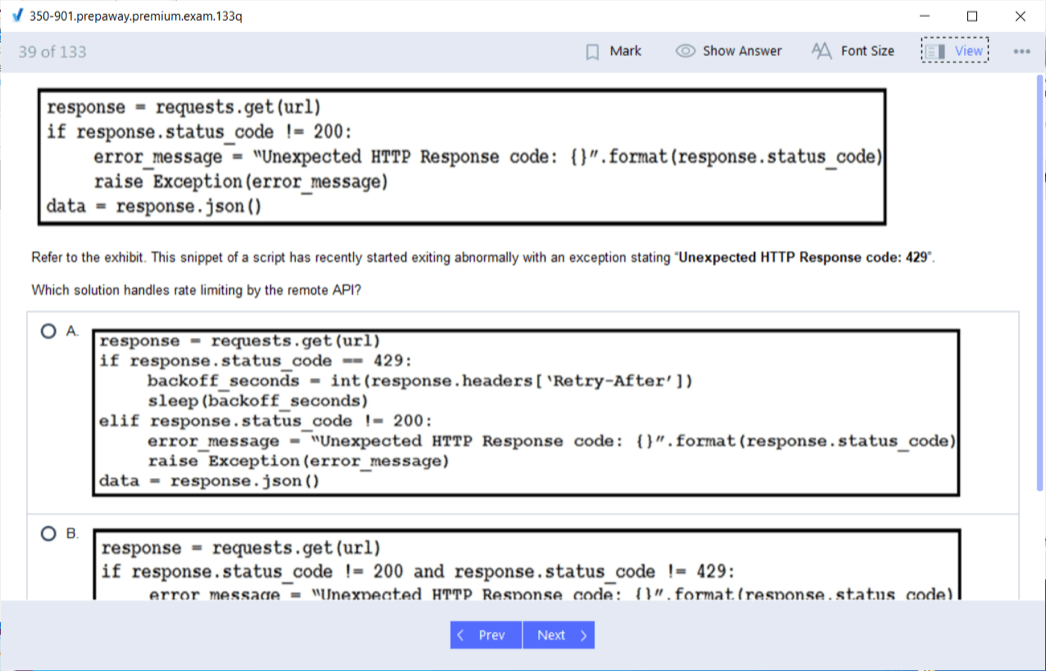
Good practice exercises begin with data rather than syntax drills. Retrieve interface or inventory information, normalize it, evaluate it against an intended condition, and produce a useful outcome. Then add error handling: authentication can fail, a resource can be missing, the API can return an unexpected status, or a field can be absent. Automation that works only under ideal conditions is not operationally mature.
Specialized automation concentrations go deeper in particular domains. The 300-435 ENAUTO exam applies automation to enterprise networking, while 300-635 DCNAUTO applies similar principles to data-center platforms. AUTOCOR supplies the shared engineering language: APIs, Python, models, source control, reusable workflows, and validation.
Infrastructure as code changes how teams define and review change
Infrastructure as code is tied for the largest blueprint weight because it turns configuration into a managed engineering artifact. Terraform, Ansible, Git, YAML, JSON, and CI/CD are not separate buzzwords; together they create a workflow in which intended state can be proposed, reviewed, tested, applied, and tracked. A candidate should understand why that workflow is safer and more scalable than making undocumented device-by-device changes.
Terraform is fundamentally state-oriented: resources are declared, dependencies are resolved, and a plan shows the delta between desired and known state. Ansible commonly expresses ordered automation in playbooks and uses modules to act on systems. The tools can overlap, but they are not identical. Study scenarios should focus on why a team would choose one pattern, how inventory or variables are organized, and how the workflow remains repeatable across environments.
Git is the control plane for collaboration around the automation itself. Branches isolate work, merge requests or pull requests create review points, commits provide history, and tags or releases can mark known versions. Candidates should be able to reason about a safe change path from local modification through review and deployment. The older DevNet Professional naming remains useful historical context for this skill family, but Cisco’s current program positions these capabilities under Automation.
CI/CD and lab simulation should validate intent before production
A pipeline is valuable when it catches unsafe or incorrect change before the network experiences it. AUTOCOR expects candidates to understand how linting, unit checks, policy tests, simulated environments, staged deployment, and post-change validation can be chained together. The exact tooling can vary; the engineering principle is that a change should prove as much as practical about itself before it reaches production.
Cisco Modeling Labs can support this process by providing network topologies that automation can target during development or testing. A lab does not reproduce every production dependency, but it allows teams to validate topology assumptions, configuration generation, protocol behavior, and test logic in a controlled environment. Candidates should understand both the value and the limit of simulation: passing in a lab increases confidence but does not eliminate the need for production safeguards.
Source-of-truth systems are equally important. Automation becomes dangerous when inventory, addressing, intended roles, or policy are spread across inconsistent spreadsheets and scripts. A source of truth gives the workflow an authoritative data set from which configuration and validation can be derived. When studying, follow a piece of intent—such as a new site or VLAN—from source-of-truth data through generated configuration, deployment, and verification.
Operations automation is about observability and closed-loop confidence
Automation does not end after configuration is pushed. The operations domain focuses on telemetry, logs, validation frameworks, secure communications, and the ability to evaluate whether the environment actually reached the intended state. This distinction is fundamental: deployment reports what the automation attempted, while validation reports what the network is doing.
Model-driven telemetry can stream structured operational data, allowing systems to detect changes or thresholds without repeatedly scraping commands. Logs provide event context, and APIs expose platform state. Tools such as pyATS can turn expected network behavior into repeatable tests. Candidates should be able to distinguish a configuration check from a service check: an interface may be configured correctly while a routing or application dependency still fails.
Create validation in layers. Verify the resource exists, verify the configuration is correct, verify the control plane converged, and finally verify the service outcome. That pattern makes troubleshooting precise because each failed layer narrows the cause. It also makes rollback decisions more defensible. Automation should not declare success solely because an API returned a successful status code.
Security belongs inside the automation workflow, not after it
Automation concentrates privilege. A script or pipeline may be able to change hundreds of devices faster than a human operator, which means weak credential handling, poor certificate validation, overbroad authorization, or unsafe input handling can scale risk just as quickly. AUTOCOR therefore includes secure coding and TLS-related operational knowledge as core engineering concerns.
Candidates should understand why secrets should not be hard-coded into repositories, why service accounts should receive only the permissions they need, and why encrypted transport still requires correct certificate trust. API tokens, SSH keys, certificates, and vault systems solve different pieces of the identity and secret-management problem. The correct design should make credentials replaceable and auditable without forcing them into code.
Secure coding also means treating external data as untrusted. Validate input, handle exceptions, avoid logging secrets, and understand the consequences of executing generated content. These habits become even more important when AI-assisted tools begin producing code or commands. The question is not whether automation makes operations safer by default; safety comes from controls built into the workflow.
AI in automation is a new domain with practical engineering boundaries
AI in Automation now represents a significant portion of AUTOCOR. Candidates should understand where generative or conversational systems can accelerate coding, documentation, analysis, or operator interaction and where they create risk. An AI assistant can suggest a script rapidly, but speed does not prove correctness. The engineer remains responsible for testing assumptions, checking permissions, validating output, and preventing hallucinated commands or unsupported configuration.
The blueprint’s inclusion of conversational agents, large language models, and a Python FastMCP server signals that Cisco expects candidates to understand tool-using AI patterns rather than just prompt writing. A useful mental model is that the model proposes or selects an action, while deterministic tools interact with systems. Clear schemas, constrained permissions, logging, and validation help prevent an AI layer from becoming an uncontrolled administrative interface.
AI recommendations should be treated as input to an engineering process. Ask what data the recommendation used, whether it applies to the actual platform version, what would change if executed, and how the result will be verified. In study labs, deliberately challenge AI-generated code with malformed input, partial data, and platform differences. Learning to reject a plausible but incorrect answer is part of the skill being measured.
A strong AUTOCOR study plan builds one end-to-end automation system
Instead of practicing every objective as an isolated exercise, build a small automation project that touches the whole blueprint. Keep intended device or service data in a source-of-truth file, version the project in Git, use Python or Ansible to retrieve and change state, represent infrastructure in Terraform where appropriate, and validate outcomes with structured tests. Add logging, exception handling, secret management, and a pipeline step so the project behaves like an operational system.
Then introduce failure. Remove a required variable, return a 401 from an API, alter a YANG path, create drift between desired and actual state, or cause a validation test to fail. The learning comes from explaining which layer should detect the problem and whether the workflow should stop, retry, roll back, or escalate. That is the difference between writing automation and engineering automation.
Cisco’s current certification portfolio increasingly rewards this cross-disciplinary approach because network engineers are expected to combine platform knowledge with software practices. AUTOCOR preparation is complete when a candidate can explain not only how to automate a task, but how to make the automation repeatable, reviewable, secure, observable, and trustworthy.
Cisco DEVCOR 350-901 practice test questions and answers, training course, study guide are uploaded in ETE Files format by real users. Study and Pass 350-901 Designing, Deploying, and Managing Network Automation Systems certification exam dumps & practice test questions and answers are to help students.
- 200-301 - Cisco Certified Network Associate (CCNA)
- 350-401 - Implementing Cisco Enterprise Network Core Technologies (ENCOR)
- 300-410 - Implementing Cisco Enterprise Advanced Routing and Services (ENARSI)
- 350-701 - Implementing and Operating Cisco Security Core Technologies
- 300-415 - Implementing Cisco SD-WAN Solutions (ENSDWI)
- 350-601 - Implementing and Operating Cisco Data Center Core Technologies (DCCOR)
- 300-420 - Designing Cisco Enterprise Networks (ENSLD)
- 300-715 - Implementing and Configuring Cisco Identity Services Engine (300-715 SISE)
- 810-110 - Cisco AI Technical Practitioner (AITECH)
- 350-801 - Implementing Cisco Collaboration Core Technologies (CLCOR)
- 350-101 - Implementing and Operating Cisco Wireless Core Technologies (WLCOR)
- 350-501 - Implementing and Operating Cisco Service Provider Network Core Technologies (SPCOR)
- 350-201 - Performing Cybersecurity Using Cisco Security Technologies (CBRCOR)
- 200-901 - DevNet Associate (DEVASC)
- 400-007 - Cisco Certified Design Expert
- 200-201 - Understanding Cisco Cybersecurity Operations Fundamentals (CBROPS)
- 300-710 - Securing Networks with Cisco Firewalls
- 500-220 - Cisco Meraki Solutions Specialist
- 100-150 - Cisco Certified Support Technician (CCST) Networking
- 350-901 - Designing, Deploying, and Managing Network Automation Systems
- 300-620 - Implementing Cisco Application Centric Infrastructure (DCACI)
- 820-605 - Cisco Customer Success Manager (CSM)
- 300-110 - Designing Cisco Wireless Networks (WLSD)
- 300-640 - Implementing Cisco Data Center AI Infrastructure (DCAI)
- 300-730 - Implementing Secure Solutions with Virtual Private Networks (SVPN 300-730)
- 800-150 - Supporting Cisco Devices for Field Technicians
- 300-510 - Implementing Cisco Service Provider Advanced Routing Solutions (SPRI)
- 300-815 - Implementing Cisco Advanced Call Control and Mobility Services (CLASSM)
- 300-745 - Designing Cisco Security Infrastructure
- 300-435 - Automating Cisco Enterprise Solutions (ENAUTO)
- 700-805 - Cisco Renewals Manager (CRM)
- 500-442 - Administering Cisco Contact Center Enterprise
- 300-610 - Designing Cisco Data Center Infrastructure for Traditional and AI Workloads
- 300-515 - Implementing Cisco Service Provider VPN Services (SPVI)
- 300-440 - Designing and Implementing Cloud Connectivity (ENCC)
- 100-160 - Cisco Certified Support Technician (CCST) Cybersecurity
- 100-140 - Cisco Certified Support Technician (CCST) IT Support
- 300-720 - Securing Email with Cisco Email Security Appliance (300-720 SESA)
- 300-425 - Designing Cisco Enterprise Wireless Networks (300-425 ENWLSD)
- 300-220 - Conducting Threat Hunting and Defending using Cisco Technologies for Cybersecurity
- 300-215 - Conducting Forensic Analysis and Incident Response Using Cisco CyberOps Technologies (CBRFIR)
- 500-560 - Cisco Networking: On-Premise and Cloud Solutions (OCSE)
- 700-750 - Cisco Small and Medium Business Engineer
- 700-246 - Cisco Environmental Sustainability Practice-Building - Stage 2 (CESPB)
- 700-242 - Cisco Environmental Sustainability Fundamentals - Stage 1 (CESF)
- 500-470 - Cisco Enterprise Networks SDA, SDWAN and ISE Exam for System Engineers (ENSDENG)
- 500-443 - Advanced Administration and Reporting of Contact Center Enterprise
- 300-430 - Implementing Cisco Enterprise Wireless Networks (300-430 ENWLSI)
- 300-445 - Designing and Implementing Enterprise Network Assurance
- 300-615 - Troubleshooting Cisco Data Center Infrastructure (DCIT)
- 300-830 - Implementing Cisco Collaboration Cloud Customer Experience (CLCCE)
- 300-820 - Implementing Cisco Collaboration Cloud and Edge Solutions
- 300-725 - Securing the Web with Cisco Web Security Appliance (300-725 SWSA)
- 010-151 - Supporting Cisco Data Center System Devices (DCTECH)
Purchase Cisco 350-901 Exam Training Products Individually
Why customers love us?
What do our customers say?
The resources provided for the Cisco certification exam were exceptional. The exam dumps and video courses offered clear and concise explanations of each topic. I felt thoroughly prepared for the 350-901 test and passed with ease.
Studying for the Cisco certification exam was a breeze with the comprehensive materials from this site. The detailed study guides and accurate exam dumps helped me understand every concept. I aced the 350-901 exam on my first try!
I was impressed with the quality of the 350-901 preparation materials for the Cisco certification exam. The video courses were engaging, and the study guides covered all the essential topics. These resources made a significant difference in my study routine and overall performance. I went into the exam feeling confident and well-prepared.
The 350-901 materials for the Cisco certification exam were invaluable. They provided detailed, concise explanations for each topic, helping me grasp the entire syllabus. After studying with these resources, I was able to tackle the final test questions confidently and successfully.
Thanks to the comprehensive study guides and video courses, I aced the 350-901 exam. The exam dumps were spot on and helped me understand the types of questions to expect. The certification exam was much less intimidating thanks to their excellent prep materials. So, I highly recommend their services for anyone preparing for this certification exam.
Achieving my Cisco certification was a seamless experience. The detailed study guide and practice questions ensured I was fully prepared for 350-901. The customer support was responsive and helpful throughout my journey. Highly recommend their services for anyone preparing for their certification test.
I couldn't be happier with my certification results! The study materials were comprehensive and easy to understand, making my preparation for the 350-901 stress-free. Using these resources, I was able to pass my exam on the first attempt. They are a must-have for anyone serious about advancing their career.
The practice exams were incredibly helpful in familiarizing me with the actual test format. I felt confident and well-prepared going into my 350-901 certification exam. The support and guidance provided were top-notch. I couldn't have obtained my Cisco certification without these amazing tools!
The materials provided for the 350-901 were comprehensive and very well-structured. The practice tests were particularly useful in building my confidence and understanding the exam format. After using these materials, I felt well-prepared and was able to solve all the questions on the final test with ease. Passing the certification exam was a huge relief! I feel much more competent in my role. Thank you!
The certification prep was excellent. The content was up-to-date and aligned perfectly with the exam requirements. I appreciated the clear explanations and real-world examples that made complex topics easier to grasp. I passed 350-901 successfully. It was a game-changer for my career in IT!


