
- Home
- Cisco Certifications
- 300-610 Designing Cisco Data Center Infrastructure for Traditional and AI Workloads Dumps
Pass Cisco DCID 300-610 Exam in First Attempt Guaranteed!
Get 100% Latest Exam Questions, Accurate & Verified Answers to Pass the Actual Exam!
30 Days Free Updates, Instant Download!


300-610 Premium File
- Premium File 321 Questions & Answers. Last Update: Oct 01, 2026
Whats Included:
- Latest Questions
- 100% Accurate Answers
- Fast Exam Updates
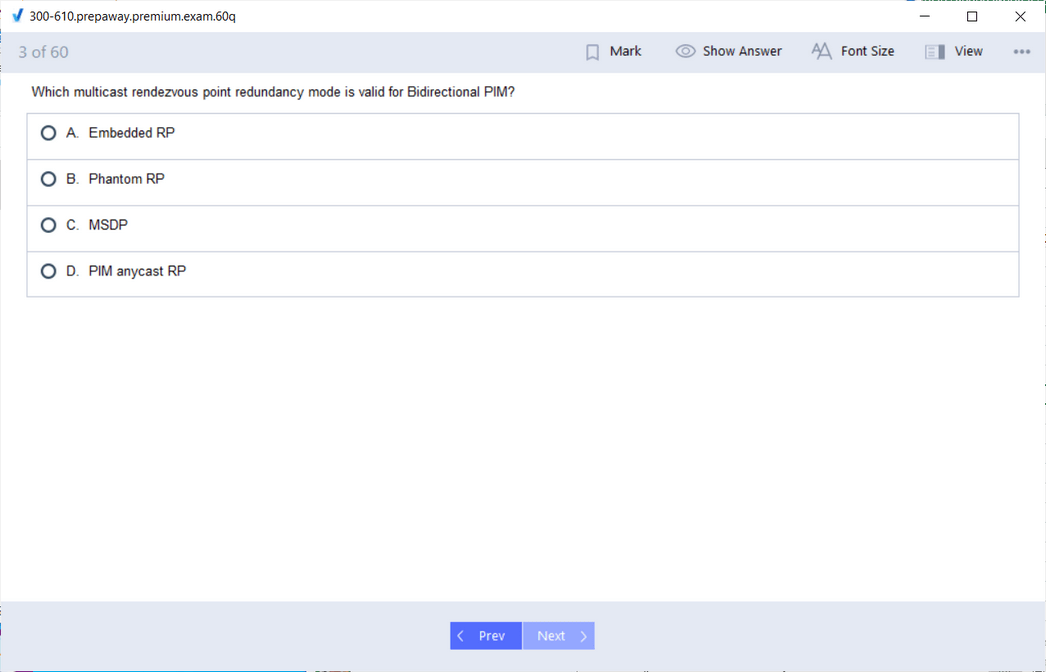
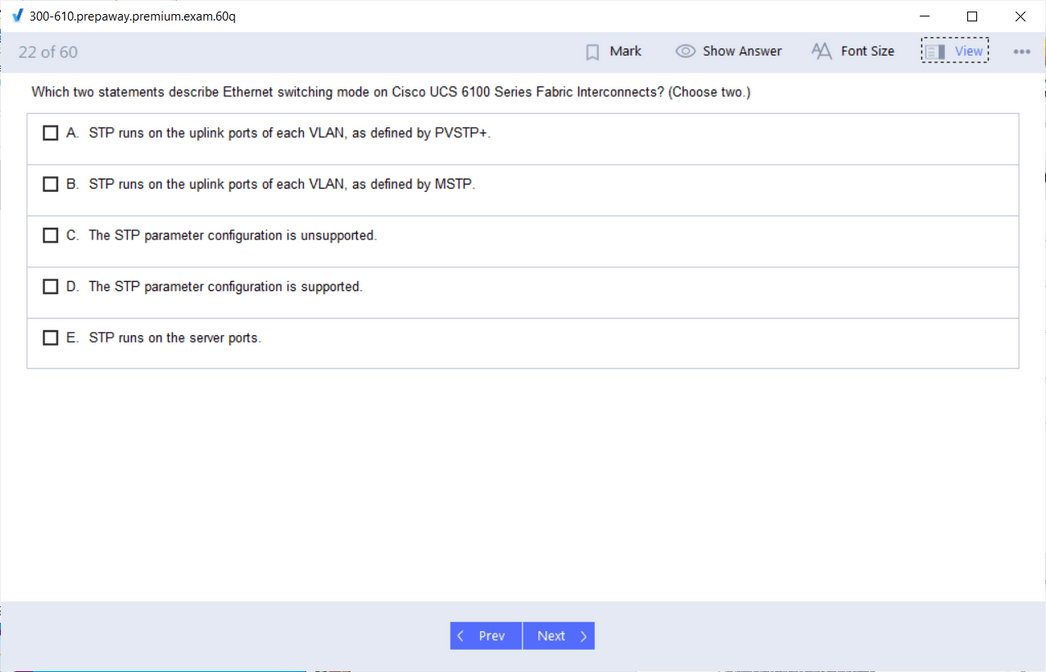
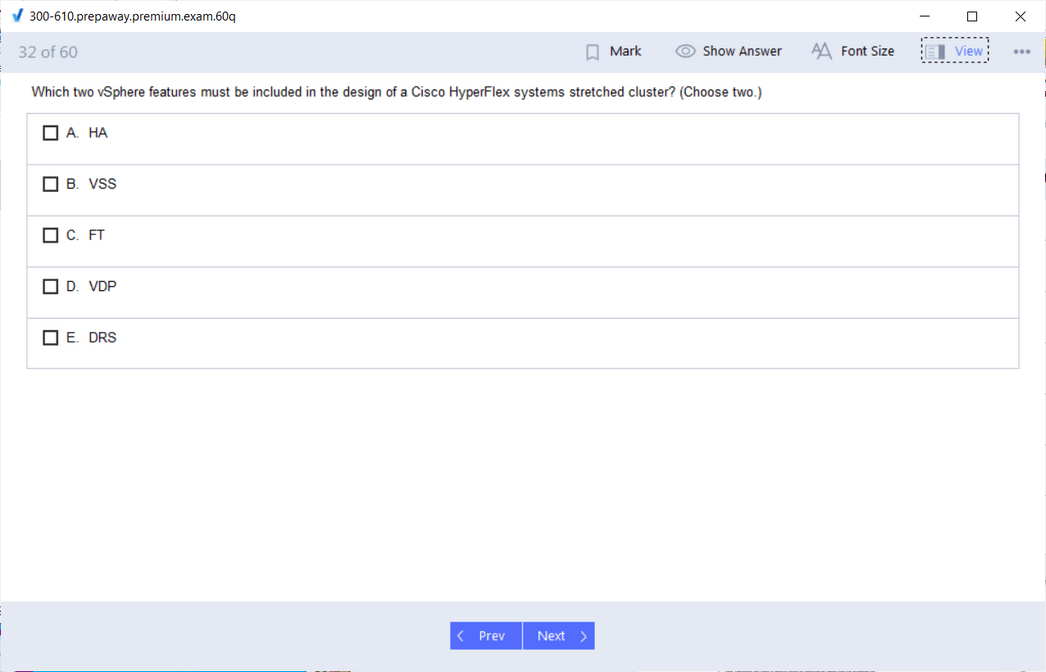
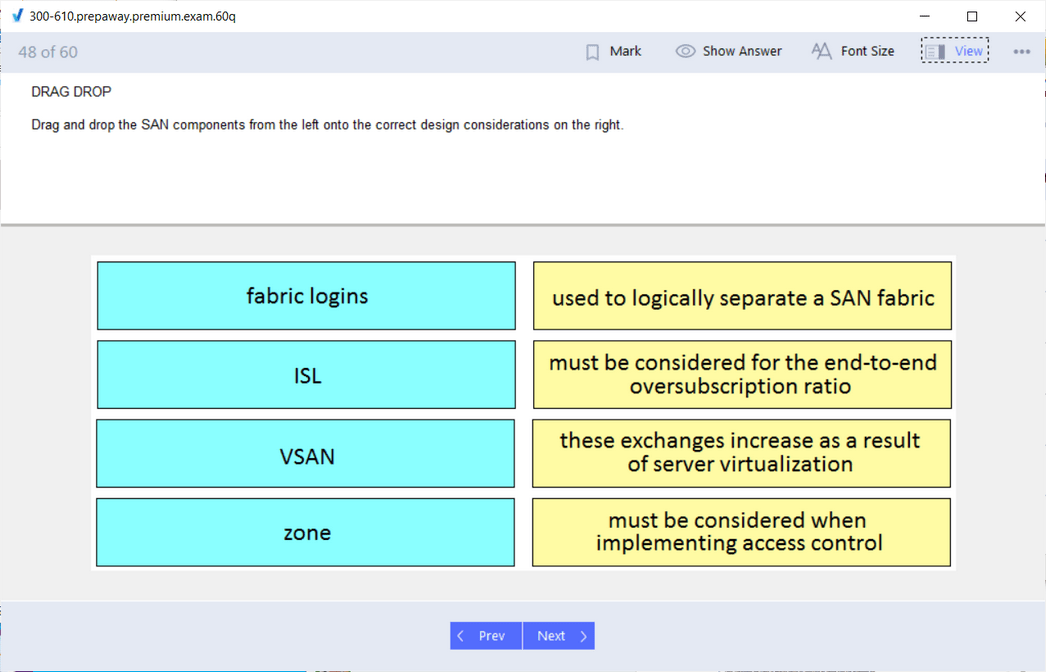
Last Week Results!
 83% students found the test questions almost same
All Cisco DCID 300-610 certification exam dumps, study guide, training courses are Prepared by industry experts. PrepAway's ETE files povide the 300-610 Designing Cisco Data Center Infrastructure for Traditional and AI Workloads practice test questions and answers & exam dumps, study guide and training courses help you study and pass hassle-free!
300-610 DCID: Designing Data Center Infrastructure for Traditional and AI Workloads
Cisco’s 300-610 DCID exam is the design-focused concentration in the current CCNP Data Center program. The live v1.2 blueprint is broader than a conventional network-design exam because Cisco now expects candidates to think about traditional application environments and AI workloads together. Network topology, compute, storage, automation, security, and operational sustainability all have to be considered as parts of one data-center design.
The most important change in the current blueprint is the explicit inclusion of AI and machine-learning infrastructure. Candidates need to understand the difference between training and inference, the role of GPUs and DPUs or SmartNICs, and the network characteristics required by high-performance workloads. Technologies such as RoCEv2, Ethernet, InfiniBand, RDMA, lossless behavior, and AI-oriented compute and storage are now relevant design inputs rather than specialist side topics.
DCID is not about choosing the “best” product in isolation. A defensible design explains why a technology fits a requirement, what tradeoffs it introduces, and how availability, scale, manageability, security, and cost are affected. The strongest preparation therefore compares options in realistic scenarios instead of memorizing feature lists.
Data center design begins with requirements and failure domains
A good design starts by translating business and application requirements into technical constraints. How much east-west bandwidth is needed? What failure can the workload tolerate? Which components must scale independently? Does the application require deterministic latency, lossless transport, rapid convergence, or simple operational ownership? These questions define the architecture before a particular topology or product is selected.
Failure-domain thinking is especially important. A redundant pair of devices is not meaningful if both depend on the same power feed, control plane, uplink, storage path, or orchestration service. In lab diagrams, deliberately mark rack, leaf, spine, fabric, site, and management failure boundaries. Then test the design against link, device, and site failures. This habit turns high availability from a slogan into a measurable property.
AI workloads change the assumptions behind network design
AI training can generate large synchronized traffic flows between accelerators, while inference workloads may prioritize predictable response time, scale-out service placement, and efficient access to models or vector data. Candidates should understand these workload differences before selecting a transport. The relationship between generative AI and machine learning matters because infrastructure requirements follow from the workload rather than from the label “AI.”
GPU clusters can be sensitive to latency, congestion, and packet loss in ways that ordinary enterprise applications are not. DPUs and SmartNICs may offload networking or security functions. AI designs also raise sustainability questions because power, cooling, utilization, and hardware density become architectural constraints. The exam expects candidates to recognize these pressures and connect them to data-center choices rather than treating AI as an application-layer topic.
High-performance transport requires comparing Ethernet, RoCEv2, and InfiniBand
The current blueprint asks candidates to evaluate technologies used for high-performance networking. Ethernet offers operational familiarity and broad ecosystem integration, while RoCEv2 uses RDMA over routable Ethernet to reduce CPU involvement and improve data movement. InfiniBand provides a mature high-performance fabric widely associated with large compute environments. The design question is which operational and performance characteristics fit the workload.
Do not memorize a one-line winner. Compare convergence, congestion control, loss characteristics, routing, management, interoperability, and the skills required to operate the environment. For RoCEv2, understand why quality of service, congestion management, and lossless behavior matter. For any design, ask how traffic will be monitored and troubleshot when performance degrades. A high-throughput fabric that operators cannot observe or recover is not a complete design.
Layer 2 and Layer 3 choices shape mobility, convergence, and scale
DCID includes evaluation of Layer 2 and Layer 3 connectivity, including endpoint or IP mobility, redundancy, convergence, service insertion, vPC, LACP, and routing virtualization. Layer 2 extension can simplify certain mobility requirements, but larger failure domains and control-plane complexity may follow. Layer 3 boundaries can improve scale and isolation while requiring the application or overlay architecture to handle mobility differently.
Use scenario comparisons rather than rigid rules. A workload that requires local Layer 2 adjacency has different constraints from a stateless application that can be addressed through routed endpoints or a load balancer. Examine how first-hop redundancy, routing convergence, and service insertion behave during failure. The best answer is usually the architecture that satisfies the actual requirement with the smallest unnecessary failure domain.
Compute design extends beyond choosing a server model
Compute architecture includes server form factor, CPU and accelerator resources, connectivity, firmware and policy management, service profiles or profiles, and the operational model that surrounds Cisco UCS and related systems. Candidates should understand how pools, templates, policies, and management platforms can make a compute environment repeatable rather than manually configured one server at a time.
AI expands this area with accelerator placement and high-bandwidth interconnect requirements. A design must consider whether GPUs are local to a server, connected through specialized fabrics, or pooled through an architecture that changes the east-west traffic pattern. Capacity planning should include PCIe topology, network interface bandwidth, storage throughput, and power and cooling. These dependencies make compute design inseparable from the network and facility assumptions.
Storage networking must be matched to application behavior
Data-center applications can depend on block, file, object, and specialized high-throughput storage patterns. DCID candidates need to understand Fibre Channel concepts, storage topologies, virtualization, and the network characteristics that protect storage traffic. Storage is not merely another VLAN; availability, loss sensitivity, zoning, multipathing, and latency can directly affect application stability.
For AI and analytics, data ingestion and checkpointing can create enormous storage demand. Design for throughput as well as capacity. Ask whether the network can feed accelerators fast enough, whether storage becomes the bottleneck during concurrent jobs, and how failures are isolated. A balanced architecture prevents expensive compute from sitting idle while waiting for data, which is why storage and transport must be planned together.
ACI, VXLAN, and fabric designs should be evaluated as policy systems
Modern data-center networks frequently separate the physical transport from overlay or policy constructs. Cisco ACI, VXLAN EVPN, and other fabric approaches can provide scalable segmentation, endpoint mobility, and centralized intent, but each introduces control-plane and operational dependencies. The 300-620 DCACI concentration goes deeper into ACI implementation; DCID should focus on when the architecture fits and how it interacts with external networks, services, and operations.
In design scenarios, identify the underlay, overlay, endpoint-learning model, policy boundary, and external connectivity point. Then ask what happens when a controller, route reflector, spine, leaf, or external link fails. This prevents the common mistake of treating a “fabric” as one indivisible feature and helps explain why a design remains resilient or where a dependency must be mitigated.
AI-ready Ethernet design also forces careful thinking about congestion. Remote Direct Memory Access over Converged Ethernet depends on a fabric that can control loss and queue pressure without creating widespread pause behavior. Designers should understand how Priority Flow Control, Explicit Congestion Notification, traffic classes, buffering, oversubscription, and link speed interact. The right answer is rarely “make the network lossless everywhere.” It is to identify which traffic actually requires special treatment and preserve ordinary traffic behavior around it.
Security and services belong in the design model as well. Segmentation, firewall insertion, load balancing, telemetry, out-of-band management, and failure-domain boundaries affect topology and capacity. A design that looks elegant in a pure forwarding diagram may become fragile when every north-south flow is forced through one service node or when east-west inspection creates a bottleneck. DCID preparation should therefore include diagrams that show policy and service paths, not only switch-to-switch links.
Modern AI clusters also expose facility constraints that network-only diagrams can hide. High-density accelerators increase power draw and cooling requirements, while storage and fabric bandwidth scale with the size and parallelism of the workload. A practical design exercise should state assumptions for rack density, redundancy, power, cooling, cabling, and growth before choosing a topology. Those constraints are not outside the architecture; they determine whether the design can actually be deployed and expanded.
Automation is part of the architecture, not an afterthought
Repeatable infrastructure depends on structured configuration, APIs, templates, orchestration, and infrastructure as code. DCID includes management and automation because a design that requires hundreds of manual, device-specific changes may be technically possible but operationally poor. Candidates should consider controller-based management, configuration lifecycle, source control, validation, and how changes are rolled back.
Automation also affects data quality. Intent systems and orchestration platforms need accurate models, credentials, dependencies, and observability. The current Data Center track connects this design perspective with the automation concentration at 300-635 DCNAUTO. Even when automation is not the primary design goal, the architecture should expose interfaces and operational boundaries that make consistent automation possible.
Design reviews should end with explicit trade-offs. Redundancy improves resilience but adds cost and operational state; larger failure domains simplify some designs but increase blast radius; tighter oversubscription improves performance but consumes ports and optics. Writing down the reason for each choice is useful preparation because DCID questions often test whether a design satisfies a requirement, not whether a particular technology is universally best.
Use DCCOR and DCAI to frame the current DCID scope
The 350-601 DCCOR core supplies the implementation and operations foundation that a designer needs to make realistic choices. The newer 300-640 DCAI concentration goes deeper into implementation, monitoring, and troubleshooting of AI infrastructure. DCID sits between those perspectives: it asks how to choose and combine network, compute, storage, and automation components before they are built.
Prepare by writing short design justifications. For each practice scenario, document the workload, traffic pattern, availability target, scale, management model, security boundary, and failure domains. Then choose technologies and state the tradeoffs. If you can explain why a design works for both normal operation and failure, and how it changes for AI workloads versus traditional applications, you are studying the decision-making skill that the current 300-610 blueprint is intended to validate.
Cisco DCID 300-610 practice test questions and answers, training course, study guide are uploaded in ETE Files format by real users. Study and Pass 300-610 Designing Cisco Data Center Infrastructure for Traditional and AI Workloads certification exam dumps & practice test questions and answers are to help students.
Exam Comments * The most recent comment are on top
- 200-301 - Cisco Certified Network Associate (CCNA)
- 350-401 - Implementing Cisco Enterprise Network Core Technologies (ENCOR)
- 300-410 - Implementing Cisco Enterprise Advanced Routing and Services (ENARSI)
- 350-701 - Implementing and Operating Cisco Security Core Technologies
- 300-415 - Implementing Cisco SD-WAN Solutions (ENSDWI)
- 300-420 - Designing Cisco Enterprise Networks (ENSLD)
- 300-715 - Implementing and Configuring Cisco Identity Services Engine (300-715 SISE)
- 350-601 - Implementing and Operating Cisco Data Center Core Technologies (DCCOR)
- 810-110 - Cisco AI Technical Practitioner (AITECH)
- 350-101 - Implementing and Operating Cisco Wireless Core Technologies (WLCOR)
- 350-801 - Implementing Cisco Collaboration Core Technologies (CLCOR)
- 350-501 - Implementing and Operating Cisco Service Provider Network Core Technologies (SPCOR)
- 350-201 - Performing Cybersecurity Using Cisco Security Technologies (CBRCOR)
- 400-007 - Cisco Certified Design Expert
- 500-220 - Cisco Meraki Solutions Specialist
- 200-901 - DevNet Associate (DEVASC)
- 300-710 - Securing Networks with Cisco Firewalls
- 200-201 - Understanding Cisco Cybersecurity Operations Fundamentals (CBROPS)
- 300-620 - Implementing Cisco Application Centric Infrastructure (DCACI)
- 100-150 - Cisco Certified Support Technician (CCST) Networking
- 300-730 - Implementing Secure Solutions with Virtual Private Networks (SVPN 300-730)
- 350-901 - Designing, Deploying, and Managing Network Automation Systems
- 820-605 - Cisco Customer Success Manager (CSM)
- 300-640 - Implementing Cisco Data Center AI Infrastructure (DCAI)
- 300-745 - Designing Cisco Security Infrastructure
- 300-435 - Automating Cisco Enterprise Solutions (ENAUTO)
- 300-110 - Designing Cisco Wireless Networks (WLSD)
- 300-510 - Implementing Cisco Service Provider Advanced Routing Solutions (SPRI)
- 800-150 - Supporting Cisco Devices for Field Technicians
- 300-815 - Implementing Cisco Advanced Call Control and Mobility Services (CLASSM)
- 300-440 - Designing and Implementing Cloud Connectivity (ENCC)
- 300-720 - Securing Email with Cisco Email Security Appliance (300-720 SESA)
- 300-425 - Designing Cisco Enterprise Wireless Networks (300-425 ENWLSD)
- 100-140 - Cisco Certified Support Technician (CCST) IT Support
- 300-220 - Conducting Threat Hunting and Defending using Cisco Technologies for Cybersecurity
- 100-160 - Cisco Certified Support Technician (CCST) Cybersecurity
- 300-610 - Designing Cisco Data Center Infrastructure for Traditional and AI Workloads
- 500-442 - Administering Cisco Contact Center Enterprise
- 300-515 - Implementing Cisco Service Provider VPN Services (SPVI)
- 700-805 - Cisco Renewals Manager (CRM)
- 300-215 - Conducting Forensic Analysis and Incident Response Using Cisco CyberOps Technologies (CBRFIR)
- 300-830 - Implementing Cisco Collaboration Cloud Customer Experience (CLCCE)
- 500-470 - Cisco Enterprise Networks SDA, SDWAN and ISE Exam for System Engineers (ENSDENG)
- 300-820 - Implementing Cisco Collaboration Cloud and Edge Solutions
- 500-560 - Cisco Networking: On-Premise and Cloud Solutions (OCSE)
- 700-242 - Cisco Environmental Sustainability Fundamentals - Stage 1 (CESF)
- 300-615 - Troubleshooting Cisco Data Center Infrastructure (DCIT)
- 500-443 - Advanced Administration and Reporting of Contact Center Enterprise
- 700-750 - Cisco Small and Medium Business Engineer
- 300-430 - Implementing Cisco Enterprise Wireless Networks (300-430 ENWLSI)
- 300-635 - Automating Cisco Data Center Solutions (DCAUTO)
- 300-445 - Designing and Implementing Enterprise Network Assurance
- 300-725 - Securing the Web with Cisco Web Security Appliance (300-725 SWSA)
- 010-151 - Supporting Cisco Data Center System Devices (DCTECH)
Why customers love us?
What do our customers say?
The resources provided for the Cisco certification exam were exceptional. The exam dumps and video courses offered clear and concise explanations of each topic. I felt thoroughly prepared for the 300-610 test and passed with ease.
Studying for the Cisco certification exam was a breeze with the comprehensive materials from this site. The detailed study guides and accurate exam dumps helped me understand every concept. I aced the 300-610 exam on my first try!
I was impressed with the quality of the 300-610 preparation materials for the Cisco certification exam. The video courses were engaging, and the study guides covered all the essential topics. These resources made a significant difference in my study routine and overall performance. I went into the exam feeling confident and well-prepared.
The 300-610 materials for the Cisco certification exam were invaluable. They provided detailed, concise explanations for each topic, helping me grasp the entire syllabus. After studying with these resources, I was able to tackle the final test questions confidently and successfully.
Thanks to the comprehensive study guides and video courses, I aced the 300-610 exam. The exam dumps were spot on and helped me understand the types of questions to expect. The certification exam was much less intimidating thanks to their excellent prep materials. So, I highly recommend their services for anyone preparing for this certification exam.
Achieving my Cisco certification was a seamless experience. The detailed study guide and practice questions ensured I was fully prepared for 300-610. The customer support was responsive and helpful throughout my journey. Highly recommend their services for anyone preparing for their certification test.
I couldn't be happier with my certification results! The study materials were comprehensive and easy to understand, making my preparation for the 300-610 stress-free. Using these resources, I was able to pass my exam on the first attempt. They are a must-have for anyone serious about advancing their career.
The practice exams were incredibly helpful in familiarizing me with the actual test format. I felt confident and well-prepared going into my 300-610 certification exam. The support and guidance provided were top-notch. I couldn't have obtained my Cisco certification without these amazing tools!
The materials provided for the 300-610 were comprehensive and very well-structured. The practice tests were particularly useful in building my confidence and understanding the exam format. After using these materials, I felt well-prepared and was able to solve all the questions on the final test with ease. Passing the certification exam was a huge relief! I feel much more competent in my role. Thank you!
The certification prep was excellent. The content was up-to-date and aligned perfectly with the exam requirements. I appreciated the clear explanations and real-world examples that made complex topics easier to grasp. I passed 300-610 successfully. It was a game-changer for my career in IT!