
Pass ISC CISSP Certification Exam in First Attempt Guaranteed!
Get 100% Latest Exam Questions, Accurate & Verified Answers to Pass the Actual Exam!
30 Days Free Updates, Instant Download!


CISSP Premium Bundle
- Premium File 484 Questions & Answers. Last update: Oct 12, 2026
- Training Course 62 Video Lectures
- Study Guide 2003 Pages
CISSP Premium Bundle
- Premium File 484 Questions & Answers
Last update: Oct 12, 2026 - Training Course 62 Video Lectures
- Study Guide 2003 Pages
Purchase Individually

Premium File
Training Course

Study Guide
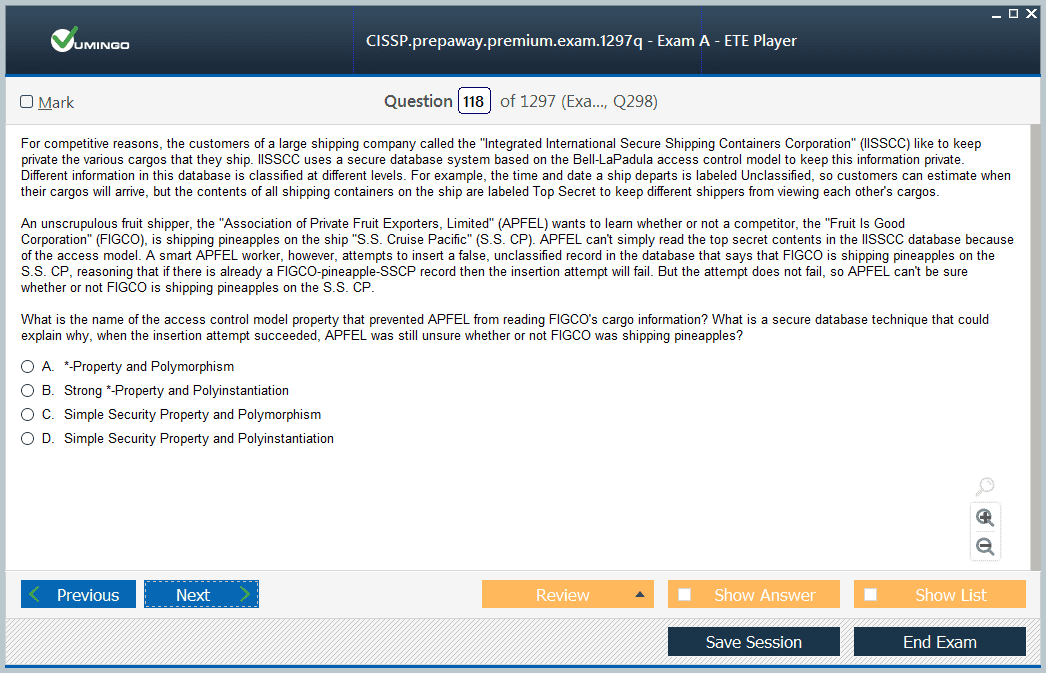
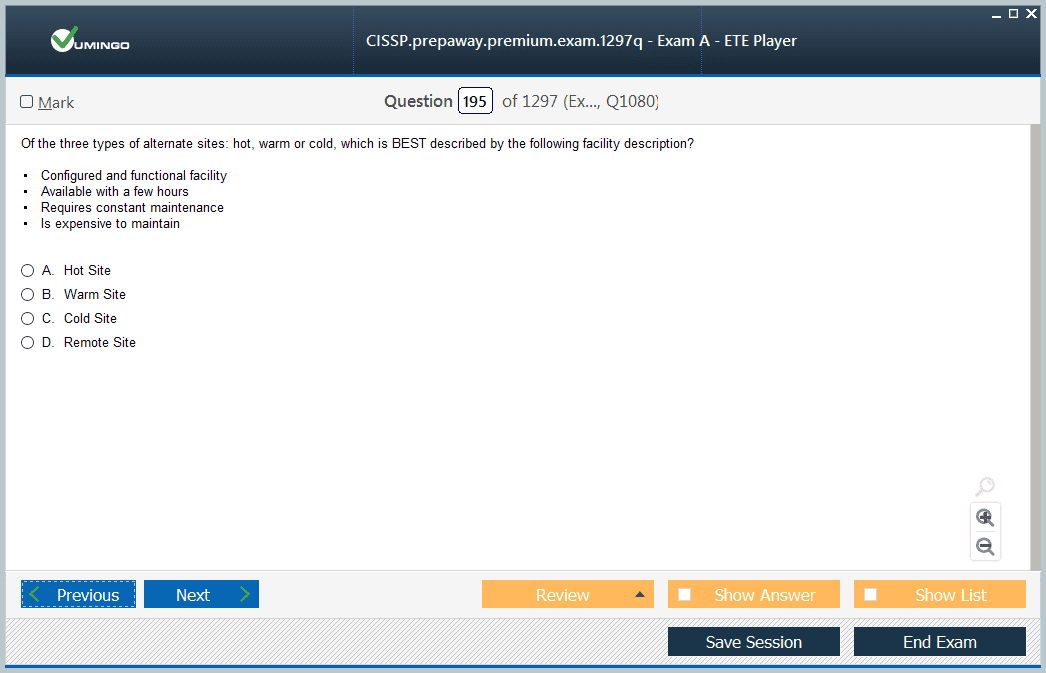
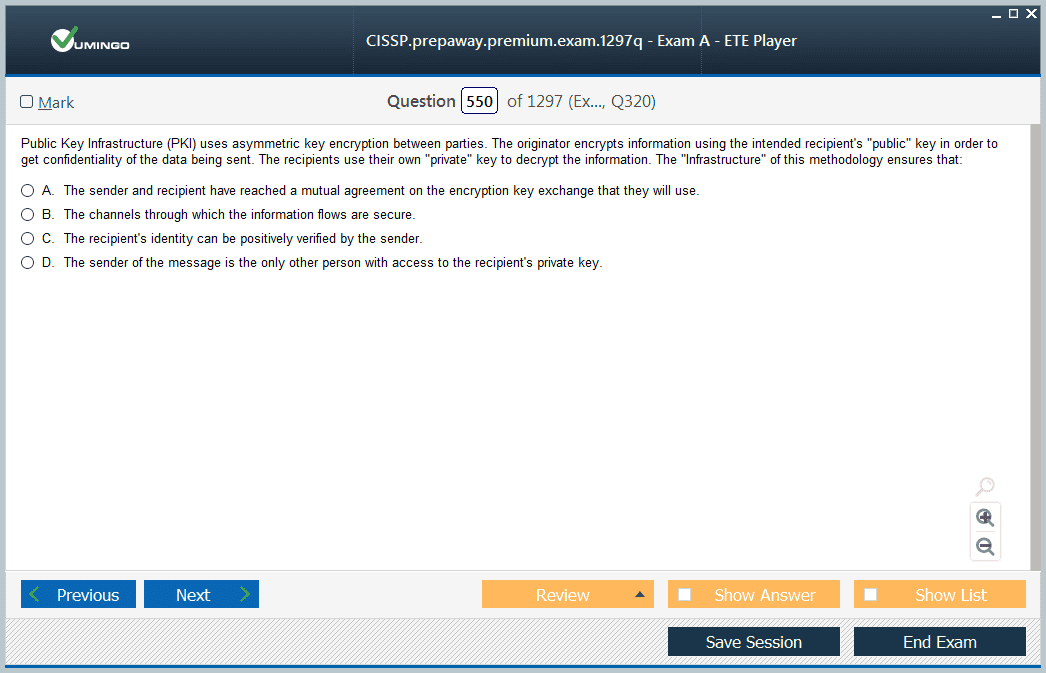
CISSP Exam - Certified Information Systems Security Professional
| Download Free CISSP Exam Questions |
|---|
ISC CISSP Certification Practice Test Questions and Answers, ISC CISSP Certification Exam Dumps
All ISC CISSP certification exam dumps, study guide, training courses are prepared by industry experts. ISC CISSP certification practice test questions and answers, exam dumps, study guide and training courses help candidates to study and pass hassle-free!
CISSP Certification in 2026: Current CAT Exam, Eight Domains, and Experience Requirements
The ISC2 Certified Information Systems Security Professional (CISSP) remains a broad advanced cybersecurity credential covering security management, architecture, engineering, networks, identity, testing, operations, and software development security. The current exam uses Computerized Adaptive Testing for all languages supported by the CAT program and is designed to assess whether experienced professionals can integrate security decisions across a complex enterprise.
The current CISSP exam is three hours and contains 100–150 items, including multiple-choice and advanced item types, with a passing grade of 700 out of 1000. The broader ISC2 certifications portfolio includes CCSP and role-specific credentials, but CISSP remains the most general advanced security certification in the family.
Use the Current Eight-Domain Weighting
The current CISSP outline uses eight domains: Security and Risk Management (16%), Asset Security (10%), Security Architecture and Engineering (13%), Communication and Network Security (13%), Identity and Access Management (13%), Security Assessment and Testing (12%), Security Operations (13%), and Software Development Security (10%).
Do not study them as isolated books. A cloud application incident can involve data classification, architecture, network design, identity, testing, operations, and secure development at the same time. CISSP questions often reward the professional who sees that larger system.
Security and Risk Management Set the Decision Framework
This domain covers governance, policy, legal and regulatory considerations, professional ethics, risk management, threat modeling, supply-chain risk, business continuity, personnel security, and awareness. The PrepAway deep dive on CISSP security and risk management can help connect foundational principles with enterprise decisions.
Practise distinguishing control implementation from risk ownership. Security professionals can recommend controls, but business leaders may own acceptance of residual risk. Clear roles prevent technical teams from making unauthorized business-risk decisions.
Architecture and Engineering Require Security Principles
Understand secure design principles, trusted computing concepts, cryptography, physical security, vulnerabilities in system architectures, and how controls fit different environments. The PrepAway discussion of security architecture and engineering provides supporting context.
A good architecture reduces attack surface, limits trust, contains failure, protects secrets, and creates observable control points. Avoid memorizing reference architectures without understanding which threat or business requirement each component addresses.
Network Security Should Be Explained as a Path
Communication and network security covers secure design, protocols, segmentation, wireless, remote access, and network attacks. The PrepAway guide to communication and network security can reinforce the domain.
Trace data from source to destination and identify where identity, encryption, routing, filtering, inspection, and monitoring occur. This method is more reliable than memorizing devices because modern networks span campus, cloud, remote users, SaaS, and API traffic.
Identity and Access Management Is an Enterprise Control Plane
IAM includes identification, authentication, authorization, federation, provisioning, privilege, access models, and lifecycle management. Understand human and machine identities, not only employee accounts.
Practise scenarios involving compromised credentials, excessive privilege, terminated users, service accounts, and federation failures. Ask which control should prevent, detect, or contain the issue and which team owns the correction.
Assessment and Testing Must Produce Evidence
Security assessment includes control testing, audits, vulnerability assessment, penetration testing, code review, metrics, and reporting. The goal is evidence of security posture, not simply generating tool output.
Choose the assessment method based on the question. A vulnerability scan, configuration review, penetration test, audit, and red-team exercise provide different evidence and have different risks.
Security Operations Cover the Full Incident and Resilience Lifecycle
Operations includes investigations, incident response, logging, monitoring, recovery, change, vulnerability management, physical operations, resource protection, and continuity. The PrepAway article on CISSP security operations can reinforce this domain.
Practise designing response and recovery before a failure. Define logging, escalation, backup, administrative access, containment, evidence preservation, and restoration. Security controls are less useful if they cannot be operated during an incident.
Secure Software Development Extends Security Into Delivery
Software development security covers lifecycle models, secure coding, testing, acquired software, environments, and application threats. Security should be integrated into requirements, design, development, testing, deployment, and maintenance.
Use threat modeling, code review, dependency management, secret handling, testing, and deployment controls according to risk. CISSP candidates should understand enough development practice to evaluate security without assuming every application team uses the same methodology.
To earn CISSP, ISC2 currently requires five years of cumulative full-time experience in at least two of the eight domains, subject to the current one-year waiver rules for qualifying education or credentials. Candidates who pass without the experience can follow the Associate of ISC2 pathway while earning the required experience.
Experienced CISSPs may later pursue concentrations such as ISSAP, ISSEP, or ISSMP. Cloud-focused professionals may choose CCSP instead of or in addition to a concentration, depending on role.
Asset security requires information classification, ownership, handling, retention, privacy, and lifecycle control. Data should be protected according to value and sensitivity from creation through storage, use, sharing, archival, and destruction. Copies in backups, logs, analytics, or development environments need the same governance attention as primary systems.
Business continuity and disaster recovery are not separate from cybersecurity. Define critical processes, dependencies, recovery objectives, alternate capabilities, communication, and testing. A resilient organization should be able to operate through technology failure and restore trusted systems after a security incident.
Supply-chain security should include software, hardware, services, contractors, managed providers, and dependencies. Evaluate trust, provenance, access, contractual security, vulnerability handling, and exit strategy. Senior security professionals need to understand how third-party risk becomes part of enterprise risk.
Cryptography should be understood as an operational system. Algorithm strength matters, but so do key generation, storage, rotation, certificate trust, revocation, backup, hardware protection, and protocol configuration. Many real failures occur in implementation and lifecycle management rather than in the mathematics.
Security leadership also requires communication. CISSP-level professionals frequently explain risk to architects, developers, executives, auditors, legal teams, and operators. Practise translating a technical issue into the decision each audience needs to make without losing accuracy.
For final review, take one enterprise scenario and identify which of the eight domains contribute to the solution. A ransomware event, cloud migration, merger, or new application can touch nearly every domain. This exercise is more representative of CISSP reasoning than completing another set of single-topic flashcards.
Physical security should not be ignored simply because most modern systems are cloud connected. Facilities, power, environmental controls, media handling, secure areas, surveillance, and hardware disposal all contribute to confidentiality, integrity, and availability. A data center outage or unauthorized physical access can bypass logical protections.
Security assessment results should feed governance and operations. A penetration test, audit, code review, or vulnerability scan creates value only when findings are prioritized, assigned, remediated, retested, and used to improve design. Senior security professionals should understand the full feedback loop.
For final practice, write a security architecture and incident plan for a fictional organization with cloud services, remote workers, software development, third parties, sensitive data, and regulatory obligations. Identify which CISSP domains influence each decision. If the solution requires all eight domains naturally, your study is integrated at the right level.
Privacy and security overlap but are not identical. Security protects information and systems from unauthorized impact, while privacy also addresses appropriate collection, use, disclosure, retention, and individual rights. CISSP candidates should understand when a technically secure system can still create privacy risk.
Before scheduling, review ISC2’s current experience-waiver list and endorsement requirements. ISC2 updated the waiver list in 2026, so an older study site may incorrectly tell you that a particular degree or certification still qualifies for the one-year experience waiver.
Use a final mixed-domain exercise with an acquisition or cloud migration. Identify data classification, identity, architecture, network segmentation, supplier risk, secure development, testing, incident response, continuity, and governance. Then explain which role owns each decision and what evidence proves the control is working.
CISSP questions often ask for the best professional action rather than the most technical one. Read for scope, lifecycle stage, business objective, and role authority before choosing an answer.
Enterprise security also depends on personnel processes such as onboarding, role changes, separation of duties, privileged access, termination, and security awareness. Technical controls are weakened when identity lifecycle or organizational responsibilities are unclear. Include people and process dependencies whenever you design a security control.
Before scheduling, complete one timed CAT-style practice session and review not only wrong answers but why the distractors were attractive. This exposes whether the gap is technical knowledge, role perspective, lifecycle timing, or failure to identify the primary business requirement.
Keep a short glossary of terms you repeatedly confuse and review it before the exam.
Recheck the live outline before booking.
Final Readiness Check
- Use the current eight-domain CISSP exam outline and current CAT format.
- Practise integrated scenarios across risk, architecture, networks, IAM, testing, operations, and software security.
- Choose controls according to business requirements, risk ownership, and lifecycle context.
- Confirm current experience and waiver rules before applying for certification.
- Use specialist or cloud credentials only when they match your post-CISSP role.
CISSP is broad because senior security decisions rarely fit within one technical domain. The strongest preparation teaches you to connect governance, architecture, people, systems, operations, and software into a security posture that can be explained and defended.
CISSP certification practice test questions and answers, training course, study guide are uploaded in ETE files format by real users. Study and pass ISC CISSP certification exam dumps & practice test questions and answers are the best available resource to help students pass at the first attempt.




Hope this helps