Salesforce Marketing Cloud Engagement Specialist: Email Operations Beyond the Legacy Name
The historical Marketing Cloud Email Specialist label reflects the former name of a credential that Salesforce renamed in July 2026. The current title is Salesforce Certified Marketing Cloud Engagement Specialist. The underlying role remains centered on email marketing practice inside Marketing Cloud Engagement: message design, subscriber and data management, inbox delivery, testing, and the operational decisions that keep campaigns useful rather than merely sendable.
The rename matters because candidates searching older study material can easily assume they are looking at a retired certification. They are not. The subject is still current, but the visible title has changed to align with Salesforce's present product naming. That makes this page a bridge between the historical exam label and the current credential rather than a description of an obsolete email platform.
The specialist sits beside the Marketing Cloud Engagement Administrator, consultant, and developer roles. The specialist is narrower than those paths but not simpler in the sense of being purely creative. Good email operations require disciplined data, permission, deliverability, measurement, and lifecycle thinking.
Subscriber identity is the starting point for every reliable send
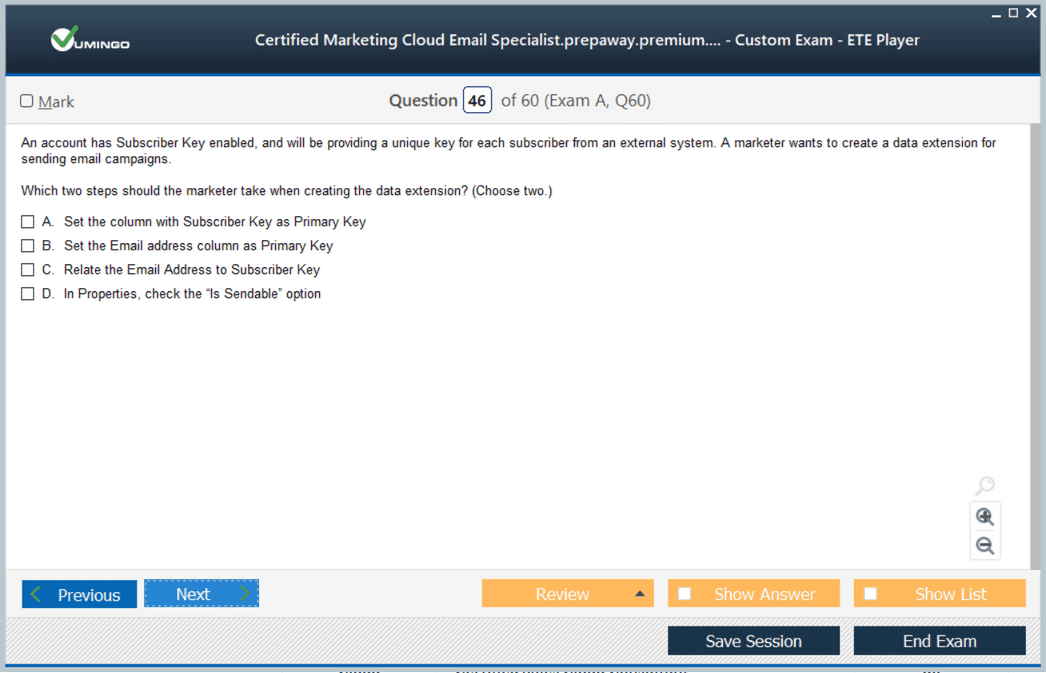
A campaign can have excellent copy and still fail if the wrong people enter the audience. The specialist therefore needs to understand how subscribers, contacts, subscriber keys, data extensions, suppression logic, and preference information influence who receives a message. Identity decisions are operational decisions because they determine whether records can be matched, updated, deduplicated, and suppressed consistently.
Data extensions should have a clear purpose. A sendable audience, a temporary staging table, an import landing area, and a reporting dataset do not need the same retention or ownership rules. When a team creates new tables for every campaign without documenting the source of truth, segmentation becomes harder to trust.
The broader principles in data modeling apply here: keys, relationships, cardinality, and ownership should be intentional. A campaign team may not use database-architecture terminology every day, but it still depends on those concepts whenever attributes are joined, synchronized, or reused across audiences.
Segmentation quality depends on both business logic and data quality
Audience rules should answer a business question in language that a reviewer can understand. “Customers who purchased in the last 90 days and have not opted out” is easier to validate than a chain of opaque filters whose purpose is known only to the original builder. Specialists should be able to trace a final audience back to its source attributes and explain why each condition exists.
Freshness matters as much as correctness. A segment built from yesterday's profile data may be acceptable for a weekly newsletter and unacceptable for a time-sensitive service communication. Campaign design should therefore include an explicit expectation for when source systems update and how late-arriving records are handled.
Data quality checks inside the pipeline are especially important before a large send. Null identifiers, malformed addresses, unexpected duplicates, and bad date values can change audience size or personalization behavior. Detecting those conditions before the message is scheduled is safer than discovering them from bounce reports or customer complaints.
Message design has to survive real inbox conditions
Email design is not only about how a message looks in the editor. The specialist should consider subject lines, preheaders, content hierarchy, accessible structure, image dependence, mobile rendering, links, fallback text, and how dynamic content behaves when an expected attribute is missing. A beautifully designed message that collapses when one personalization field is blank is not production ready.
Reusable templates and content blocks reduce inconsistency, but they need governance. Teams should know which components are approved, which variables they require, and which elements can be changed safely by campaign builders. Reuse should make quality easier to maintain, not spread an old mistake across many sends.
The strategic side of email marketing and subscriber loyalty also matters. Frequency, relevance, and expectation management influence engagement over time. A technically perfect message can still erode trust if recipients receive content they did not expect or receive it too often.
Personalization should fail predictably instead of failing visibly
Dynamic content, personalization strings, and conditional blocks can make email more relevant, but each dependency increases the number of states that need to be tested. Specialists should know what happens when a first name is absent, when a product field contains an unexpected value, or when an audience member qualifies for more than one content rule.
Fallback logic should be deliberate. A neutral greeting is usually better than exposing an empty variable. A default offer may be safer than showing a broken content block. The correct fallback depends on the campaign, but the general rule is that missing data should produce a controlled experience rather than an accidental one.
Personalization also raises privacy questions. Using an attribute because it exists in a data extension is not the same as having a good reason to expose it in a message. The specialist should understand the difference between data that is operationally available and data that is appropriate to use for the communication.
Deliverability is a system of reputation, authentication, and list discipline
Inbox placement is influenced by more than creative quality. Sender authentication, domain configuration, bounce behavior, complaint rates, engagement, list quality, sending consistency, and reputation all contribute. Specialists should recognize deliverability as a long-running operational property rather than a switch that can be fixed immediately before launch.
Sudden volume changes deserve caution. If a program usually sends to a modest engaged audience and suddenly expands to a much larger inactive list, the technical platform may complete the send while mailbox providers react negatively. Segmentation and warm-up strategy therefore have a direct relationship with reputation.
Bounce categories should be interpreted, not merely counted. A transient mailbox problem and a permanently invalid address imply different actions. Repeatedly retrying records that cannot receive mail wastes capacity and can damage reputation, while suppressing every temporary failure too aggressively can remove valid subscribers.
Testing must cover the audience, content, links, and operational path
Proof sends are useful, but they do not exercise every production condition. A complete test plan should include representative data states, different content branches, link validation, unsubscribe behavior, sender configuration, tracking settings, and the actual audience query or automation path used for the live campaign.
A small seed list can help confirm rendering and inbox placement, but it cannot prove that the full audience is correct. Specialists should compare expected counts, sample records from edge cases, and verify exclusion logic before scheduling. Large changes in audience size need explanation, not just approval because the query completed successfully.
The current Marketing Cloud Engagement Developer role goes deeper into programmatic personalization, scripting, and API work. The specialist still needs enough technical awareness to recognize when a campaign issue is caused by content, data, automation, or code and route the problem to the right owner.
Consent and preference handling must remain consistent across campaigns
Unsubscribe and preference management are not isolated footer features. A recipient's current permission state should influence audience construction before a message is sent. Teams also need to understand whether preferences apply globally, by brand, by communication type, or through a more detailed model.
Suppression rules should be documented so campaign builders do not recreate them differently each time. If legal, service, transactional, or subscription categories have different handling, the distinction needs to be visible in both data and process. An undocumented exception is difficult to audit and easy to misuse.
Specialists should work closely with administrators when preference data crosses business units or integrated systems. The Marketing Cloud Engagement Consultant path covers broader implementation design, while the specialist is responsible for applying those structures correctly in day-to-day campaign execution.
Measurement should connect engagement signals to a decision
Open and click metrics are useful only when the team understands what action follows from them. A report that shows engagement without changing audience strategy, content, testing, or cadence becomes decorative. Specialists should identify the question behind each metric before building the report.
Delivery metrics help separate content performance from operational problems. A campaign with poor click activity and normal delivery requires a different investigation from one with high bounce or complaint rates. Trend analysis is more useful than reacting to a single percentage in isolation.
Campaign learning should also feed future segmentation. Engagement history can help distinguish active subscribers from people who have stopped responding, but the response should not always be “send more.” Re-engagement, reduced frequency, different content, or suppression may be more appropriate depending on the program.
The current credential rewards disciplined email operations, not button memorization
Candidates preparing under the old Email Specialist name should align their study to the current Marketing Cloud Engagement Specialist scope and current product behavior. Salesforce's July 2026 name change did not erase the practical core of the role; it clarified the product identity around it.
Adjacent credentials show where the specialist's responsibility stops. The Marketing Cloud Account Engagement Specialist serves a different B2B automation product, while the administrator role governs platform configuration and the developer role owns deeper scripting and integration work. Understanding those boundaries prevents candidates from studying every Marketing Cloud topic equally.
The durable skill is the ability to take a campaign from audience definition to reliable delivery with evidence at every step. That means knowing the data, testing the message, protecting consent, monitoring deliverability, and using results to make the next send better. Those habits remain valuable even as Salesforce changes product names and interface details.







 83% students found the test questions almost same




