Pass Microsoft Certified: Power Platform Functional Consultant Associate Certification Exam in First Attempt Guaranteed!
Get 100% Latest Exam Questions, Accurate & Verified Answers to Pass the Actual Exam!
30 Days Free Updates, Instant Download!


PL-200 Premium Bundle
- Premium File 328 Questions & Answers. Last update: Nov 02, 2026
- Training Course 94 Video Lectures
- Study Guide 800 Pages
PL-200 Premium Bundle
- Premium File 328 Questions & Answers
Last update: Nov 02, 2026 - Training Course 94 Video Lectures
- Study Guide 800 Pages
Purchase Individually

Premium File
Training Course
Study Guide
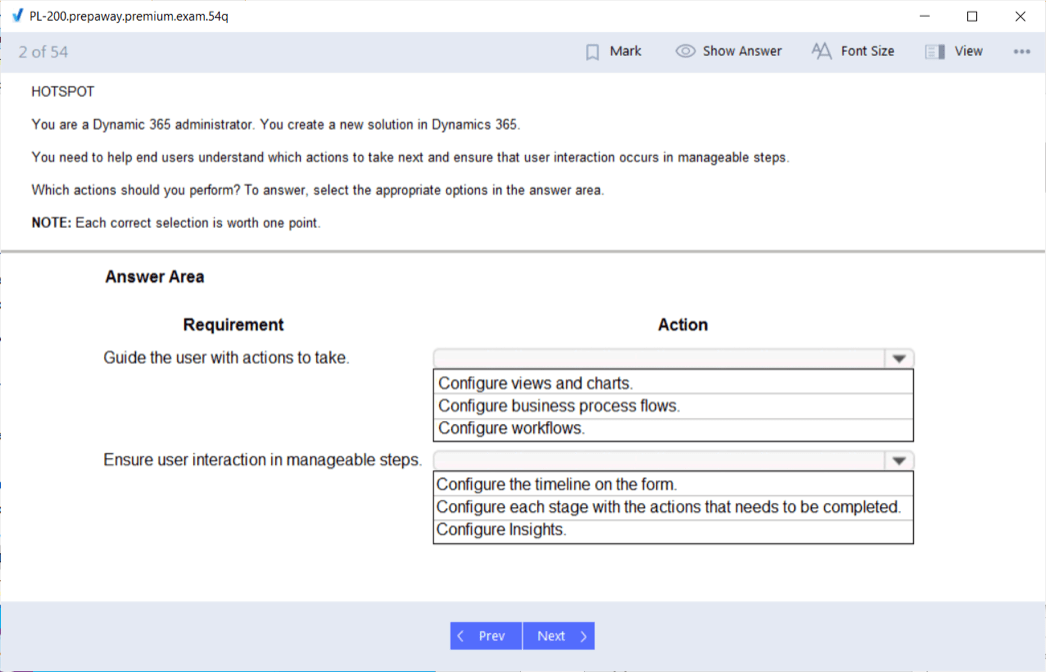


PL-200 Exam - Microsoft Power Platform Functional Consultant
| Download Free PL-200 Exam Questions |
|---|
Microsoft Microsoft Certified: Power Platform Functional Consultant Associate Certification Practice Test Questions and Answers, Microsoft Microsoft Certified: Power Platform Functional Consultant Associate Certification Exam Dumps
All Microsoft Microsoft Certified: Power Platform Functional Consultant Associate certification exam dumps, study guide, training courses are prepared by industry experts. Microsoft Microsoft Certified: Power Platform Functional Consultant Associate certification practice test questions and answers, exam dumps, study guide and training courses help candidates to study and pass hassle-free!
Power Platform Functional Consultant Associate Is Retired: From PL-200 to AB-410 Intelligent Applications Builder
Microsoft Certified: Power Platform Functional Consultant Associate is a retired credential in the broader Microsoft certification portfolio. Microsoft retired PL-200 and the credential on August 31, 2026. The direct replacement is Intelligent Applications Builder Associate, available through AB-410. Microsoft’s current replacement certification validates AI-powered business solutions built with Power Platform, Copilot, natural-language prompts, low-code tools, Dataverse, Power Apps, Power Automate, Power Pages, and awareness of Copilot Studio.
This is a real shift in role emphasis rather than a silent exam-code change. PL-200 focused on discovery, Dataverse, apps, automation, Power Pages, and solution implementation. AB-410 preserves many of those functional skills while expecting candidates to map business processes to intelligent low-code solutions and use Copilot-assisted creation more deliberately.
PL-200 Ended on August 31, 2026
Microsoft’s retirement list marks PL-200 and Power Platform Functional Consultant Associate as retired. Existing holders retain their historical credential according to Microsoft policy, but new candidates should not prepare to schedule PL-200.
PrepAway content such as the PL-200 functional consultant path can still teach durable requirements, Dataverse, Power Apps, and automation concepts when the retired exam details are clearly labeled.
AB-410 Is the Direct Current Replacement
Microsoft explicitly identifies Intelligent Applications Builder Associate as the replacement. The current AB-410 exam provides 120 minutes and assesses creating a foundation for intelligent applications, creating intelligent applications, and building business application logic and automation.
The replacement assumes familiarity with Copilot in Power Apps, Power Automate, Power Pages, Dataverse, Copilot Studio, AI models/prompts, Power Fx, environment governance, and solution lifecycle.
Requirements Discovery Still Comes First
Functional solution building begins with users, processes, data, pain points, rules, approvals, integrations, and success measures. AI and low-code features should be selected only after the process is understood.
Use workshops, user stories, prototypes, and acceptance criteria so the solution solves the actual business problem instead of reproducing a vague request.
Dataverse Remains the Core Data Platform
Design tables, columns, relationships, security, business rules, choices, forms, and views according to business meaning. Good data design makes low-code apps and AI assistance more reliable.
Define ownership and data quality early. Intelligent applications amplify bad data as quickly as traditional automation does.
Power Apps and Power Pages Build User Experiences
Use model-driven apps, canvas apps, and Power Pages according to audience and workflow. Apply Power Fx and configuration before escalating to custom code.
Test mobile, accessibility, role-based experience, and authentication. A low-code app still needs product-quality usability and security.
Power Automate Builds Business Logic and Integration
Design flows, approvals, notifications, process orchestration, data movement, and exception handling. Automation should have clear owners and visible failures.
Use connection references and solution lifecycle so workflows can move safely between environments.
Copilot Makes the New Role More AI-Centered
AB-410 expects candidates to use Copilot in Power Platform products and understand agents. Natural-language creation can speed development, but generated formulas, flows, data structures, or apps still require validation.
Intelligent solutions should preserve permissions, business rules, and auditability. The model should not become an uncontrolled route around approved process.
Developer and Architect Paths Remain Separate
Power Platform Developer Associate serves deeper custom development and is itself transitioning from PL-400 to AB-400. The current Agentic AI Business Solutions Architect path is the expert direction for cross-platform AI solution architecture.
Intelligent Applications Builder sits between fundamentals and deeper developer/architect roles for professionals who translate business requirements into low-code and AI-enabled applications.
Environment strategy remains important in the replacement role. Define development, test, and production environments, data policies, security groups, solution ownership, and connector governance. Low-code velocity becomes risky when makers build directly in production with personal connections and no lifecycle control.
Business-process mapping should identify triggers, decisions, exceptions, data, approvals, and handoffs before choosing app or automation components. A consultant should know when the requirement is best served by a model-driven app, canvas app, flow, Power Pages site, agent, or combination.
Dataverse design should include data types, relationships, ownership, security, auditing, duplicate detection, and business rules. Poor schema design makes every downstream app and agent more difficult to maintain.
Power Fx remains important for formulas and low-code business logic. Understand delegation, variables, collections, data operations, and maintainable formula design at the level expected by the current intelligent-app builder role.
Power Automate should include exception handling and monitoring. If a process updates customer or financial records, define what happens when one downstream action fails. Use scopes, retries, conditions, error paths, and notifications so operations do not rely on manually discovering broken automation.
Copilot-assisted creation should be treated as a starting point, not a proof of correctness. Review generated formulas, flows, tables, and app structures for security, performance, data quality, and alignment with requirements.
Agents should be connected to governed knowledge and narrow actions. Define what the agent may read, what it may change, when a human must approve, and which logs show the action taken. An intelligent application is safer when authorization and business rules remain explicit.
User acceptance testing should cover personas and exceptions. Makers often validate the happy path because it is easiest to demonstrate. Consultants should test missing data, rejected approvals, permission differences, duplicate records, unavailable services, and user mistakes.
For final transition practice, take an old PL-200 solution and modernize it: add environment governance, Copilot-assisted building, one agent use case, current Dataverse security, and documented ALM. Map each old objective to the AB-410 skill groups so you can see which functional skills transfer and which intelligent-app capabilities are new.
Power Pages design should include identity provider, web roles, table permissions, forms, lists, external data needs, and lifecycle. Public or partner-facing solutions should be penetration-tested and reviewed for unintended Dataverse exposure before go-live.
Business rules and validation should be placed at the right layer. Some logic belongs in Dataverse so all apps respect it; some belongs in a specific app for user experience; some belongs in a flow for process automation. Keep rules centralized when they represent enterprise policy.
Analytics should be built into the solution where it helps users and owners understand adoption, process health, exceptions, and value. Low-code projects can fail silently when nobody measures whether the app or automation improved the business outcome.
Change management matters because low-code solutions often alter everyday work. Train users, define support, collect feedback, phase rollout, and communicate ownership. A technically correct app can still fail if the organization is not prepared to adopt the new process.
AB-410 also expects familiarity with AI Hub, prompts, and Copilot-assisted experiences. Consultants should know enough AI to choose appropriate use cases and validate output without drifting into unnecessary custom model engineering.
Before scheduling AB-410, verify the live Microsoft certification page because the replacement credential is new and its study resources may continue to expand after the 2026 transition.
Environment governance should also consider maker onboarding and support. Define who can create environments, who can use premium connectors, which templates are approved, and how unsupported personal apps are identified before they become business-critical.
Solution ownership should be explicit after handoff. Name the business owner, technical owner, data owner, and support team. Low-code solutions often fail later because everyone assumes someone else is maintaining the app or flow.
Copilot and agent features should be evaluated for measurable value. Decide whether they reduce process time, improve user completion, or handle common questions better. Do not add AI solely because the new certification emphasizes intelligent applications.
For final preparation, document one solution from discovery through data model, app, automation, agent, security, testing, deployment, and support. This single artifact can show how PL-200-era functional discipline becomes AB-410-era intelligent application building.
Data-loss-prevention policies should be considered during design, especially when solutions combine business and consumer connectors. A flow that works in a maker’s test environment may be blocked in production if governance policy is ignored until deployment.
Keep one current intelligent-app portfolio example that demonstrates Dataverse, app experience, automation, an agent, governance, and deployment. It provides stronger evidence of current skill than a PL-200 study plan after retirement.
Before scheduling AB-410, review its current Microsoft guide and confirm that your practice solution includes Dataverse, Power Apps, Power Automate, governance, Copilot-assisted building, and agent-aware design.
Functional consultants should also define decommissioning. When an app, flow, or agent is replaced, decide how users are migrated, connections are revoked, data is retained, and obsolete components are removed. Low-code environments become difficult to govern when old solutions remain active without owners.
Rehearse one stakeholder conversation in which the requested automation is not the right solution. Explain whether the real issue is data quality, policy, training, or process design. Good consulting includes knowing when not to automate.
Final Readiness Check
- Treat Power Platform Functional Consultant Associate and PL-200 as retired from August 31, 2026.
- Use AB-410 for the current Intelligent Applications Builder Associate path.
- Carry forward requirements, Dataverse, Power Apps, Power Automate, Power Pages, security, and ALM skills.
- Add Copilot-assisted creation, AI prompts, intelligent apps, and agent awareness.
- Build a current portfolio instead of relying on retired PL-200 exam material.
The Power Platform functional role did not disappear; Microsoft reframed it around intelligent application building. The strongest transition preserves functional-consulting discipline while adding AI-assisted low-code development and modern governance.
Microsoft Certified: Power Platform Functional Consultant Associate certification practice test questions and answers, training course, study guide are uploaded in ETE files format by real users. Study and pass Microsoft Microsoft Certified: Power Platform Functional Consultant Associate certification exam dumps & practice test questions and answers are the best available resource to help students pass at the first attempt.