
- Home
- SAS Institute Certifications
- A00-250 SAS Platform Administration for SAS 9 Dumps
Pass SAS Institute A00-250 Exam in First Attempt Guaranteed!
Get 100% Latest Exam Questions, Accurate & Verified Answers to Pass the Actual Exam!
30 Days Free Updates, Instant Download!


A00-250 Premium File
- Premium File 65 Questions & Answers. Last Update: Oct 12, 2026
Whats Included:
- Latest Questions
- 100% Accurate Answers
- Fast Exam Updates
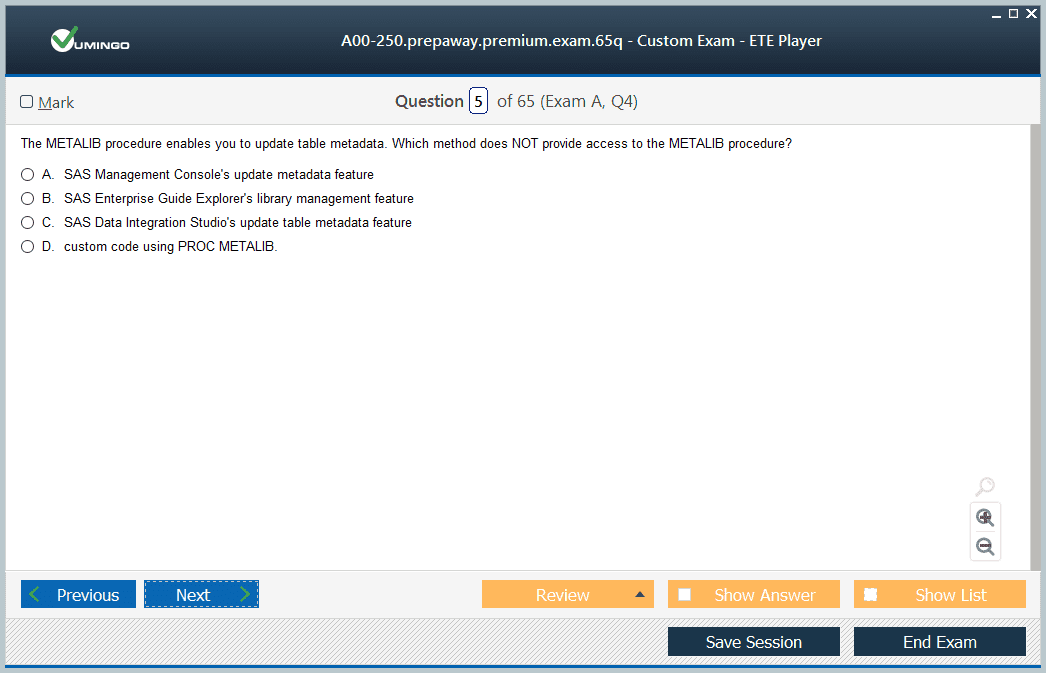
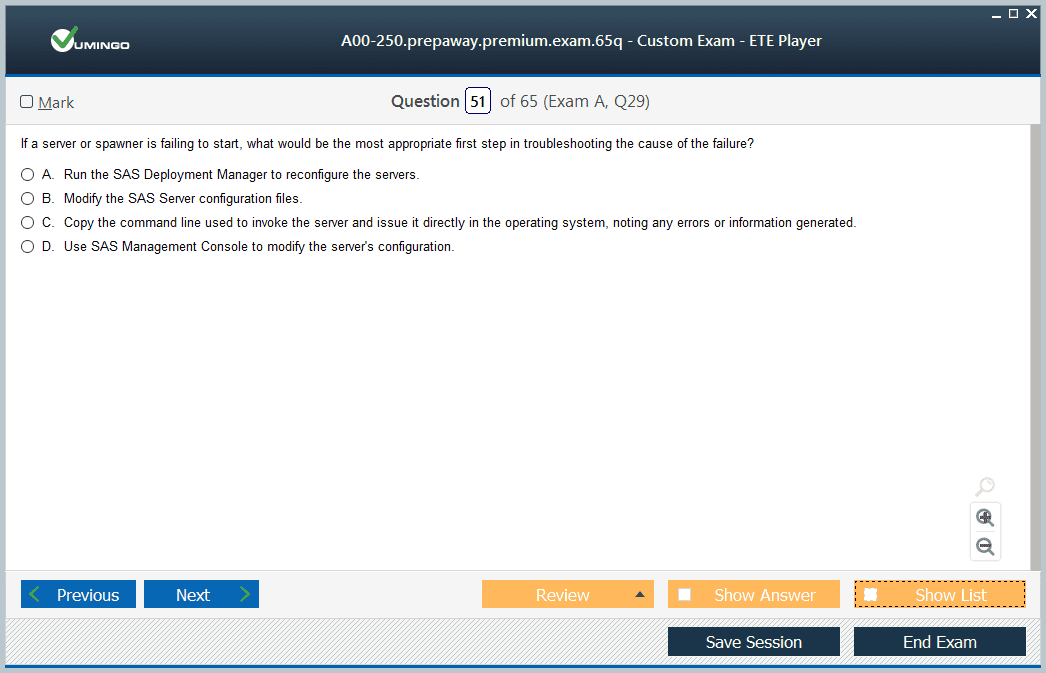
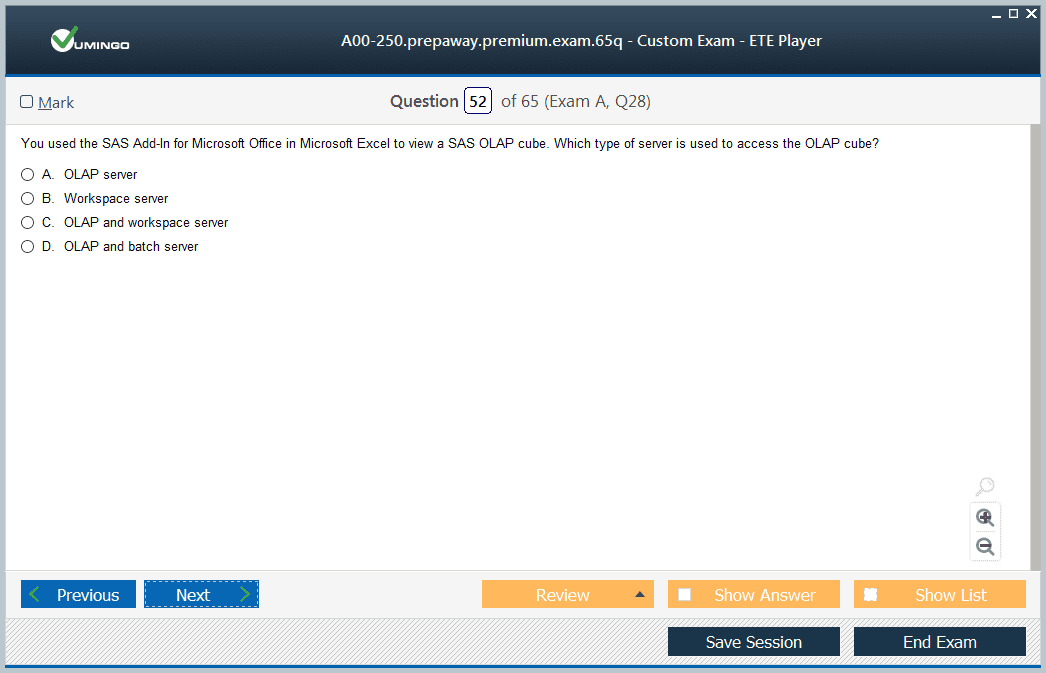
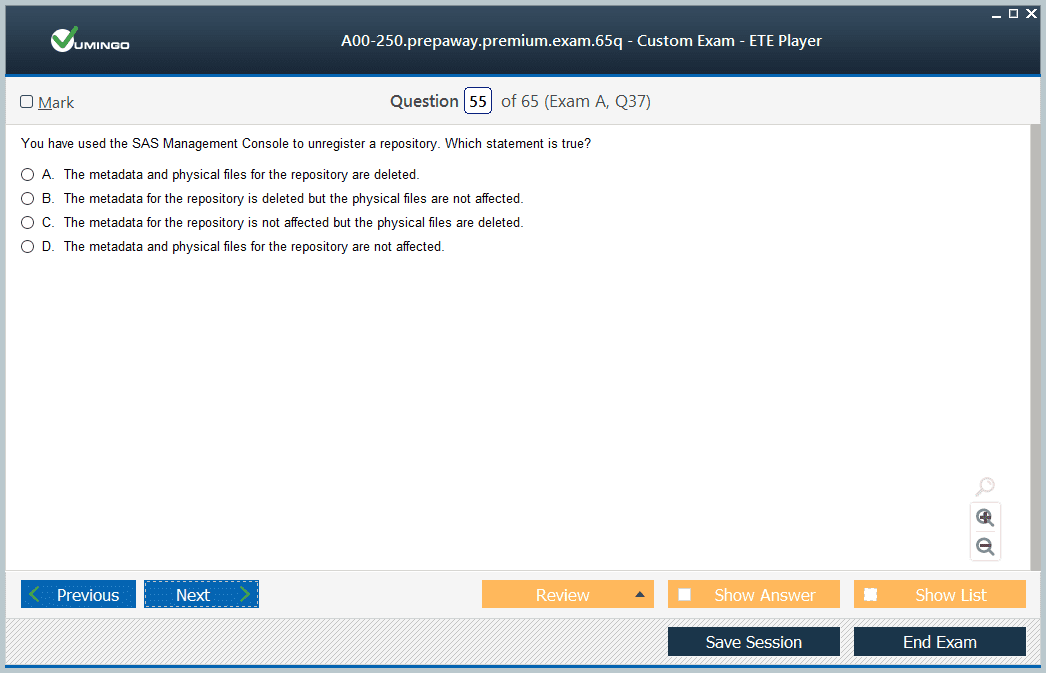
Last Week Results!
 83% students found the test questions almost same
All SAS Institute A00-250 certification exam dumps, study guide, training courses are Prepared by industry experts. PrepAway's ETE files povide the A00-250 SAS Platform Administration for SAS 9 practice test questions and answers & exam dumps, study guide and training courses help you study and pass hassle-free!
A00-250: SAS 9.4 Platform Administration in Practice
A00-250 is the current SAS Platform Administration for SAS 9 exam. SAS lists it against SAS 9.4 Maintenance 8 and tests management of the SAS environment, server monitoring and troubleshooting, backup, users, data access, metadata authorization, and the interaction between SAS servers and operating systems. Within the SAS certifications, this is an operations credential rather than a programming or statistical-analysis exam.
Platform administration is fundamentally about dependable service. Users need to authenticate, reach the right servers, access approved data, run workloads with predictable performance, and recover from failures. Administrators need enough understanding of SAS architecture to know which tier owns a problem and enough operating discipline to make changes without creating hidden security or availability risk.
The role intersects with programmers, analysts, and infrastructure teams. A programmer from the legacy SAS Base Programming path may understand libraries and jobs from the user side; the administrator must understand the server configuration, permissions, metadata, data connectivity, logs, scheduling, and resource controls that make those jobs work safely for many users at once.
A SAS platform should be understood as interacting services, not one server
SAS 9 deployments can include metadata, workspace, stored-process, object-spawner, web, mid-tier, and related services depending on the architecture. Troubleshooting begins by identifying which component receives the request, which credentials it uses, what dependency it calls next, and where the failure is recorded. Restarting everything may hide the symptom while destroying the evidence needed to find the root cause.
Administrators should know startup and shutdown dependencies, configuration locations, service accounts, network ports, and how the operating system influences the SAS process. A platform diagram with owners and dependencies is often more useful during an incident than a long list of commands.
Monitoring is useful only when baselines make abnormal behavior visible
Server status, process counts, memory pressure, CPU, disk space, job duration, connection failures, and queue behavior should be observed in context. The same principle described by monitoring baselines applies to SAS: a number becomes meaningful when the administrator knows what normal looks like for that time, workload, and environment.
Logs are the other half of the evidence model. Logs, metrics, traces, and useful alarms are most effective when they are collected consistently and tied to actionable thresholds. An alarm that fires constantly will be ignored; an alarm that appears only after users are already blocked is too late.
User administration is a lifecycle, not an account-creation task
Users join, change roles, move teams, gain temporary responsibilities, and leave. The administrator must map identities to SAS groups and permissions in a way that reflects business roles. Direct one-off grants can solve an urgent ticket but create a platform nobody can explain later. Group-based access and documented ownership make change easier to review.
The governance idea behind access reviews is directly applicable: permissions should be revisited after organizational change, not assumed to remain correct forever. Dormant accounts, inherited group membership, and service credentials can retain access long after the original need disappears.
Metadata authorization and host permissions must agree
SAS security can involve metadata permissions, operating-system accounts, file-system rights, database credentials, and external identity systems. A user may have metadata visibility but still fail because the underlying file or database access is denied. The reverse can also happen: host access may exist while metadata intentionally hides the resource.
Administrators should therefore apply least privilege across layers. Grant only the access necessary for the role, use groups where possible, control administrative identities, and document exceptions. Broad permissions make troubleshooting appear easier until an audit or accidental data exposure reveals the cost.
Data access problems should be traced from the SAS library to the source
Libraries can point to files, databases, and other data services, each with drivers, connection strings, credentials, schemas, and network dependencies. When a library fails, the administrator should test the chain systematically: name resolution, network path, driver availability, authentication, authorization, source status, and SAS configuration. Randomly changing credentials can obscure the real issue.
Connection design also affects scalability. Shared credentials, pooled connections, per-user authentication, and service accounts have different governance consequences. The appropriate model depends on audit requirements, source capabilities, workload, and whether row-level security or user attribution is required.
Backup is not complete until recovery has been rehearsed
SAS administration includes regular backup processes for configuration and metadata, but the broader warning in backups are not a disaster recovery plan applies directly. A backup proves that data was copied. Recovery requires documented dependencies, restore order, credentials, encryption keys, compatible infrastructure, and a tested procedure that meets recovery objectives.
Administrators should know which platform components must be captured together so restored state is consistent. They should also separate platform configuration backup from business data protection, since external databases and file systems may have independent recovery processes. Periodic restore tests provide more confidence than a green backup job.
Troubleshooting should narrow the fault domain before changing the system
A useful incident sequence starts with symptoms and scope. Is one user affected or everyone? One application server or the whole environment? One data source or all libraries? Did the problem begin after a deployment, certificate change, OS patch, password rotation, or workload spike? These questions reduce the search area and protect evidence.
Once the fault domain is smaller, logs and service health can test hypotheses. The administrator should record what changed and why, especially during urgent incidents. Multiple simultaneous changes may restore service but make the root cause impossible to identify, increasing the chance that the outage returns.
A00-250 remains current because SAS 9 platforms still need disciplined operations
Even as analytics platforms evolve, organizations continue to operate SAS 9 estates with production users and regulated data. The value described in SAS certification is strongest for administrators who can translate exam topics into reliable service: controlled access, observable systems, tested recovery, clear data connectivity, and repeatable change management.
Administrators should also understand what analytical teams are doing. Statistical work represented by A00-240 business analysis can create compute-intensive jobs and large data movements, while other SAS workloads may depend on scheduled batch windows. Capacity and operations decisions are better when they reflect real user patterns instead of generic server assumptions.
Administration maturity is measured by routine change as much as by incident response
A stable SAS platform changes continuously: operating systems are patched, certificates expire, service-account passwords rotate, database drivers are updated, users join and leave, storage fills, and analytical workloads evolve. Administrators should manage these changes through repeatable procedures with testing, communication, rollback, and evidence. The safest environment is not the one that never changes; it is the one where changes are predictable enough that the team can understand their effect and recover when an assumption is wrong.
Capacity planning is part of that routine. Historical CPU, memory, disk, job duration, concurrency, and data-growth trends can show when a platform is approaching a constraint before users experience failure. Administrators should distinguish temporary spikes from sustained growth and understand whether a bottleneck is compute, I/O, network, database response, or application configuration. Adding hardware without identifying the limiting resource can move the problem rather than solve it.
Automation can improve consistency but should not remove visibility. Repetitive checks, service operations, configuration validation, account provisioning, or backup verification are good candidates for automation when the scripts produce clear logs and fail safely. Automation that silently changes production settings can make troubleshooting harder than a manual process. Administrators need version control, peer review, controlled credentials, and a documented way to run or roll back automated actions.
Finally, platform health should be reported in service terms that users understand. Availability, failed-job rates, response time, backup success, restore-test results, capacity headroom, unresolved security findings, and recurring incidents provide a better picture than a simple statement that the servers are running. A00-250 tests specific administration topics, but the professional outcome is broader: operate a SAS 9 environment so analytical teams can rely on it without needing to understand every infrastructure detail themselves.
Change records should connect technical actions to business impact. If an administrator modifies a library definition, updates a database driver, or changes a metadata permission, the record should identify affected services, validation steps, rollback, and the users or jobs that depend on it. This makes peer review more meaningful and provides a timeline when an incident appears hours or days after a change rather than immediately.
The platform team should also rehearse loss of key personnel or credentials. Shared operational knowledge, protected break-glass access, documented service accounts, and recovery of configuration repositories reduce dependency on one administrator. Resilience is organizational as well as technical. A SAS environment is safer when another qualified person can diagnose, restore, and operate it using maintained procedures instead of relying on undocumented memory.
Security patching and dependency maintenance should be planned around the same service principles. Administrators need an inventory of SAS components, Java or web tiers where applicable, drivers, certificates, and operating-system dependencies so they can assess vendor advisories and test updates. Deferring every patch because the platform is critical increases accumulated risk; applying updates without a rehearsal can create outages. A maintained test environment and defined validation suite make security maintenance predictable rather than exceptional.
SAS Institute A00-250 practice test questions and answers, training course, study guide are uploaded in ETE Files format by real users. Study and Pass A00-250 SAS Platform Administration for SAS 9 certification exam dumps & practice test questions and answers are to help students.
Exam Comments * The most recent comment are on top
Why customers love us?
What do our customers say?
The resources provided for the SAS Institute certification exam were exceptional. The exam dumps and video courses offered clear and concise explanations of each topic. I felt thoroughly prepared for the A00-250 test and passed with ease.
Studying for the SAS Institute certification exam was a breeze with the comprehensive materials from this site. The detailed study guides and accurate exam dumps helped me understand every concept. I aced the A00-250 exam on my first try!
I was impressed with the quality of the A00-250 preparation materials for the SAS Institute certification exam. The video courses were engaging, and the study guides covered all the essential topics. These resources made a significant difference in my study routine and overall performance. I went into the exam feeling confident and well-prepared.
The A00-250 materials for the SAS Institute certification exam were invaluable. They provided detailed, concise explanations for each topic, helping me grasp the entire syllabus. After studying with these resources, I was able to tackle the final test questions confidently and successfully.
Thanks to the comprehensive study guides and video courses, I aced the A00-250 exam. The exam dumps were spot on and helped me understand the types of questions to expect. The certification exam was much less intimidating thanks to their excellent prep materials. So, I highly recommend their services for anyone preparing for this certification exam.
Achieving my SAS Institute certification was a seamless experience. The detailed study guide and practice questions ensured I was fully prepared for A00-250. The customer support was responsive and helpful throughout my journey. Highly recommend their services for anyone preparing for their certification test.
I couldn't be happier with my certification results! The study materials were comprehensive and easy to understand, making my preparation for the A00-250 stress-free. Using these resources, I was able to pass my exam on the first attempt. They are a must-have for anyone serious about advancing their career.
The practice exams were incredibly helpful in familiarizing me with the actual test format. I felt confident and well-prepared going into my A00-250 certification exam. The support and guidance provided were top-notch. I couldn't have obtained my SAS Institute certification without these amazing tools!
The materials provided for the A00-250 were comprehensive and very well-structured. The practice tests were particularly useful in building my confidence and understanding the exam format. After using these materials, I felt well-prepared and was able to solve all the questions on the final test with ease. Passing the certification exam was a huge relief! I feel much more competent in my role. Thank you!
The certification prep was excellent. The content was up-to-date and aligned perfectly with the exam requirements. I appreciated the clear explanations and real-world examples that made complex topics easier to grasp. I passed A00-250 successfully. It was a game-changer for my career in IT!


