
- Home
- DSCI Certifications
- DCPP-01 DSCI certified Privacy Professional Dumps
Pass DSCI DCPP-01 Exam in First Attempt Guaranteed!
Get 100% Latest Exam Questions, Accurate & Verified Answers to Pass the Actual Exam!
30 Days Free Updates, Instant Download!


DCPP-01 Premium File
- Premium File 165 Questions & Answers. Last Update: Oct 30, 2026
Whats Included:
- Latest Questions
- 100% Accurate Answers
- Fast Exam Updates
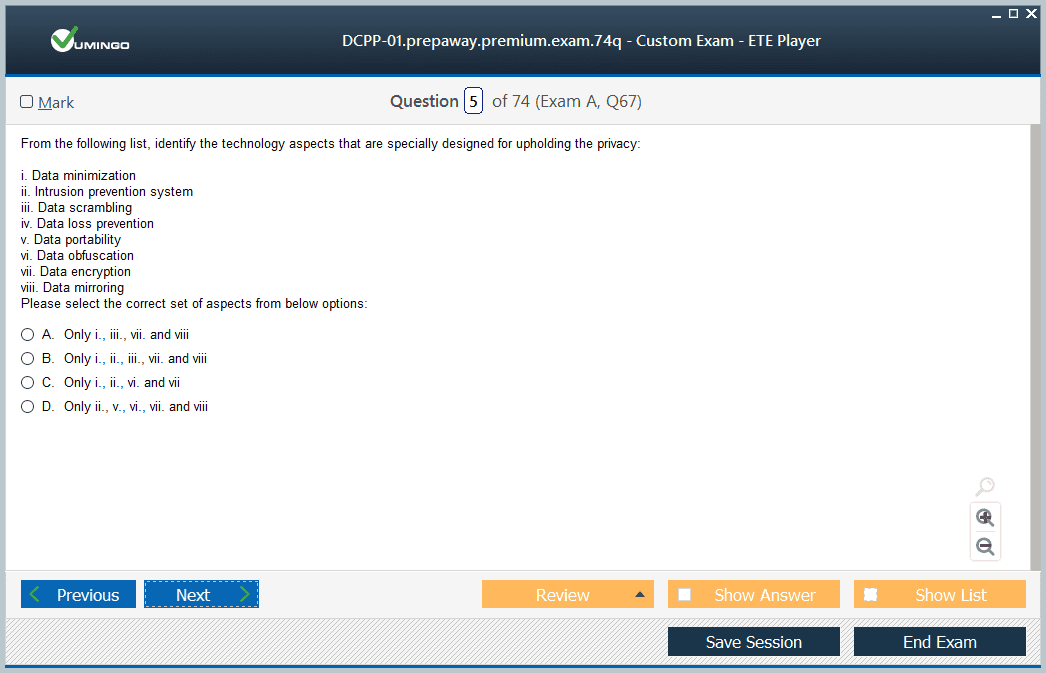
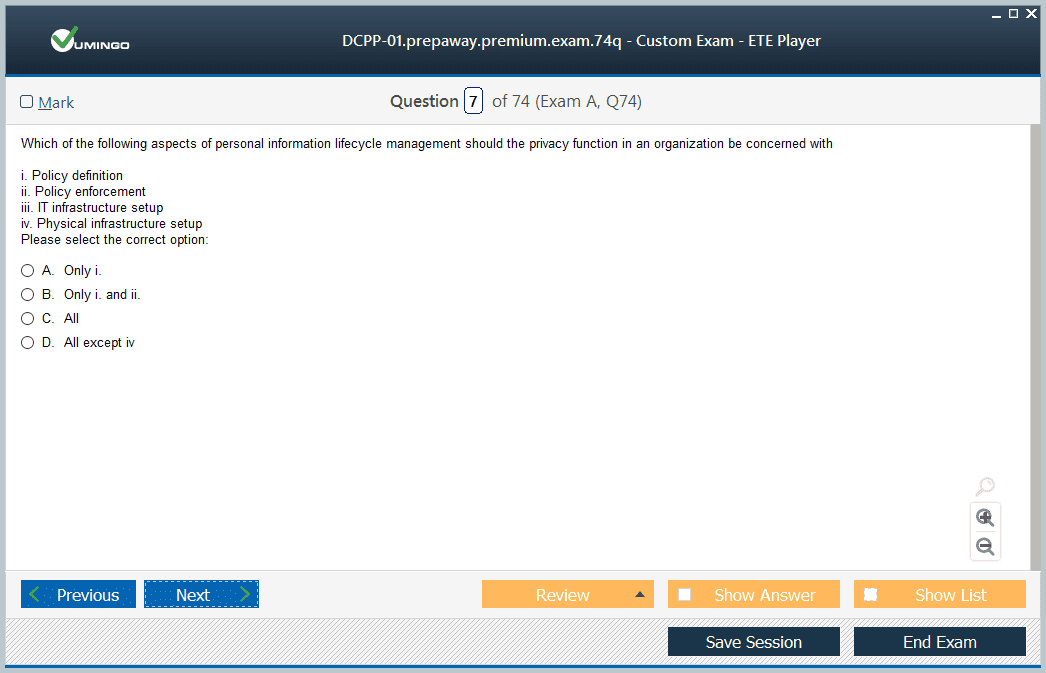
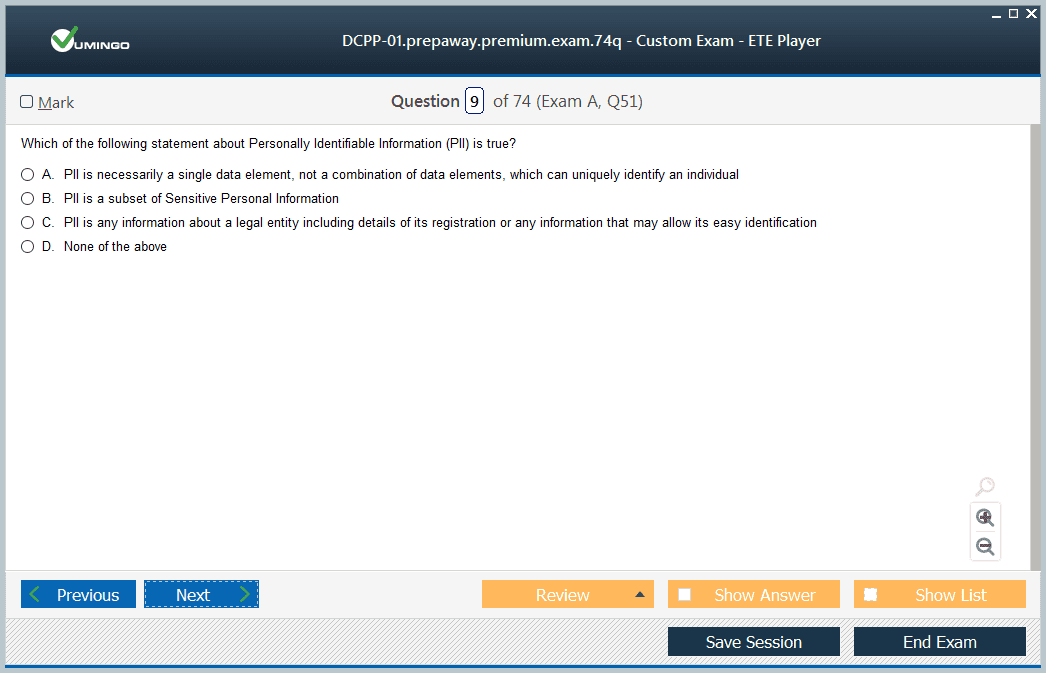
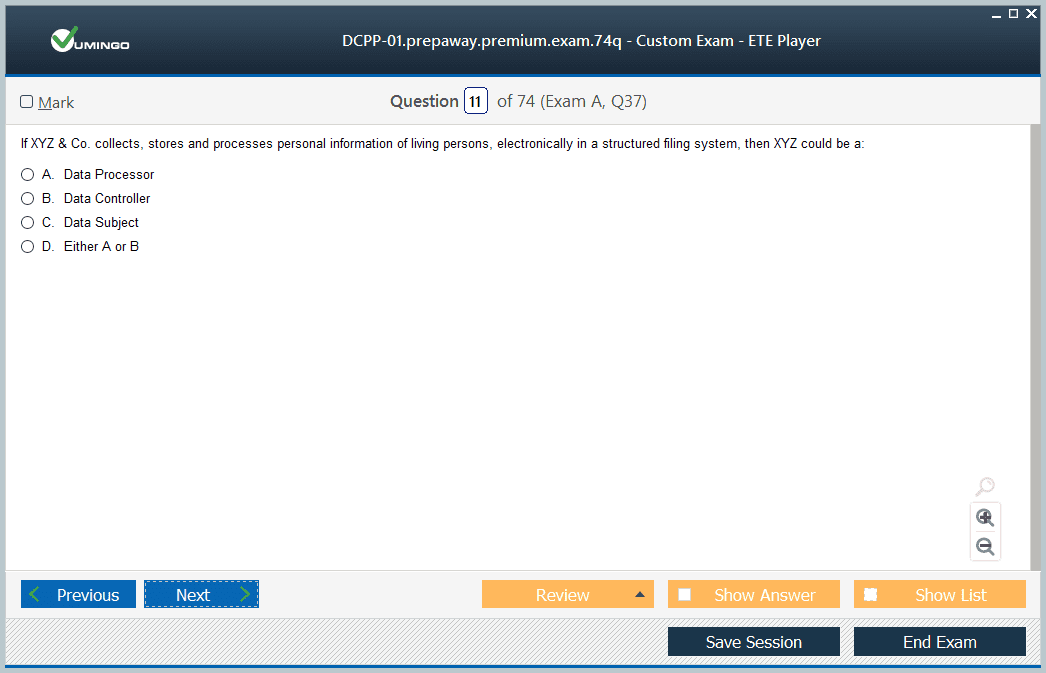
Last Week Results!
 83% students found the test questions almost same
DSCI Certified Privacy Professional (DCPP): Privacy Principles, Regulation, Technology, and Professional Practice
DCPP is the Data Security Council of India (DSCI) Certified Privacy Professional credential. DSCI and Pearson VUE publicly emphasize the DCPP credential name rather than DCPP-01 as a registration code. DSCI continues to offer the certification, and its current program material describes it as an industry credential for professionals entering or working in privacy.
DCPP is broader than an assessor-only program. DSCI describes the content as covering privacy concepts, laws and regulations, privacy principles, tools and technologies, and privacy in the organizational ecosystem. Current DSCI guidance says the assessment uses multiple-choice questions covering core concepts, practical applications, and case studies, and that the certification is awarded for three years after successful completion.
DCPLA provides a useful contrast between broad privacy-professional knowledge and organizational lead-assessor practice. DSCI states that neither certification is a formal prerequisite for the other. For privacy-management context, ISO 27701 can deepen discussion of structured privacy governance without being presented as equivalent to DCPP.
Privacy principles provide the reasoning framework behind specific legal rules
Privacy laws differ across jurisdictions, but many rely on recurring ideas: transparency, purpose limitation, data minimization, accuracy, retention control, security, individual rights, and accountability. A privacy professional should understand the rationale behind these principles so they can apply them when a scenario does not map neatly to memorized wording.
Principles can conflict in practice. A business may want more data for personalization, while minimization pushes toward collecting only what is necessary. Security teams may want long log retention, while privacy requirements may demand defined retention limits. Professional judgment requires documenting the purpose, risk, and legal basis for the chosen balance.
Case studies are useful because they expose these tensions. Instead of asking only “what does the rule say?â€, ask who the individuals are, what data is involved, why it is processed, who receives it, how long it persists, and what harm could occur if the processing is unexpected or insecure.
Regulatory literacy means understanding scope, obligations, and organizational impact
Privacy professionals need a method for reading laws and regulatory guidance. Identify territorial and material scope, key definitions, roles of parties, rights, lawful conditions, notice requirements, security expectations, breach obligations, cross-border rules, retention implications, and enforcement mechanisms.
The goal is not to become legal counsel by memorizing statutes. It is to recognize when a business activity creates a privacy question and to gather the facts that legal or compliance teams need. A professional who can describe the data flow and processing purpose clearly makes regulatory analysis much more effective.
Regulatory change management is equally important. Organizations should track relevant developments, assess impact, assign owners, update controls, and preserve evidence that the change was implemented. A law-update newsletter has little value if it never changes operations.
Notices, consent, and individual rights depend on accurate data-process knowledge
Privacy notices should reflect what the organization actually does with personal information. If the underlying inventory is incomplete, notices can become generic or misleading. Professionals should work with product, marketing, HR, security, and operations teams to keep descriptions aligned with real processing.
Consent is appropriate only in contexts where it is a valid and usable choice under the applicable rules. It should not be treated as a universal answer to every processing activity. Where consent is used, the organization needs evidence of what the person agreed to and a practical way to withdraw or update the choice.
Rights requests such as access, correction, deletion, objection, or portability can require coordination across many systems. A mature process authenticates the requester, locates relevant data, applies exceptions correctly, tracks deadlines, and preserves an audit trail.
Privacy engineering turns policy into requirements for systems and products
Privacy cannot live only in legal documents. Product and engineering teams need concrete requirements: data minimization, field-level access, retention logic, encryption, consent state, auditability, export or deletion workflows, and safe defaults. These controls are easier to build during design than to retrofit later.
Privacy by design means asking questions early in the lifecycle: Does the feature need this data? Can identifiers be separated or pseudonymized? Who should access it? How will it be deleted? What happens when a user changes a preference? What new risks are introduced by analytics or machine learning?
Technical controls should be testable. A retention policy is stronger when a system can demonstrate deletion events than when a document merely states a period. Privacy professionals need enough technology fluency to ask for that evidence.
Security is necessary for privacy but does not define privacy by itself
Encryption, access control, vulnerability management, monitoring, and incident response protect personal information from unauthorized use or disclosure. These controls are critical, but a perfectly secure system can still create a privacy problem if it collects excessive data or uses information for an unexpected purpose.
Privacy professionals should therefore collaborate closely with security teams while keeping the broader processing context visible. Security answers “can unauthorized parties get the data?â€; privacy also asks “should the organization have it, use it this way, keep it this long, or share it with this recipient?â€
Incident response similarly needs both perspectives. A security event may become a privacy incident depending on the data involved, affected individuals, likely consequences, jurisdiction, and contractual obligations.
Third-party and cross-border processing requires lifecycle governance
Organizations often rely on processors, cloud providers, analytics services, payment companies, marketing platforms, and professional advisers. Privacy professionals should understand what each third party receives, the purpose of processing, where the data is handled, which subprocessors are involved, and what happens when the relationship ends.
Due diligence and contract terms are starting points, not the whole control. Vendor risk can change as services evolve, incidents occur, or data use expands. High-risk relationships need periodic review and a process for material changes.
Cross-border transfers add legal and operational complexity. The appropriate mechanism depends on applicable law and organizational circumstances, so professionals should be prepared to gather data-location facts and escalate legal questions rather than relying on generic assumptions.
Governance and metrics show whether privacy works across the organization
An effective privacy program defines accountable leadership, operational owners, escalation paths, risk assessment methods, policy management, training, monitoring, and reporting. The structure should fit the organization’s size and data risk rather than copying a diagram from another company.
Metrics should connect activity to outcomes. Training completion is useful, but incident trends, rights-response timeliness, overdue retention actions, vendor-review coverage, privacy-review findings, and remediation closure can reveal whether controls are effective.
Governance also requires documented exceptions. Business teams sometimes need temporary deviations, but the rationale, risk acceptance, compensating controls, owner, and expiration date should be explicit. Permanent undocumented exceptions undermine both accountability and assessment.
DCPP preparation should combine conceptual breadth with scenario reasoning
Because privacy spans law, technology, risk, operations, and individual expectations, study should connect the domains rather than isolate them. Work through scenarios involving marketing consent, employee monitoring, cloud processing, a rights request, a supplier breach, data retention, and a new analytics use case.
For each scenario, identify the personal information, individuals, purpose, parties, legal or policy questions, security risks, rights impact, required evidence, and likely stakeholders. This method is more durable than memorizing isolated definitions because it mirrors how privacy professionals work.
Candidates should also verify current DSCI assessment logistics directly before scheduling. Public certification pages can change fees, training dates, or operational details, while the underlying privacy knowledge remains broader and more stable.
DCPP is particularly valuable when it helps professionals become translators between legal, technical, and business teams. A privacy issue often stalls because each group uses different language. The professional’s job is to convert an abstract requirement into a clear process or system change and then confirm that the change actually happened.
Good privacy practice also depends on proportionate judgment. Not every dataset or activity has the same risk. Prioritize controls where sensitivity, scale, vulnerability of individuals, novel technology, or irreversible consequences make failure more harmful.
Privacy impact assessments are a practical bridge between principles and project delivery. A good assessment describes the proposed processing, necessity, data categories, individuals affected, systems and recipients, risks, safeguards, open decisions, and accountable owners. It should influence design before launch rather than become a form completed after the important choices are fixed.
Retention is one of the most operationally difficult privacy topics because data is copied into backups, analytics platforms, documents, logs, and third-party services. Retention schedules should be linked to systems and deletion mechanisms, and exceptions such as legal holds should be controlled. A policy period without technical execution does not reduce the real data footprint.
Breach response requires speed and disciplined fact gathering. Teams need to know what happened, which personal information was affected, how many individuals may be involved, the likely consequences, whether the exposure continues, which jurisdictions apply, and what containment is underway. Privacy professionals help translate technical incident facts into impact and notification decisions.
Artificial intelligence and automated decision systems create privacy questions about data provenance, purpose, transparency, bias, human oversight, retention, and the ability to honor rights. Professionals should ask what data trains or prompts the system, whether sensitive attributes are involved, how outputs affect people, and which controls verify that the use remains within the approved purpose.
Privacy culture is strengthened when product, HR, marketing, procurement, and security teams know when to involve specialists. Short role-specific guidance and clear escalation channels are often more effective than one generic annual course. DCPP knowledge becomes valuable when it helps colleagues recognize a privacy decision before a problem is embedded in a system.
Professional credibility depends on knowing the boundary of one’s role. A privacy professional can identify issues, gather facts, recommend controls, and coordinate stakeholders, but should escalate jurisdiction-specific legal interpretation to qualified counsel when required. Sound privacy work combines confidence in the process with humility about specialized legal questions.
Why customers love us?
What do our customers say?
The resources provided for the DSCI certification exam were exceptional. The exam dumps and video courses offered clear and concise explanations of each topic. I felt thoroughly prepared for the DCPP-01 test and passed with ease.
Studying for the DSCI certification exam was a breeze with the comprehensive materials from this site. The detailed study guides and accurate exam dumps helped me understand every concept. I aced the DCPP-01 exam on my first try!
I was impressed with the quality of the DCPP-01 preparation materials for the DSCI certification exam. The video courses were engaging, and the study guides covered all the essential topics. These resources made a significant difference in my study routine and overall performance. I went into the exam feeling confident and well-prepared.
The DCPP-01 materials for the DSCI certification exam were invaluable. They provided detailed, concise explanations for each topic, helping me grasp the entire syllabus. After studying with these resources, I was able to tackle the final test questions confidently and successfully.
Thanks to the comprehensive study guides and video courses, I aced the DCPP-01 exam. The exam dumps were spot on and helped me understand the types of questions to expect. The certification exam was much less intimidating thanks to their excellent prep materials. So, I highly recommend their services for anyone preparing for this certification exam.
Achieving my DSCI certification was a seamless experience. The detailed study guide and practice questions ensured I was fully prepared for DCPP-01. The customer support was responsive and helpful throughout my journey. Highly recommend their services for anyone preparing for their certification test.
I couldn't be happier with my certification results! The study materials were comprehensive and easy to understand, making my preparation for the DCPP-01 stress-free. Using these resources, I was able to pass my exam on the first attempt. They are a must-have for anyone serious about advancing their career.
The practice exams were incredibly helpful in familiarizing me with the actual test format. I felt confident and well-prepared going into my DCPP-01 certification exam. The support and guidance provided were top-notch. I couldn't have obtained my DSCI certification without these amazing tools!
The materials provided for the DCPP-01 were comprehensive and very well-structured. The practice tests were particularly useful in building my confidence and understanding the exam format. After using these materials, I felt well-prepared and was able to solve all the questions on the final test with ease. Passing the certification exam was a huge relief! I feel much more competent in my role. Thank you!
The certification prep was excellent. The content was up-to-date and aligned perfectly with the exam requirements. I appreciated the clear explanations and real-world examples that made complex topics easier to grasp. I passed DCPP-01 successfully. It was a game-changer for my career in IT!


