CPA Practice Test

CPA Test Premium Bundle
- Premium File 1241 Questions & Answers. Last update: Sep 27, 2026
- Training Course 45 Video Lectures
- Study Guide 3213 Pages
CPA Test Premium Bundle
- Premium File 1241 Questions & Answers
Last update: Sep 27, 2026 - Training Course 45 Video Lectures
- Study Guide 3213 Pages
Purchase Individually

Premium File
Training Course
Study Guide
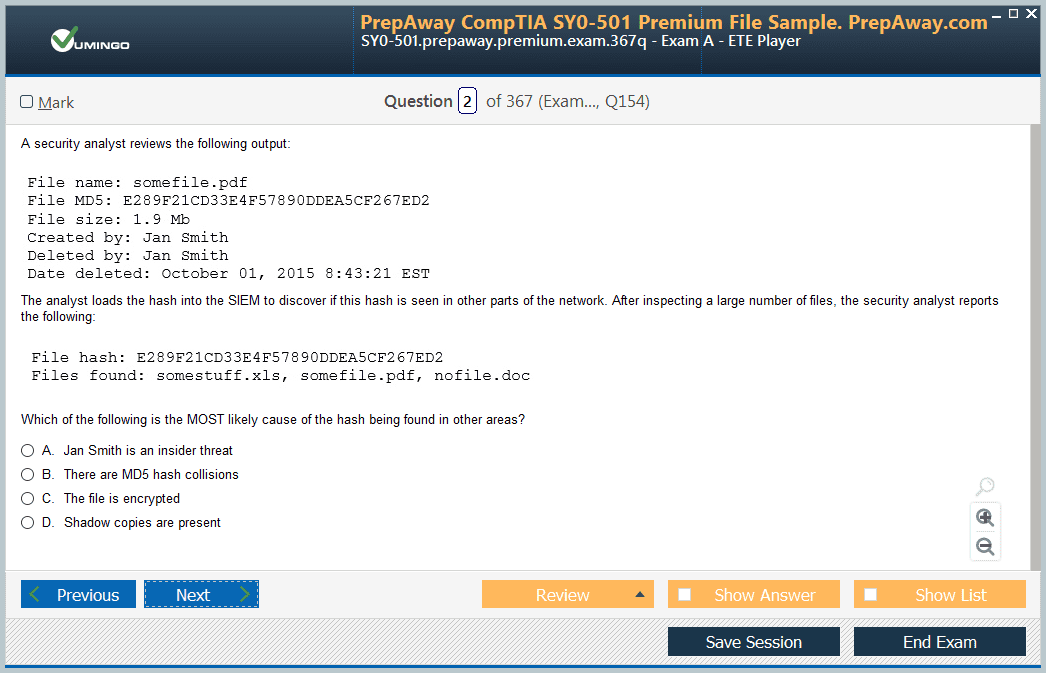
Test Prep CPA Course Practice Test Questions and Answers, Test Prep CPA Course Exam Dumps
All Test Prep CPA certification exam dumps, study guide, training courses are prepared by industry experts. Test Prep CPA certification practice test questions and answers, exam dumps, study guide and training courses help candidates to study and pass hassle-free!
CPA certification practice test questions and answers, training course, study guide are uploaded in ETE files format by real users. Study and pass Test Prep CPA certification exam dumps & practice test questions and answers are the best available resource to help students pass at the first attempt.
CPA Test Exam - Certified Public Accountant Test: Auditing and Attestation, Business Environment and Concepts, Financial Accounting and Reporting, Regulation
| Download Free CPA Test Exam Questions |
|---|
Test Prep CPA Certification Practice Test Questions and Answers, Test Prep CPA Certification Exam Dumps
All Test Prep CPA certification exam dumps, study guide, training courses are prepared by industry experts. Test Prep CPA certification practice test questions and answers, exam dumps, study guide and training courses help candidates to study and pass hassle-free!
CPA Exam: Core Knowledge, Discipline Choice, and Applied Accounting Judgment
The Uniform CPA Examination is one component of the U.S. CPA licensure process and is administered within a system involving the 55 licensing jurisdictions, NASBA, the AICPA, and Prometric. Because eligibility and licensure requirements are set at the jurisdiction level, candidates should use the current requirements of the board through which they apply rather than assuming one education or experience rule applies everywhere. PrepAway’s CPA test can support exam-focused review, but jurisdiction policy remains the authority for application and licensure.
The current exam follows the Core plus Discipline model. Candidates take all three Core sections—Auditing and Attestation, Financial Accounting and Reporting, and Taxation and Regulation—and choose one Discipline: Business Analysis and Reporting, Information Systems and Controls, or Tax Compliance and Planning. Regardless of Discipline, successful completion contributes to the same CPA license; the Discipline does not restrict the license to a specialty.
Four Sections Add Up to Sixteen Hours
The exam consists of four four-hour sections for 16 hours of testing in total. Candidates sit one section at a time rather than taking a single 16-hour event. That structure allows a study schedule to concentrate on one section, but it also requires careful credit-window planning under the rules of the applicable jurisdiction.
The broader AICPA certifications provides useful context for accounting credentials, but the Uniform CPA Examination has its own blueprints and administration rules. Candidates should always match their materials to the current CPA Exam year because eligible accounting standards, tax law, and blueprint emphases can change.
The Three Core Sections Test Shared Entry-Level Competence
AUD focuses on auditing and attestation, including professional responsibilities, risk assessment, evidence, conclusions, and reporting. FAR covers financial accounting and reporting for business entities as well as governmental and not-for-profit topics identified in the current blueprint. REG addresses federal taxation, business law, ethics, and professional responsibilities.
These Core sections are intended to assess knowledge that newly licensed CPAs need regardless of later specialization. A candidate’s professional background can create uneven starting points. Someone in tax may move quickly through parts of REG but need more deliberate FAR review; an audit associate may have the opposite profile. Diagnostics should therefore precede rigid calendars.
Choose BAR, ISC, or TCP for the Discipline Section
BAR extends into business analysis, technical accounting, reporting, data and performance considerations. ISC emphasizes information systems, controls, technology-related assurance, data management, security, privacy, and SOC-related work. TCP concentrates on tax compliance and planning for individuals and entities at a more advanced level than REG.
Choose based on knowledge, work exposure, and the type of material you can sustain for a full study cycle. Pass-rate tables can be informative about populations but do not determine an individual’s best choice, particularly because candidates self-select into Disciplines. A better decision compares the blueprint with your actual experience and interests.
Every Section Uses MCQ and Task-Based Simulation Testlets
The current CPA Exam uses five testlets per section. The first two contain multiple-choice questions; the final three contain task-based simulations. AICPA’s 2026 blueprint information lists different item counts by section. For example, AUD uses 39 MCQs in each of its first two testlets and seven TBSs across the final three; FAR uses 25 plus 25 MCQs and seven TBSs; REG uses 36 plus 36 MCQs and eight TBSs.
Discipline counts also vary. BAR uses 25 plus 25 MCQs and seven TBSs, ISC uses 41 plus 41 MCQs and six TBSs, and TCP uses 34 plus 34 MCQs and eight TBSs. The counts matter for pacing, but the deeper point is that every section requires both recognition and applied work.
Task-Based Simulations Demand Document and Data Judgment
A TBS can present exhibits, source documents, tables, communications, accounting records, or other evidence and ask the candidate to complete an analysis. This is closer to workpaper reasoning than a conventional multiple-choice item. Candidates need to decide which documents matter, identify conflicting or incomplete information, and enter results accurately.
Practice simulations early enough to develop a repeatable workflow: read the requirement, inventory the exhibits, identify the controlling rule or objective, calculate or reconcile, and review for incomplete cells. Waiting until the final week to learn the simulation interface leaves too much execution risk.
A 75 Is a Scaled Passing Score, Not 75 Percent Correct
AICPA reports CPA Exam section scores on a 0–99 scale and requires a minimum reported score of 75 to pass. The organization explicitly notes that 75 is not a percentage correct. Scores combine scaled performance on MCQs and TBSs and account for factors such as item difficulty rather than using a simple raw percentage.
For most sections, MCQs and TBSs each contribute 50 percent of the score. ISC is the exception under the current model, with MCQs weighted 60 percent and TBSs 40 percent. That distribution is another reason not to prepare only by drilling multiple-choice questions.
Use the Current Blueprints as the Study Contract
The AICPA blueprints organize each section by content area, group, topic, skill level, task statements, item types, and score weights. They are the best boundary for deciding whether a study resource is current and sufficiently complete. When a review course adds detail, map it back to a blueprint task so the extra work has a clear purpose.
Pay attention to the policy for new pronouncements and law changes. Accounting, auditing, tax, and legal changes do not necessarily become testable immediately on publication. The AICPA has timing rules for when new material becomes eligible for testing, which helps candidates avoid learning a change under the wrong exam-effective date.
Administration and Licensure Rules Must Be Checked Locally
NASBA’s candidate guidance emphasizes that a candidate must be declared eligible by a U.S. jurisdiction and that boards set education, examination, and experience requirements. Testing can often occur outside the jurisdiction through the Prometric network, but sitting elsewhere does not allow a candidate to bypass the board’s eligibility or licensing rules.
Before scheduling, verify the Notice to Schedule or equivalent authorization, name and identification requirements, credit-expiration rules, retake rules, and the board’s current licensure pathway. Treat those administrative checks as part of preparation. The best content knowledge cannot compensate for an expired authorization or a misunderstanding about jurisdiction requirements.
Build Section Readiness Around Application, Not Page Counts
Measure progress with mixed MCQs, simulations, and explanation. For a missed MCQ, state the rule and why the distractor was tempting. For a simulation, identify whether the failure came from accounting knowledge, exhibit navigation, calculation, or data entry. Those categories point directly to the next study action.
Full timed practice should eventually reproduce the four-hour cognitive load of the real section. The objective is to finish with enough time to review without rushing the final simulations. A candidate is ready when performance is stable across blueprint areas and item types, not simply when a video course has been completed.
Section sequencing can be strategic, but there is no universal best order. Some candidates begin with their strongest Core section to build momentum; others start with FAR because its accounting foundation supports later material. The right sequence should account for work experience, busy-season constraints, jurisdiction credit rules, and the availability windows for Discipline sections. Put the sequence in writing so that one reschedule does not unravel the entire plan.
For simulations, document review deserves its own practice. Open exhibits with a question in mind rather than reading every document linearly. Label what each exhibit can prove, reconcile inconsistent figures, and note whether the requirement asks for an entry, adjustment, classification, conclusion, or explanation. This reduces the time lost reopening the same source repeatedly.
Tax candidates should be especially careful about effective dates. A rule that is current in professional practice may not yet be eligible for testing under AICPA’s new-pronouncement policy, while an older rule may have just been removed from the exam. Use a review course only if it clearly identifies the blueprint effective date and updates tax-law changes on the schedule used by the exam.
Professional skepticism is a useful cross-section habit. In AUD it is explicit, but similar care helps in FAR, REG, and the Disciplines: do not accept a figure or representation before considering whether it is supported, complete, classified correctly, and consistent with the requirement. Simulations are designed to reward careful evaluation of evidence.
Memorization tools are most effective for compact rules, thresholds, and definitions. They are less effective for multi-step accounting treatments, tax applications, and audit judgments that depend on facts. For those, build short scenario cards: facts on one side, required treatment and reasoning on the other. This preserves application rather than reducing everything to isolated facts.
Build a final administrative checklist alongside the content checklist. Confirm the legal name on the testing appointment, acceptable identification, Prometric location and arrival rules, what materials are permitted, and the board’s current credit conditions. Candidates often focus so heavily on technical material that these small but consequential details are left to the last day.
One last readiness test is whether you can explain a missed question in professional language without leaning on the answer key. If you can state the governing rule, apply it to the facts, and show why the alternative treatment fails, the knowledge is far more likely to transfer to a new simulation or multiple-choice scenario.
CPA certification practice test questions and answers, training course, study guide are uploaded in ETE files format by real users. Study and pass Test Prep CPA certification exam dumps & practice test questions and answers are the best available resource to help students pass at the first attempt.