
- Home
- CyberArk Certifications
- CAU302 CyberArk Defender + Sentry Dumps
Pass CyberArk CAU302 Exam in First Attempt Guaranteed!
Get 100% Latest Exam Questions, Accurate & Verified Answers to Pass the Actual Exam!
30 Days Free Updates, Instant Download!


CAU302 Premium File
- Premium File 227 Questions & Answers. Last Update: Sep 27, 2026
Whats Included:
- Latest Questions
- 100% Accurate Answers
- Fast Exam Updates
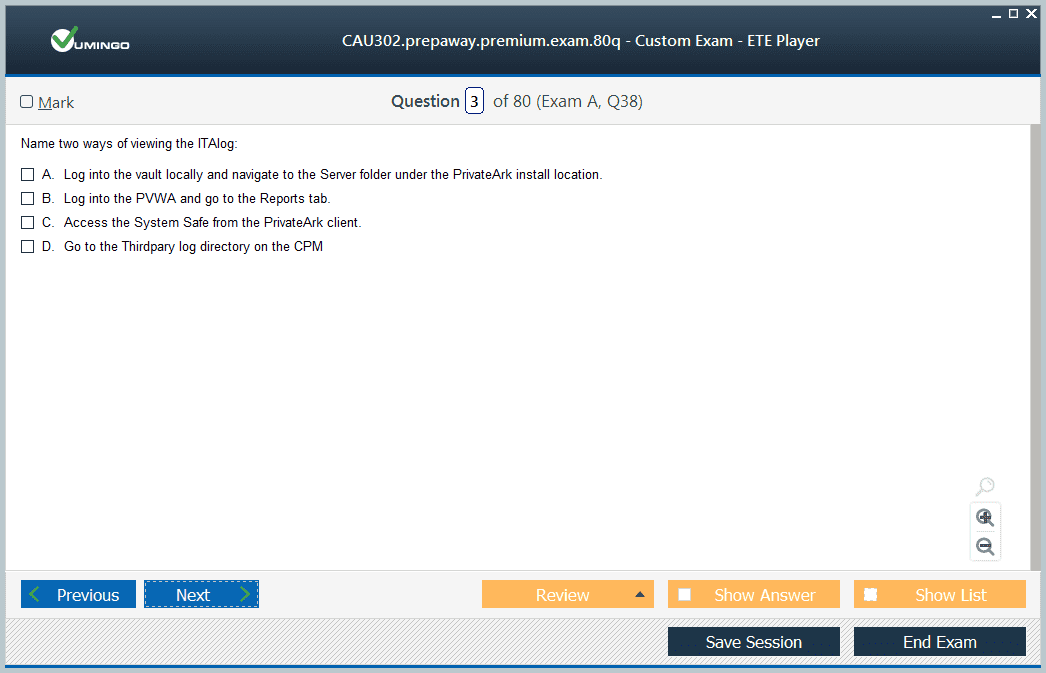
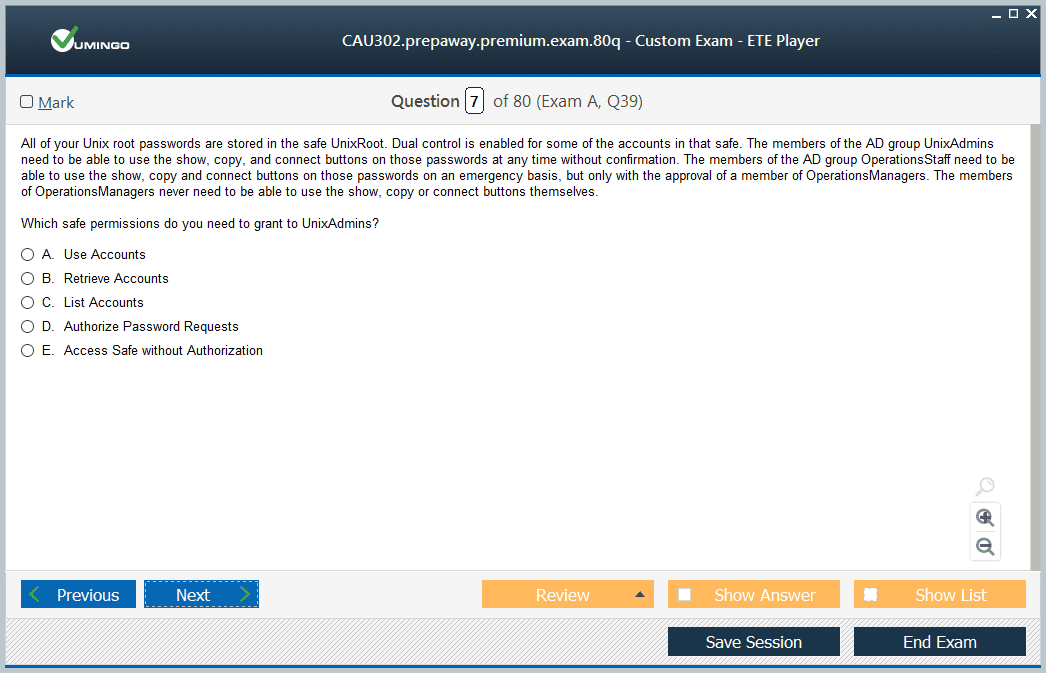
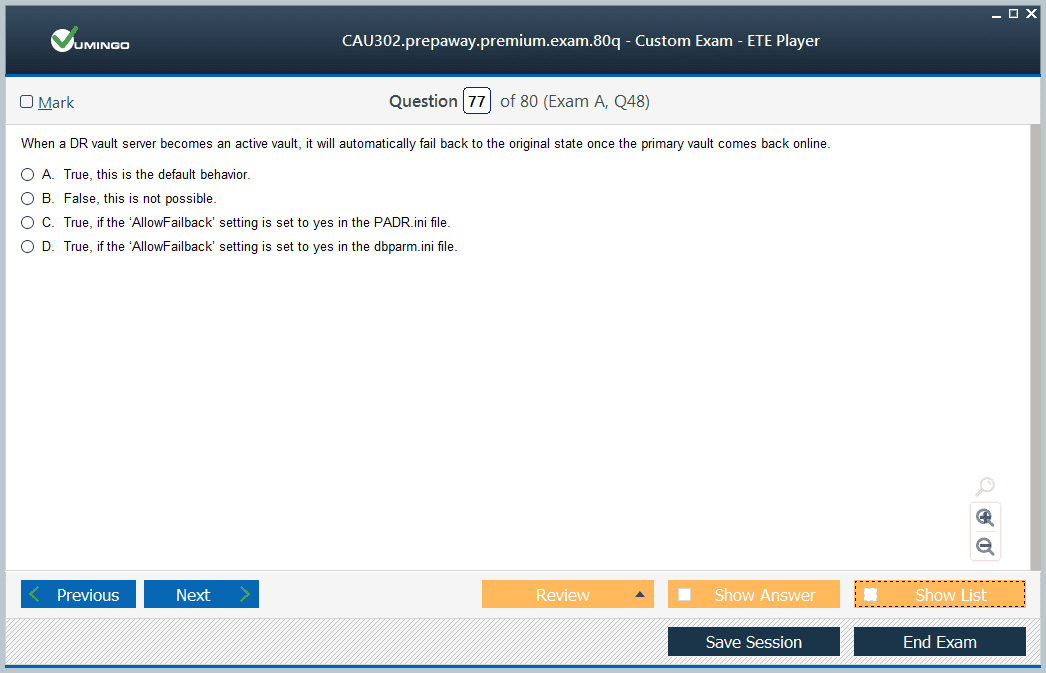
Last Week Results!
 83% students found the test questions almost same
All CyberArk CAU302 certification exam dumps, study guide, training courses are Prepared by industry experts. PrepAway's ETE files povide the CAU302 CyberArk Defender + Sentry practice test questions and answers & exam dumps, study guide and training courses help you study and pass hassle-free!
CAU302: Legacy CyberArk Defender + Sentry and the Modern Certification Split
CAU302 is a legacy CyberArk exam historically described as a combined Defender + Sentry credential. It does not appear in CyberArk’s current official Pearson VUE certification catalog. The modern program separates operational administration from deployment/configuration and further divides both levels by solution area. Candidates should treat CAU302 as a historical bridge, not as evidence of a currently schedulable combined exam.
The current CyberArk certifications make the split explicit. Defender covers day-to-day operations for Identity/Access, Endpoint Privilege Manager, and Privileged Access Management, while Sentry covers implementation tracks such as PAM, Privilege Cloud/modern PAM, and Secrets Manager. The older CAU201 and CAU301 material represents the historical sides of that combined model.
CAU302 remains useful for understanding why administration and implementation knowledge reinforce each other. A deployment engineer who does not understand operations may build something difficult to support; an administrator who does not understand architecture may struggle to diagnose failures. Current certifications narrow the exam scope, but strong CyberArk professionals still benefit from seeing both perspectives.
Defender and Sentry represent different phases of the same service lifecycle
Sentry work begins with requirements, architecture, installation, integration, configuration, and handoff. Defender work continues with onboarding, policy administration, monitoring, support, maintenance, and incident response. A reliable privileged-access service depends on both. The distinction helps organizations assign responsibilities and helps candidates choose the certification that matches their primary work.
Use a lifecycle diagram from design through retirement. Mark which tasks belong mainly to implementation, which belong to operations, and where responsibility overlaps. Certificate planning starts during implementation but renewal happens in operations. Backup architecture is designed by implementers but restore testing is an operational responsibility. Platform policies are configured during rollout but tuned as real systems are onboarded.
This lifecycle view is more useful than treating the old combined exam as a list of unrelated product facts. It explains how one design decision creates downstream operational work.
Clear responsibility boundaries prevent gaps between those phases. A RACI-style ownership model can identify who designs a platform, who approves it, who onboards accounts, who responds to failed rotations, who renews certificates, and who validates recovery. Without explicit ownership, implementation teams may assume operations will complete a task while operations assumes it was delivered as part of the build. The combined historical perspective is useful precisely because it exposes these handoff risks.
Architecture knowledge makes daily troubleshooting faster and safer
Administrators need to know how requests travel through the system: user authentication, portal access, Safe authorization, password retrieval or rotation, session brokering, target connectivity, and logging. Without that map, a failure often leads to random service restarts or permission changes. With it, the administrator can identify the component responsible for the last successful stage.
Implementation engineers should likewise understand which telemetry operations will need after go-live. Configure health monitoring, centralized logs, clear component names, time synchronization, certificate ownership, and meaningful alerts during the build. Troubleshooting capability is part of architecture because observability cannot always be bolted on later without disruption.
Practice fault scenarios that cross the boundary: a directory outage, expired certificate, target password mismatch, session connector failure, load-balancer misroute, or backup restore. Explain both the architectural cause and the operational recovery.
Capacity is another bridge between design and operations. Session concurrency, account growth, password-change workload, log volume, recording storage, connector placement, and backup windows all evolve after go-live. Architects should establish sizing assumptions and monitoring thresholds; operators should compare real growth with those assumptions and trigger review before saturation becomes an incident. Capacity planning is therefore a recurring control, not a calculation performed once during installation.
Privileged account lifecycle connects security policy to system behavior
Accounts move through discovery, onboarding, ownership assignment, platform association, rotation, use, review, reconciliation, and retirement. The implementation side creates platforms, connectivity, and policies that support that lifecycle. The operational side monitors failures, resolves exceptions, adjusts ownership, and ensures unmanaged accounts do not accumulate.
Current Defender - PAM focuses on administration, while Sentry - PAM focuses on implementation. Studying both concepts clarifies why a password policy cannot be designed in isolation from target behavior. Service accounts, clustered applications, and dependent credentials may need special coordination to avoid outages during rotation.
Least privilege also applies to the PAM platform itself. Safe permissions, administrative roles, service identities, and emergency access should be designed and reviewed so no one receives broad rights simply because troubleshooting is easier that way.
Session management must satisfy security, usability, and evidence requirements
Privileged sessions may need credential isolation, protocol brokering, recording, monitoring, approval, and restrictions. Sentry-level design chooses architecture, connectors, network paths, storage, and policies. Defender-level operations investigate launch failures, review recordings when authorized, monitor capacity, and maintain connection components.
Performance matters. Additional security controls should not make legitimate administration unreliable. Measure connection latency, target compatibility, concurrent-session demand, and recording storage. If users consistently bypass the privileged access path because it is unusable, the control has failed operationally even if the architecture diagram looks secure.
Evidence governance matters as well. Session recordings and metadata can contain sensitive information. Define who can view them, how long they are retained, how access is logged, and how they are protected from tampering.
Identity, MFA, and role design connect PAM to the wider access program
Privileged access rarely operates as an isolated identity island. Directory groups, federation, MFA, administrator roles, and lifecycle processes determine who can request or use privileged accounts. The current identity-focused Defender path represented by Defender Access shows how CyberArk certification now separates workforce identity administration from PAM while keeping them conceptually connected.
Architects should design authentication dependencies with redundancy and clear trust. Operators should know how to distinguish a directory problem, MFA failure, CyberArk authorization issue, and target-account problem. Shared symptoms such as “cannot launch a session” can originate at very different layers.
Access reviews should combine identity and PAM evidence. Verify not only that an account exists in a Safe but also that current users and groups still need the ability to use or manage it. This is where organizational role changes become privileged-access risk.
Secrets and cloud delivery broaden the old Defender + Sentry model
Modern CyberArk environments may include Privilege Cloud, secrets management, endpoint privilege, and identity services in addition to self-hosted PAM. The certification program reflects this expansion by offering solution-specific exams such as Sentry - Privilege Cloud and Sentry - Secrets Manager. A single legacy combined exam could not represent all of these operational models with equal depth.
Cloud delivery changes responsibility boundaries. CyberArk may operate more platform infrastructure, while the customer still owns identity integration, connector placement, policy, target reachability, account onboarding, and organizational processes. Study the exact current model instead of transferring assumptions from a self-hosted CAU302 lab.
Application secrets introduce non-human identity and automation. Availability, API authentication, rotation compatibility, and least-privilege application access become central. These topics deserve their own current study material rather than being squeezed into a historical combined framework.
Change, upgrade, and recovery work spans both certification perspectives
Upgrades begin as implementation projects but become routine operational responsibilities. Review compatibility, component order, backup, rollback, maintenance windows, connector impact, and target-system dependencies. Test in representative environments and preserve evidence of the pre-change state. A security platform should not be upgraded with less discipline than the critical systems it protects.
Disaster recovery requires architecture and operations to agree. The design must provide backup, replication, keys, alternate components, and documented dependencies; the operations team must test those mechanisms and know how to invoke them under pressure. Emergency access procedures should be validated without becoming standing bypasses.
After significant changes, repeat acceptance tests: login, account retrieval, rotation, reconciliation, session launch, recording, reporting, and monitoring. This confirms that the whole service works rather than proving only that individual servers are online.
Recovery exercises should be timed and observed. It is not enough to know that backups exist; teams need evidence that keys, configuration, databases, recordings where applicable, and dependent services can be restored in the required order. Record recovery duration, manual decisions, unexpected dependencies, and post-restore validation. Feed those findings back into architecture and runbooks so each exercise improves the service rather than simply satisfying a checklist.
Choose a current certification path instead of preparing for CAU302 as one exam
CyberArk’s official catalog now lists separate Defender and Sentry exams. If your work is daily PAM administration, use current Defender - PAM material. If you deploy PAM, use Sentry - PAM. If you operate identity or endpoint privilege, choose those Defender tracks. If you implement cloud PAM or secrets management, use the corresponding Sentry path. Verify the exact exam code through CyberArk University and Pearson VUE.
The value of CAU302 is historical integration. It reminds candidates that operational and deployment skills depend on each other. Preserve that systems thinking while narrowing exam preparation to the current role. Do not rely on third-party “updated” CAU302 question banks as proof that the official combined exam still exists.
Final readiness for the modern program means you can explain where your responsibility begins and ends, understand how your solution interacts with adjacent CyberArk services, and collaborate across implementation and operations. That is a stronger professional outcome than memorizing a legacy combined blueprint after the certification structure has moved on.
Candidates moving from broad legacy training should create a responsibility matrix for the current role they actually perform. Put administration, deployment, cloud delivery, secrets, endpoint privilege, and identity work into separate columns and mark which activities occur weekly in the job. The strongest current exam choice is the one whose objectives align with that real responsibility set. This avoids studying an unnecessarily broad historical syllabus while still preserving the cross-functional understanding that made CAU302 useful.
A useful final exercise is to follow one privileged identity across the complete service lifecycle: request, approval, onboarding, authentication, credential rotation, session use, monitoring, incident handling, review, and retirement. Mark which current Defender or Sentry specialty owns each activity and where another team or service participates. This preserves the integrated thinking of the old combined credential while making clear why the modern program separates certifications by operating role and solution.
CyberArk CAU302 practice test questions and answers, training course, study guide are uploaded in ETE Files format by real users. Study and Pass CAU302 CyberArk Defender + Sentry certification exam dumps & practice test questions and answers are to help students.
Why customers love us?
What do our customers say?
The resources provided for the CyberArk certification exam were exceptional. The exam dumps and video courses offered clear and concise explanations of each topic. I felt thoroughly prepared for the CAU302 test and passed with ease.
Studying for the CyberArk certification exam was a breeze with the comprehensive materials from this site. The detailed study guides and accurate exam dumps helped me understand every concept. I aced the CAU302 exam on my first try!
I was impressed with the quality of the CAU302 preparation materials for the CyberArk certification exam. The video courses were engaging, and the study guides covered all the essential topics. These resources made a significant difference in my study routine and overall performance. I went into the exam feeling confident and well-prepared.
The CAU302 materials for the CyberArk certification exam were invaluable. They provided detailed, concise explanations for each topic, helping me grasp the entire syllabus. After studying with these resources, I was able to tackle the final test questions confidently and successfully.
Thanks to the comprehensive study guides and video courses, I aced the CAU302 exam. The exam dumps were spot on and helped me understand the types of questions to expect. The certification exam was much less intimidating thanks to their excellent prep materials. So, I highly recommend their services for anyone preparing for this certification exam.
Achieving my CyberArk certification was a seamless experience. The detailed study guide and practice questions ensured I was fully prepared for CAU302. The customer support was responsive and helpful throughout my journey. Highly recommend their services for anyone preparing for their certification test.
I couldn't be happier with my certification results! The study materials were comprehensive and easy to understand, making my preparation for the CAU302 stress-free. Using these resources, I was able to pass my exam on the first attempt. They are a must-have for anyone serious about advancing their career.
The practice exams were incredibly helpful in familiarizing me with the actual test format. I felt confident and well-prepared going into my CAU302 certification exam. The support and guidance provided were top-notch. I couldn't have obtained my CyberArk certification without these amazing tools!
The materials provided for the CAU302 were comprehensive and very well-structured. The practice tests were particularly useful in building my confidence and understanding the exam format. After using these materials, I felt well-prepared and was able to solve all the questions on the final test with ease. Passing the certification exam was a huge relief! I feel much more competent in my role. Thank you!
The certification prep was excellent. The content was up-to-date and aligned perfectly with the exam requirements. I appreciated the clear explanations and real-world examples that made complex topics easier to grasp. I passed CAU302 successfully. It was a game-changer for my career in IT!