
- Home
- IBM Certifications
- C2090-320 DB2 11 Fundamentals for z/OS Dumps
Pass IBM C2090-320 Exam in First Attempt Guaranteed!
Get 100% Latest Exam Questions, Accurate & Verified Answers to Pass the Actual Exam!
30 Days Free Updates, Instant Download!


C2090-320 Premium File
- Premium File 123 Questions & Answers. Last Update: Oct 30, 2026
Whats Included:
- Latest Questions
- 100% Accurate Answers
- Fast Exam Updates
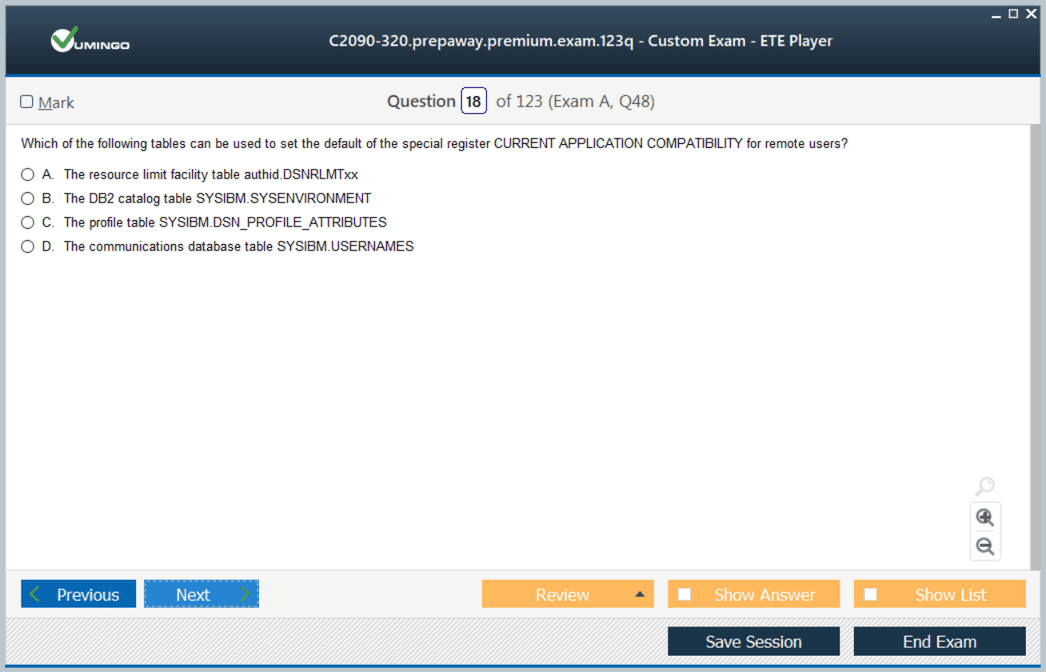
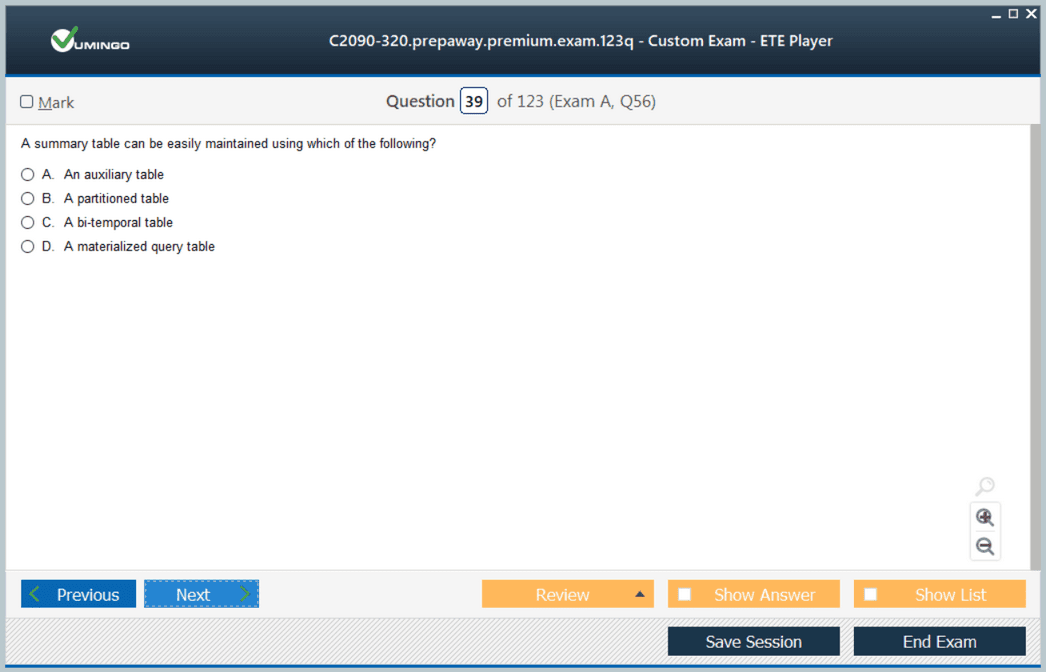
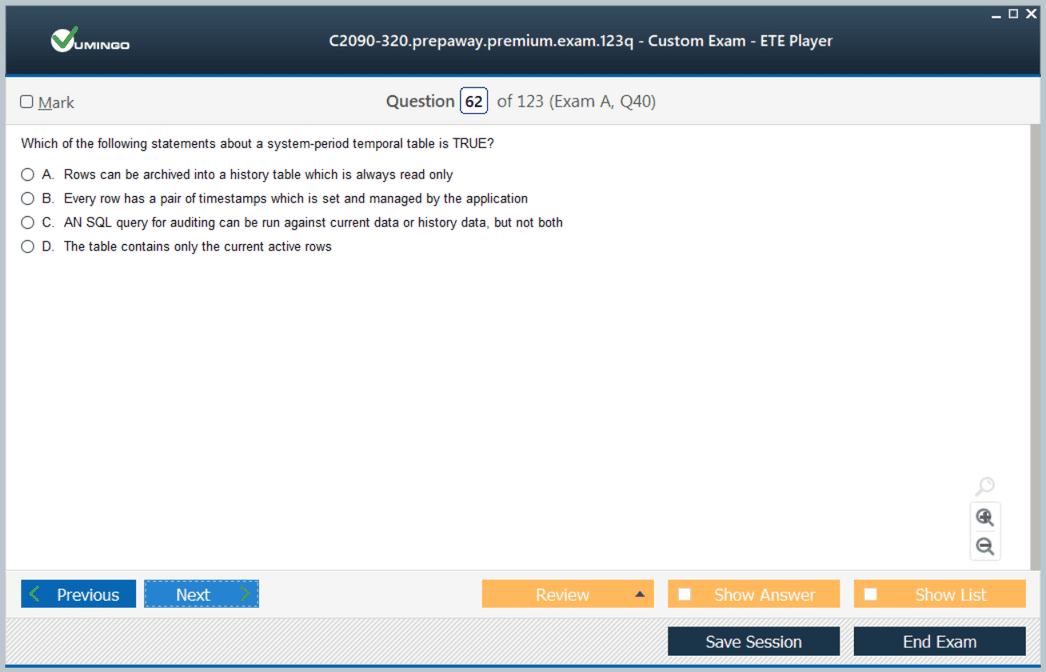
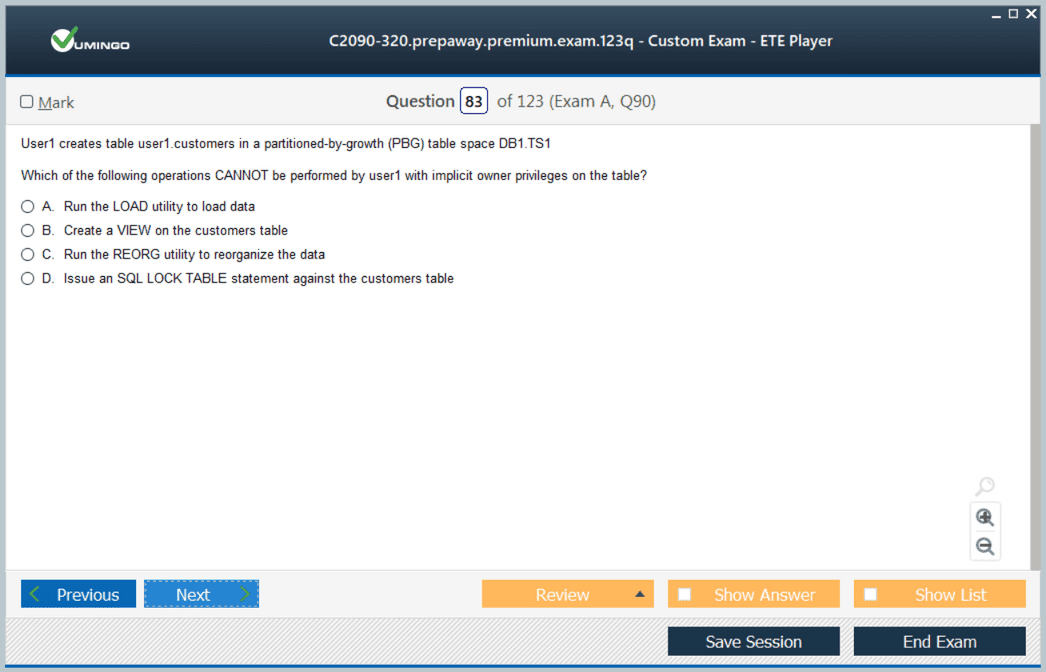
Last Week Results!
 83% students found the test questions almost same
IBM C2090-320: DB2 11 Fundamentals for z/OS
C2090-320 is a legacy IBM exam covering DB2 11 fundamentals for z/OS. IBM training-roadmap material from the DB2 11 period places it at the foundational level of the z/OS database path. The exam belongs to an older certification generation, so its code and blueprint should be presented as historical learning context rather than as a current IBM credential.
Fundamentals matter because Db2 on z/OS combines standard relational ideas with mainframe-specific implementation and operational concepts. A learner needs to understand tables and SQL, but also table spaces, indexes, packages, locking, utilities, system catalogs, and the way database work fits into a controlled z/OS environment. That foundation supports both application work and later administration.
C2090-320 sits within the historical IBM certifications portfolio. The most productive way to use the old objectives is to learn the concepts they represent and then verify current product documentation for any version-sensitive command, limit, or behavior.
Relational fundamentals explain why Db2 organizes data the way it does
A relational database represents information in tables with rows and columns, while keys and constraints express relationships and validity rules. This model allows applications to ask for results declaratively with SQL instead of specifying every physical step required to retrieve them. Db2’s optimizer determines an access plan based on the statement, available structures, and statistics.
The broader database fundamentals behind normalization, keys, SQL, transactions, and indexing are directly relevant. On z/OS, however, learners also need to connect the logical model to platform-specific physical objects and operational practices.
Good database understanding separates logical correctness from physical efficiency. A normalized design can accurately represent business relationships while still requiring indexes, partitioning, or other physical choices to meet performance and maintenance goals.
Db2 object hierarchy connects logical tables to physical storage
Tables contain business data, but z/OS administration and application behavior depend on the structures around them. Databases group related objects, table spaces provide storage organization, and indexes provide alternate access paths. Views present derived or restricted representations, while schemas and naming conventions help organize ownership and application boundaries.
Understanding the hierarchy prevents common conceptual mistakes. Dropping or altering a physical object can affect dependent applications; changing an index can influence access paths; and a table’s placement can matter for backup, recovery, and maintenance. Even at a fundamentals level, learners should ask how an object participates in the larger environment.
The Db2 catalog records metadata about these structures. Knowing how to inspect catalog information is important because many operational questions—what exists, who owns it, which indexes support a table, or what dependencies are present—can be answered by querying metadata rather than relying on memory or scripts.
SQL skills include data definition, retrieval, change, and control
SQL is not only SELECT. Learners need to recognize statements that define objects, retrieve rows, insert or modify data, and control access. They also need to reason about predicates, joins, grouping, ordering, null values, expressions, and functions because those details determine both result correctness and execution cost.
Queries should be read in terms of business meaning first. A join that produces duplicates may be syntactically valid but logically wrong if the relationship is not understood. A filter that mishandles nulls can exclude records unexpectedly. Fundamentals training should therefore emphasize result reasoning instead of memorizing clause order alone.
SQL also interacts with transactions. Several statements may form one unit of work, which means visibility and rollback behavior depend on commit boundaries and isolation. That connection becomes especially important when multiple applications update the same data concurrently.
Indexes improve access only when they match real query patterns
An index stores key values in a structure that can help Db2 locate qualifying rows without scanning all underlying data. It may also enforce uniqueness or support ordering. The tradeoff is additional storage and maintenance whenever indexed values are inserted, deleted, or changed.
The concepts in SQL indexes are useful for understanding that tradeoff. On Db2 for z/OS, learners should also recognize that statistics, clustering, and the optimizer’s estimates influence whether an index is selected for a particular statement.
More indexes are not automatically better. Redundant or low-value indexes increase write cost and maintenance work. A sensible design supports important access paths while keeping the total operational burden manageable.
Transactions and isolation protect data during concurrent work
A transaction groups related changes into a unit that can be committed or rolled back. This protects applications from partially completed business operations, such as updating one table but failing before a related table is changed. Logging provides the history needed to support rollback and recovery behavior.
Concurrency introduces a second challenge: several units of work may try to read or change the same data. Isolation levels determine what one transaction can observe about another transaction’s work. Stronger isolation can protect consistency more aggressively, while weaker isolation may allow greater concurrency for workloads that can tolerate it.
Locks are one mechanism used to coordinate access. Learners should understand why long units of work can hold resources and block others, why commit frequency matters, and why a deadlock is different from a simple wait. These concepts become central in the administrator-level DB2 11 DBA for z/OS material.
Packages and application execution connect SQL to controlled deployment
On Db2 for z/OS, application SQL is often associated with packages and plans that support controlled execution. A fundamentals learner does not need to treat these as abstract certification terms; they represent how database access is prepared, authorized, and managed in enterprise applications.
Packages also help explain why a database change can have application consequences. If object definitions or statistics change, access paths may need to be reconsidered. Deployment therefore involves coordination between database and application teams rather than assuming SQL exists independently of its runtime environment.
Dynamic SQL and static SQL have different operational characteristics, but both rely on appropriate privileges and valid database objects. Understanding the distinction helps learners interpret performance, deployment, and security discussions later.
Utilities support loading, maintenance, integrity, and recovery
Db2 environments use utilities for work that would be inefficient or unsafe to perform as ordinary application SQL. Loading large datasets, making image copies, reorganizing objects, collecting statistics, checking integrity, and recovering data all have established operational mechanisms.
At the fundamentals level, the goal is to understand purpose and effect. RUNSTATS supports optimizer decisions, REORG addresses physical organization, COPY contributes to recoverability, and LOAD handles bulk data movement. Each utility can affect object availability or state, which is why production execution is normally planned and monitored.
These activities reinforce a core lesson of data management: reliable information depends on operational processes as well as schema design. Backups, metadata, quality controls, and ownership are part of keeping data useful over time.
Authorization separates what users can do from what data exists
Database security starts by identifying who or what is connecting and which actions that identity should be allowed to perform. Object privileges can control operations such as selecting, inserting, updating, or deleting data, while broader authorities support administrative responsibilities.
Least privilege is a practical design principle. An application that only reads a reference table should not receive modification rights, and a reporting user should not need the same authority as a DBA. Smaller permission sets reduce both accidental damage and the impact of credential compromise.
Security also has a lifecycle. New objects need appropriate grants, departed users need access removed, and service accounts require ownership and credential management. A one-time grant script is not a complete access-control process.
Basic performance reasoning should also begin at the fundamentals level. A query that reads a million rows to return ten values should prompt questions about predicates, indexes, statistics, and access paths. Learners do not need to be expert tuners yet, but they should understand that SQL design and physical structures influence how much work the engine performs.
Likewise, backup and recovery concepts should not be postponed until advanced administration. Even application developers benefit from knowing that logging, image copies, and utility states exist, because long transactions and bulk changes can affect recovery and maintenance. Database reliability is a shared property of design and operations.
Db2 for z/OS and Db2 for LUW share concepts but not an administration blueprint
IBM also maintained a DB2 11.1 fundamentals path for Linux, UNIX, and Windows. The legacy DB2 11.1 Fundamentals for LUW exam covers many familiar relational ideas, but it belongs to a different platform family. That comparison is useful because it highlights which knowledge transfers—SQL, transactions, privileges, indexes—and which details must be relearned for the operating environment.
A z/OS learner should resist copying LUW operational assumptions into mainframe work. Tooling, storage concepts, subsystem administration, package management, utilities, and enterprise controls can differ substantially. The shared Db2 name is a starting point, not proof of identical procedures.
Foundational study should include the habit of reading messages and return codes carefully. Enterprise database errors often include enough structured information to narrow the issue to syntax, authorization, object state, resource limits, or concurrency. Guessing at fixes before interpreting that evidence can make a simple problem harder.
Catalog literacy supports the same diagnostic habit. Instead of relying on screenshots or assumptions, learners can query metadata to confirm object definitions, dependencies, privileges, and other facts about the database environment.
Learning should also connect terminology to practical consequences. Knowing that a table space, package, or isolation level exists is only the first step; candidates should be able to explain how each one influences storage, application execution, concurrency, maintenance, or recovery in a real environment.
C2090-320 remains useful as a historical foundation for DB2 11 on z/OS and as a bridge into deeper administration. It should not be treated as evidence that the old certification is currently available. Current learners should verify IBM’s live offerings and use current Db2 for z/OS documentation alongside any legacy objective list.
Why customers love us?
What do our customers say?
The resources provided for the IBM certification exam were exceptional. The exam dumps and video courses offered clear and concise explanations of each topic. I felt thoroughly prepared for the C2090-320 test and passed with ease.
Studying for the IBM certification exam was a breeze with the comprehensive materials from this site. The detailed study guides and accurate exam dumps helped me understand every concept. I aced the C2090-320 exam on my first try!
I was impressed with the quality of the C2090-320 preparation materials for the IBM certification exam. The video courses were engaging, and the study guides covered all the essential topics. These resources made a significant difference in my study routine and overall performance. I went into the exam feeling confident and well-prepared.
The C2090-320 materials for the IBM certification exam were invaluable. They provided detailed, concise explanations for each topic, helping me grasp the entire syllabus. After studying with these resources, I was able to tackle the final test questions confidently and successfully.
Thanks to the comprehensive study guides and video courses, I aced the C2090-320 exam. The exam dumps were spot on and helped me understand the types of questions to expect. The certification exam was much less intimidating thanks to their excellent prep materials. So, I highly recommend their services for anyone preparing for this certification exam.
Achieving my IBM certification was a seamless experience. The detailed study guide and practice questions ensured I was fully prepared for C2090-320. The customer support was responsive and helpful throughout my journey. Highly recommend their services for anyone preparing for their certification test.
I couldn't be happier with my certification results! The study materials were comprehensive and easy to understand, making my preparation for the C2090-320 stress-free. Using these resources, I was able to pass my exam on the first attempt. They are a must-have for anyone serious about advancing their career.
The practice exams were incredibly helpful in familiarizing me with the actual test format. I felt confident and well-prepared going into my C2090-320 certification exam. The support and guidance provided were top-notch. I couldn't have obtained my IBM certification without these amazing tools!
The materials provided for the C2090-320 were comprehensive and very well-structured. The practice tests were particularly useful in building my confidence and understanding the exam format. After using these materials, I felt well-prepared and was able to solve all the questions on the final test with ease. Passing the certification exam was a huge relief! I feel much more competent in my role. Thank you!
The certification prep was excellent. The content was up-to-date and aligned perfectly with the exam requirements. I appreciated the clear explanations and real-world examples that made complex topics easier to grasp. I passed C2090-320 successfully. It was a game-changer for my career in IT!


