
- Home
- IBM Certifications
- C2070-994 IBM Datacap V9.0 Solution Designer Dumps
Pass IBM C2070-994 Exam in First Attempt Guaranteed!
Get 100% Latest Exam Questions, Accurate & Verified Answers to Pass the Actual Exam!
30 Days Free Updates, Instant Download!


C2070-994 Premium File
- Premium File 67 Questions & Answers. Last Update: Nov 02, 2026
Whats Included:
- Latest Questions
- 100% Accurate Answers
- Fast Exam Updates
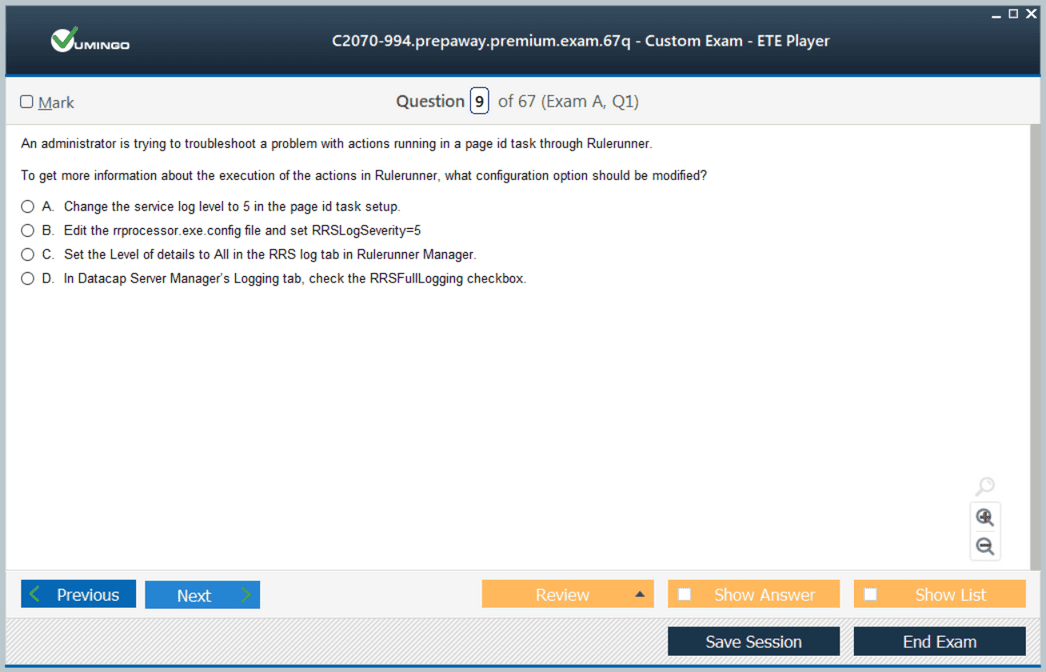
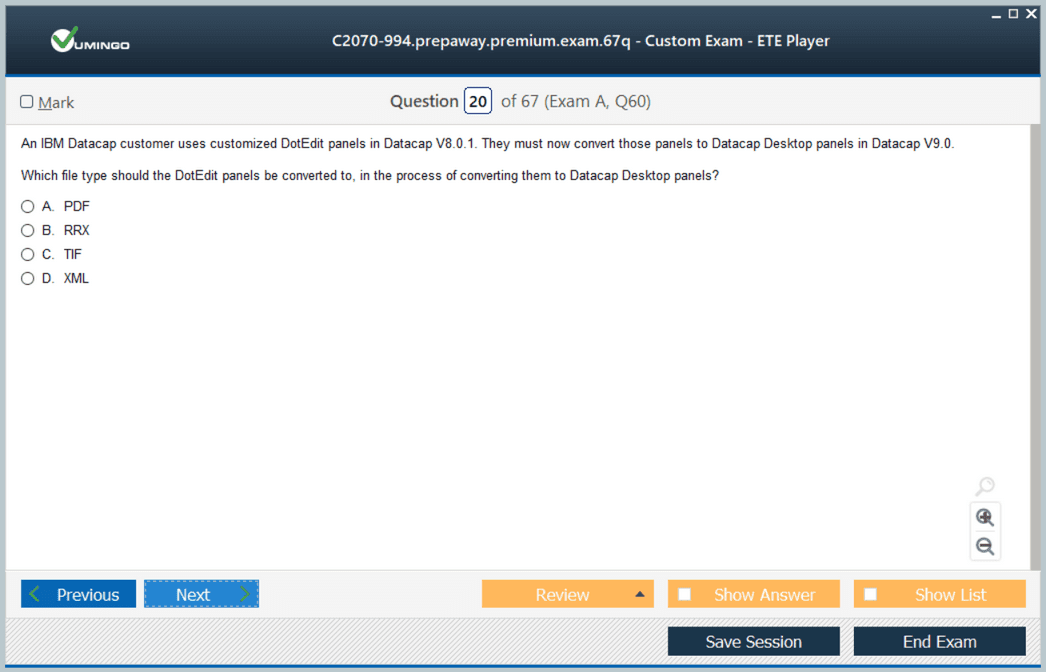
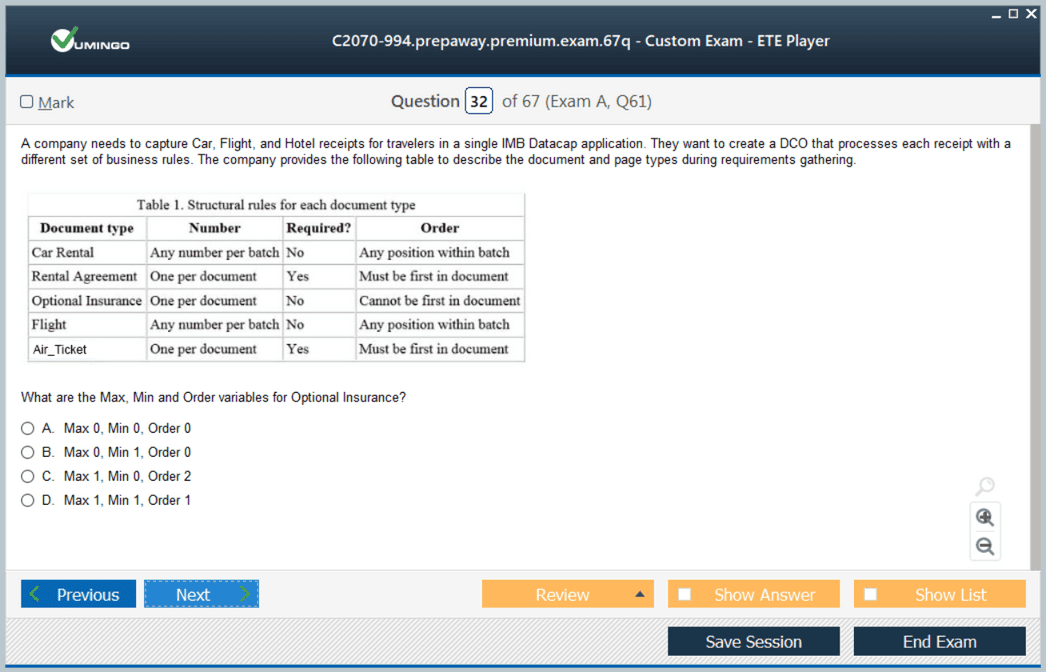
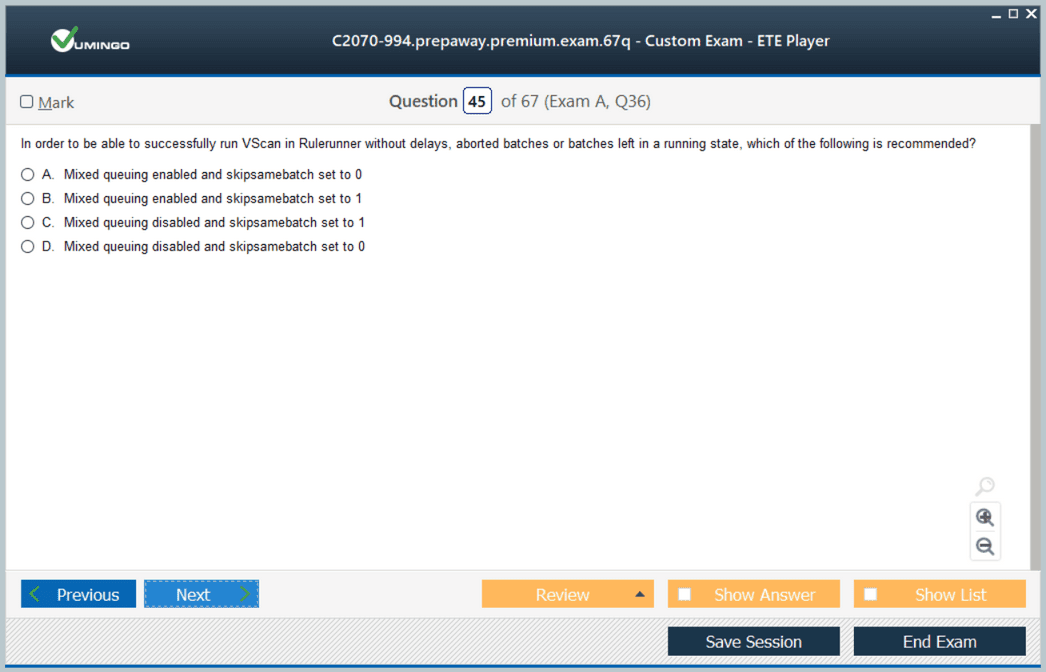
Last Week Results!
 83% students found the test questions almost same
IBM C2070-994: Datacap V9.0 Solution Designer
C2070-994 is a retired IBM Datacap V9.0 Solution Designer exam. Datacap is a document-capture platform used to ingest paper or image-based content, recognize text and fields, classify documents, apply validation rules, route exceptions, and export structured results into downstream repositories or business processes. The solution designer’s job is to turn document-processing requirements into a workable capture architecture.
The retirement status matters because the exam code and v9.0 blueprint should not be presented as a current IBM certification path. The material remains useful for organizations that still operate Datacap estates and for professionals who need historical context around enterprise document capture. Current projects should verify IBM’s present automation and document-processing portfolio instead of relying on an old certification outline.
Datacap belongs to the broader IBM certifications ecosystem. For a more current, wider automation architecture context, the approved Cloud Pak for Business Automation v2024.0.0 Solution Architect page is a useful adjacent destination because modern automation designs can combine document processing with workflow, content, and decision capabilities.
Capture design begins with document populations and business outcomes
A solution designer needs to know what documents arrive, how they arrive, what information must be extracted, where confidence can be low, who resolves exceptions, and which downstream system consumes the result. The same capture technology can be configured very differently for invoices, claims, forms, correspondence, or identity documents.
Volume and quality also matter. Clean digital PDFs behave differently from scanned paper with skew, noise, handwriting, stamps, or mixed layouts. The design should therefore start with representative samples and measurable acceptance criteria rather than a small set of ideal documents.
Sampling should include difficult cases intentionally. Folded pages, faint scans, skew, multiple languages, handwritten notes, stamps, photocopies, and unusual layouts expose weaknesses before production. A design validated only against pristine samples will produce optimistic accuracy estimates and an unexpectedly large verification workload after launch.
Document hierarchy provides the structure for recognition and validation
Datacap solutions organize batches, documents, pages, and fields so the system knows what it is processing and where extracted values belong. A well-designed hierarchy reflects the business document while remaining flexible enough to handle optional pages, attachments, separators, and variations.
Poor hierarchy design creates downstream complexity. If several unrelated document types are forced into one structure, rules become difficult to maintain. If the hierarchy is too fragmented, common logic is duplicated. Designers should look for stable document boundaries and shared field behavior.
Document separation is a related design problem. Barcodes, blank pages, fixed page counts, classification results, or other markers can identify where one document ends and another begins. The right method depends on source reliability. A separation rule that works for clean scan batches may fail on emailed PDFs containing attachments or variable page order.
Recognition is a pipeline, not a single OCR button
OCR converts image content into machine-readable text, but accurate capture usually includes image cleanup, page identification, zone or field location, recognition engines, dictionaries, validation, and confidence scoring. Designers should understand which errors originate from image quality and which come from poor recognition rules.
A general understanding of optical character recognition helps clarify the limits of the technology. OCR can read characters, but business-grade capture also needs context: whether a value is a date, account number, total, vendor, or other field, and what should happen when the extracted value fails validation.
Image preprocessing can materially affect recognition quality. Deskewing, despeckling, rotation, contrast adjustment, border removal, and page separation may improve results before OCR runs. Designers should test which transformations help each document class because aggressive cleanup can also remove faint characters or marks that have business meaning.
Rulesets turn recognition results into repeatable processing logic
Datacap rules can control image processing, classification, extraction, validation, routing, and export. The solution designer needs to decide where rules belong and how they are ordered so that later steps can rely on earlier results. Hidden dependencies between rules are a common source of difficult maintenance.
Rules should also produce understandable failure behavior. A batch that cannot be classified, a field that fails validation, or a document that lacks a required page should move to a defined exception path rather than silently continue with questionable data.
Rule reuse should be balanced against readability. Shared rules reduce duplication, but deeply nested or overly generic rules can make troubleshooting harder. Designers should create reusable components for stable behavior while keeping application-specific logic close enough to the document class that operators can understand why a value was changed or rejected.
Human verification is a designed control, not a failure of automation
No recognition system is perfect across all document populations. Verification stations allow people to review low-confidence or inconsistent fields, correct data, and release documents back into automated processing. The designer should define which conditions trigger human review and which errors should stop the batch entirely.
Too much verification destroys the economic value of automation; too little creates data-quality risk. Thresholds should therefore be tuned with real documents and business cost. A high-value financial field may justify human review at a confidence level that would be unnecessary for descriptive metadata.
Verification interfaces should present enough context for a person to decide quickly without exposing unrelated information. Field order, image zoom, validation messages, and keyboard flow all affect throughput. Human-in-the-loop design is therefore partly a user-experience problem, not only an accuracy threshold.
Batch flow and task routing determine operational throughput
Datacap applications process work through tasks and queues. Scanning, import, recognition, verification, validation, and export may run on different stations or servers. The solution designer needs to understand dependencies, concurrency, and the effect of slow stages on the entire pipeline.
Throughput analysis should look for bottlenecks rather than simply adding servers. A recognition engine may be fast while human verification accumulates a backlog, or export may slow because a downstream repository is unavailable. Monitoring needs to expose where batches are waiting and why.
Concurrency settings should be tested with realistic document sizes and recognition engines. More parallel tasks can increase throughput until CPU, memory, disk, licensing, or downstream systems become saturated. Capacity planning should therefore measure the slowest stage and its queue growth rather than assume linear scaling.
Operational service levels should be expressed in business terms such as documents processed before a cutoff or average exception turnaround, not only pages per minute. Those measures connect infrastructure tuning to the outcome that users actually care about and make it easier to decide where additional automation or staffing is justified.
Export design is where captured data becomes part of another system
Document capture is rarely the final business destination. Datacap may export images, metadata, indexes, or records into content repositories, line-of-business applications, databases, or workflow systems. Designers must understand the contract: required fields, formats, document identifiers, transaction behavior, and error handling.
The wider principles of data management apply because capture data needs ownership, validation, and lifecycle control after export. If downstream systems cannot determine which source document produced a record or whether an export was retried, reconciliation becomes difficult.
Idempotency matters during export. If a network failure occurs after the downstream system accepts a document but before Datacap records success, a retry can create a duplicate. Designs should use stable identifiers, downstream duplicate checks, or transactional patterns so that recovery does not corrupt the target system.
Security and retention need to follow the document lifecycle
Captured documents may contain personal, financial, legal, or regulated information. Solution design therefore includes access controls for scan operators, verification users, administrators, file shares, databases, and exported repositories. Temporary images and intermediate data should not be treated as harmless simply because they are part of processing.
Retention should be explicit. Some intermediate files can be removed after successful export; others may be needed for audit or reprocessing. The design needs a policy for where documents live, who can see them, how long they remain, and how deletion or archival is verified.
Temporary folders, export staging areas, backup copies, and diagnostic logs can retain sensitive information even after the main document has moved on. Security reviews should inventory these secondary locations and ensure that permissions and cleanup policies cover them. Otherwise the least visible copy may become the weakest control point.
Access reviews should include operators and service accounts as well as administrators. Capture systems often use unattended processes with broad filesystem or repository permissions; those identities need the same ownership, rotation, and least-privilege discipline as interactive users.
Legacy Datacap knowledge can inform modern intelligent document processing
Modern document-processing platforms increasingly combine OCR with machine learning, classification, extraction models, workflow orchestration, and cloud-native services. Those capabilities change implementation choices, but the fundamental questions remain: what documents arrive, what data matters, how confidence is handled, and how exceptions are controlled.
C2070-994 should therefore be used as legacy Datacap context, not as evidence that v9.0 is the current IBM credential. Professionals maintaining older solutions can still benefit from the design principles, while new projects should compare current IBM automation capabilities and evaluate whether document capture belongs inside a broader process architecture.
Modernization assessments should compare capture accuracy, model-training effort, integration options, operator experience, hosting requirements, and governance rather than assuming machine learning automatically replaces rules. Mature rules can encode valuable business knowledge. The best migration may preserve some deterministic validation while using newer models for classification or extraction where they genuinely improve results.
For teams that still run Datacap v9, modernization does not eliminate the need for stable operations in the meantime. They should continue to monitor batch backlog, recognition quality, storage growth, security, and downstream exports while planning a controlled transition. Legacy status is not a reason to relax operational discipline.
Why customers love us?
What do our customers say?
The resources provided for the IBM certification exam were exceptional. The exam dumps and video courses offered clear and concise explanations of each topic. I felt thoroughly prepared for the C2070-994 test and passed with ease.
Studying for the IBM certification exam was a breeze with the comprehensive materials from this site. The detailed study guides and accurate exam dumps helped me understand every concept. I aced the C2070-994 exam on my first try!
I was impressed with the quality of the C2070-994 preparation materials for the IBM certification exam. The video courses were engaging, and the study guides covered all the essential topics. These resources made a significant difference in my study routine and overall performance. I went into the exam feeling confident and well-prepared.
The C2070-994 materials for the IBM certification exam were invaluable. They provided detailed, concise explanations for each topic, helping me grasp the entire syllabus. After studying with these resources, I was able to tackle the final test questions confidently and successfully.
Thanks to the comprehensive study guides and video courses, I aced the C2070-994 exam. The exam dumps were spot on and helped me understand the types of questions to expect. The certification exam was much less intimidating thanks to their excellent prep materials. So, I highly recommend their services for anyone preparing for this certification exam.
Achieving my IBM certification was a seamless experience. The detailed study guide and practice questions ensured I was fully prepared for C2070-994. The customer support was responsive and helpful throughout my journey. Highly recommend their services for anyone preparing for their certification test.
I couldn't be happier with my certification results! The study materials were comprehensive and easy to understand, making my preparation for the C2070-994 stress-free. Using these resources, I was able to pass my exam on the first attempt. They are a must-have for anyone serious about advancing their career.
The practice exams were incredibly helpful in familiarizing me with the actual test format. I felt confident and well-prepared going into my C2070-994 certification exam. The support and guidance provided were top-notch. I couldn't have obtained my IBM certification without these amazing tools!
The materials provided for the C2070-994 were comprehensive and very well-structured. The practice tests were particularly useful in building my confidence and understanding the exam format. After using these materials, I felt well-prepared and was able to solve all the questions on the final test with ease. Passing the certification exam was a huge relief! I feel much more competent in my role. Thank you!
The certification prep was excellent. The content was up-to-date and aligned perfectly with the exam requirements. I appreciated the clear explanations and real-world examples that made complex topics easier to grasp. I passed C2070-994 successfully. It was a game-changer for my career in IT!


