
- Home
- IBM Certifications
- C2010-530 IBM Maximo Asset Management V7.6 Infrastructure and Implementation Dumps
Pass IBM C2010-530 Exam in First Attempt Guaranteed!
Get 100% Latest Exam Questions, Accurate & Verified Answers to Pass the Actual Exam!
30 Days Free Updates, Instant Download!


C2010-530 Premium File
- Premium File 73 Questions & Answers. Last Update: Nov 13, 2026
Whats Included:
- Latest Questions
- 100% Accurate Answers
- Fast Exam Updates
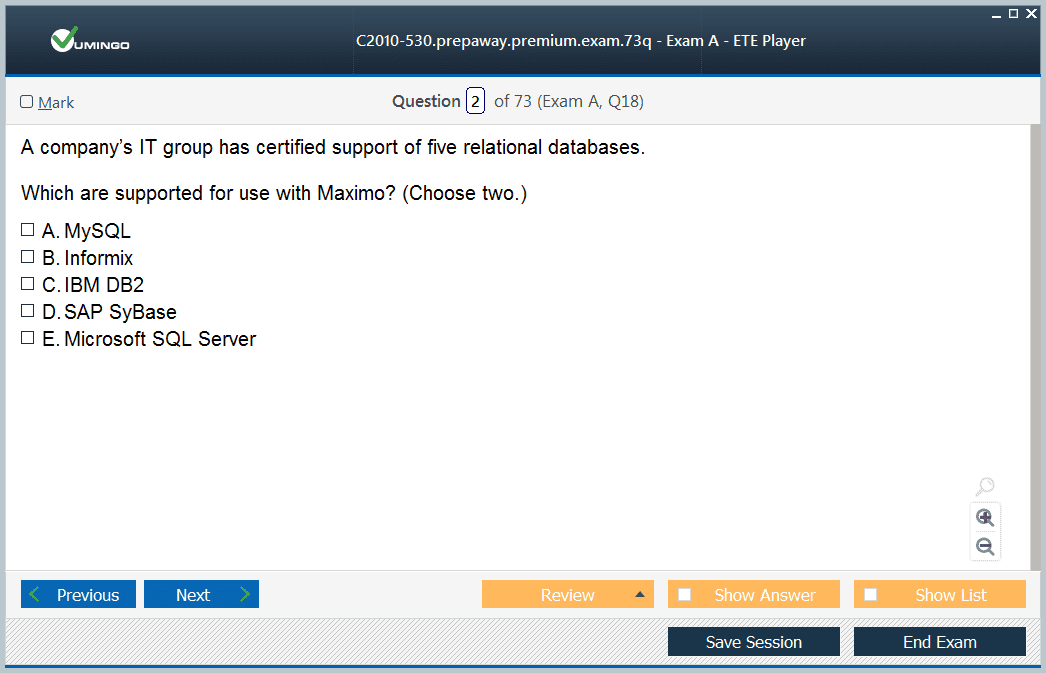
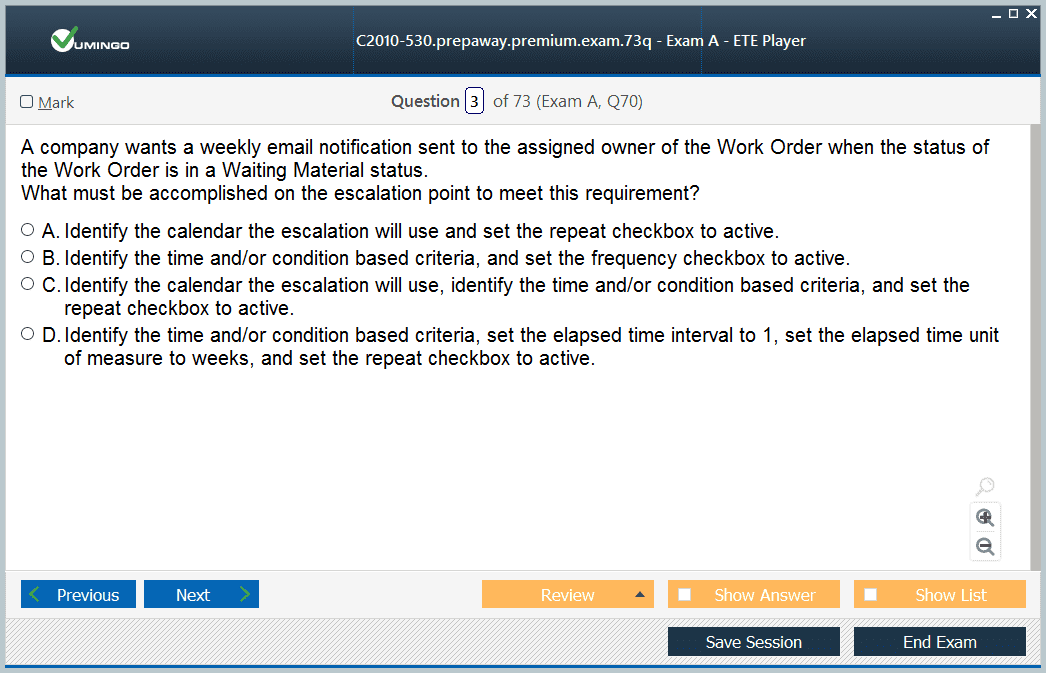
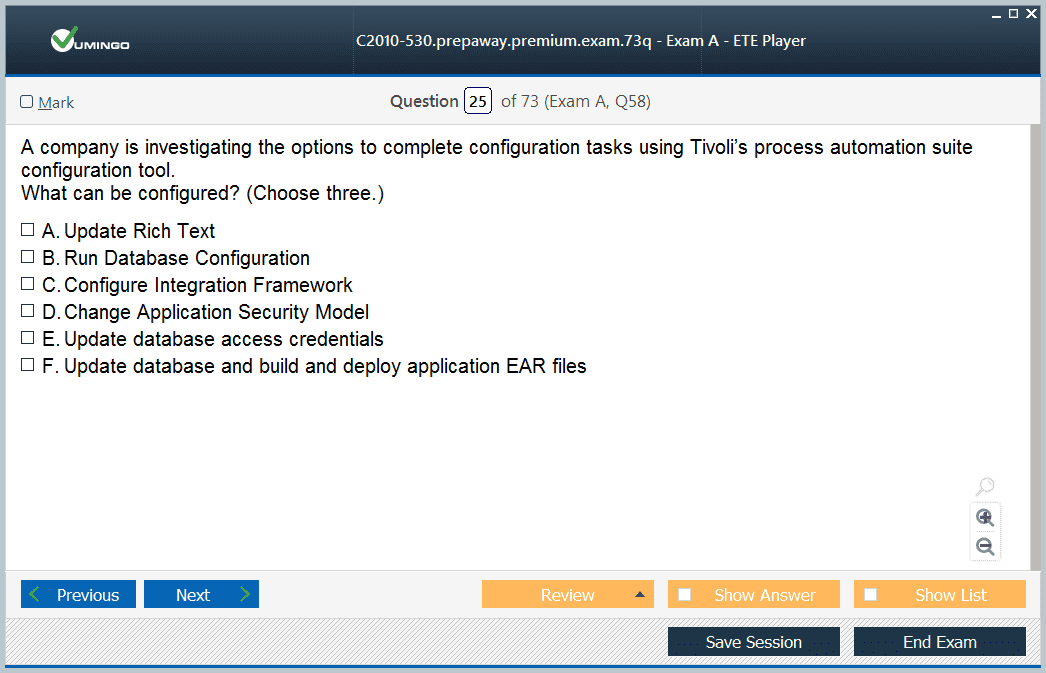
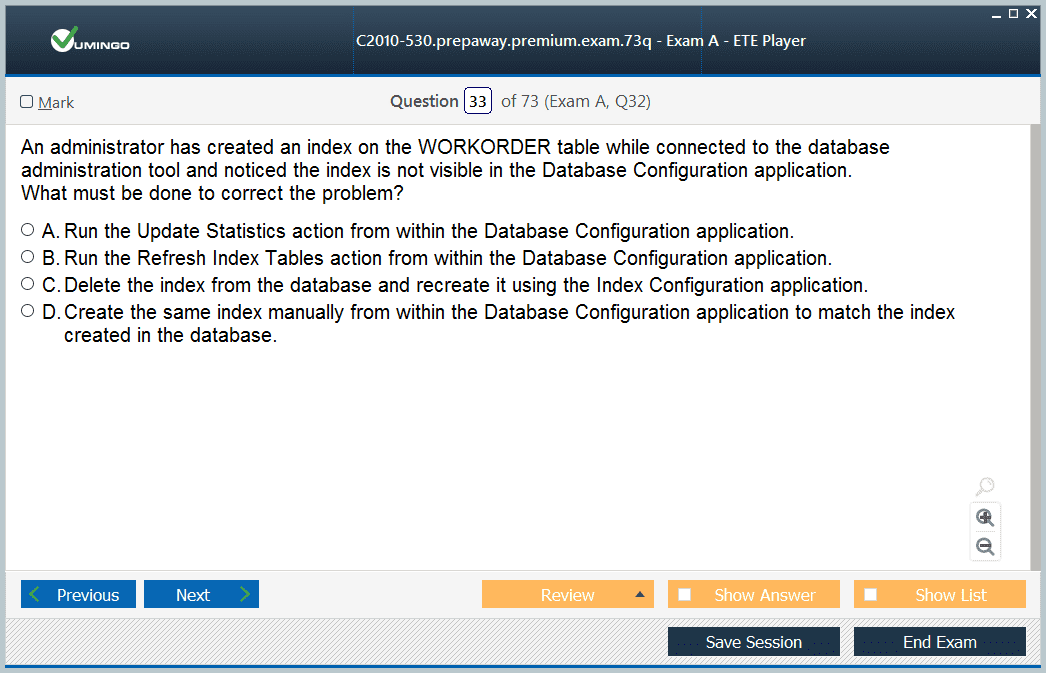
Last Week Results!
 83% students found the test questions almost same
IBM C2010-530: Maximo Asset Management V7.6 Infrastructure and Implementation
C2010-530 is a legacy IBM Maximo Asset Management v7.6 infrastructure and implementation exam. It reflects an earlier Maximo deployment model in which infrastructure specialists planned and installed the application stack, configured WebSphere and database dependencies, integrated external systems, managed security, tuned performance, and maintained the environment through fixes and upgrades.
Because Maximo has moved into the Maximo Application Suite and newer v9 paths, candidates should treat C2010-530 as historical or environment-specific material rather than assume it is a current certification target. The exam page remains valuable for professionals who maintain Maximo 7.6 estates or need to understand how older infrastructure differs from current OpenShift-based deployments.
The older infrastructure role connects naturally to IBM certifications, the companion Maximo Asset Management v7.6 Functional Analyst role, and the current Maximo Manage v9.0 Functional Deployment - Professional path. Where a 7.6 estate uses WebSphere traditional, the WebSphere v9.0.5 Administrator page also provides useful middleware context.
Maximo 7.6 infrastructure is a multi-tier system, not a single application
A traditional Maximo environment typically includes application servers, a database, HTTP or web-server components, integration endpoints, reporting services, authentication dependencies, storage, and supporting operating-system infrastructure. Implementation planning needs to account for how these layers communicate and which team owns each one.
The infrastructure specialist should be able to draw the runtime path for a user request and for an integration transaction. That simple exercise reveals where ports, certificates, service accounts, DNS, load balancing, database connections, and storage dependencies enter the design.
Environment separation is part of that topology. Development, test, training, disaster-recovery, and production systems may share architecture patterns but should not share credentials, databases, endpoints, or uncontrolled integration traffic. Infrastructure teams need a method for promoting configuration and customizations while preserving environment-specific values.
Sizing should be driven by workload shape and growth assumptions
User counts alone do not size Maximo well. Interactive sessions, cron tasks, integrations, reporting, mobile synchronization, batch processing, and data volume can create very different load profiles. A deployment that works for steady daytime activity may struggle during scheduled jobs or integration bursts.
Capacity planning should identify concurrency, transaction rates, database growth, report workloads, attachment storage, and expected expansion. The important skill is not memorizing a server specification from an old guide but understanding which workload characteristics consume CPU, memory, JVM heap, database I/O, network bandwidth, and storage.
Attachment usage can materially change storage and backup requirements. Organizations sometimes focus on database growth while documents, images, and manuals accumulate on file storage. The implementation plan should estimate attachment volume, define accessible paths for clustered servers, and include those repositories in recovery testing.
WebSphere configuration determines how Maximo application processes are organized
Maximo 7.6 commonly runs on WebSphere Application Server, where clusters, JVMs, node agents, deployment managers, data sources, and application deployments shape runtime behavior. Infrastructure specialists need enough WebSphere knowledge to separate a Maximo application issue from a middleware issue.
JVM heap, thread pools, session settings, connection pools, and cluster topology all affect application performance and resilience. When changes are required, they should be made with evidence and tested under realistic workload rather than copied from another environment with different usage patterns.
Database configuration is central to both reliability and performance
Maximo stores operational history, configuration, workflow state, inventory, work orders, purchasing records, and many other business objects in the database. Database health therefore directly affects user experience. Infrastructure planning needs correct character sets, storage, indexing, statistics, backup, recovery, and connectivity.
Understanding database fundamentals helps administrators reason about transactions, indexes, privileges, growth, and query behavior. Tuning only the application server while ignoring database waits or poorly maintained indexes can leave the real bottleneck untouched.
Database maintenance should be coordinated with Maximo workload. Statistics updates, index maintenance, backups, and heavy reporting can compete with interactive transactions or cron tasks if scheduled carelessly. Infrastructure specialists should know the business calendar and design maintenance windows around real operational demand, not only technical convenience.
Installation and configuration management should be reproducible
Maximo installation involves middleware, database preparation, product components, configuration tools, application build and deployment steps, and environment-specific properties. A production build should be documented well enough that another administrator can recreate it or understand what differs between development, test, and production.
Configuration drift is a recurring risk in long-lived estates. Manual emergency changes, inconsistent fix application, and undocumented property edits can make later upgrades unpredictable. Good implementation practice records versions, fixes, customizations, integrations, certificates, scheduled tasks, and the rationale for nondefault settings.
Customizations complicate reproducibility because they may include Java classes, database extensions, automation scripts, reports, integrations, and modified presentation files. Infrastructure teams should maintain an inventory that ties each customization to its deployment artifact and owner. Without that record, a rebuild can restore the base product successfully while silently omitting business-critical behavior.
Integration Framework design affects both Maximo and surrounding systems
Maximo Integration Framework can exchange data through object structures, enterprise services, publish channels, external systems, endpoints, and queues. Infrastructure specialists need to understand how transactions enter, where they are processed, and how failures are retained or retried.
Integration load can be significant. Bulk imports, high-frequency updates, or poorly controlled retries can compete with interactive users for database and JVM resources. Implementation planning should therefore include rate assumptions, error handling, monitoring, and a method for replaying failed transactions without creating duplicates.
Error queues and integration reprocessing deserve operational ownership. Failed messages can represent data-quality problems, unavailable endpoints, schema changes, or authorization issues. Teams should know who investigates each class of failure and how repaired transactions are replayed. Silent accumulation is especially risky because business systems can drift while Maximo itself appears healthy.
Message sequencing can matter when related records arrive through integrations. A child record that arrives before its parent, or an update that overtakes a create transaction, can fail even when both payloads are valid. Infrastructure design should account for queue ordering, retries, and the business dependencies between interface messages.
Security spans application permissions and infrastructure controls
Maximo security groups and application permissions are only part of the picture. Infrastructure teams also manage service accounts, database credentials, WebSphere administration, certificates, network segmentation, filesystem permissions, and authentication integrations. Weakness at any layer can undermine otherwise careful application controls.
General identity and access management concepts help structure least privilege and separation of duties. Maximo administrators, database administrators, middleware administrators, integration accounts, and business users should not all share equivalent authority simply because that is operationally convenient.
Shared administrative accounts should be avoided because they weaken auditability. Named administrator identities, controlled elevation, and separate service accounts make it easier to attribute changes and remove access when responsibilities change. Legacy environments often accumulate broad permissions over time, so periodic review is important even when no major upgrade is planned.
Certificate inventories are particularly important in older Maximo stacks because HTTPS, LDAP, integration endpoints, web servers, and middleware may each depend on different trust stores. Expiry monitoring and documented renewal procedures reduce avoidable outages in environments where ownership has changed over many years.
Backup and recovery should cover the whole application state
Recovering Maximo 7.6 means more than restoring a database. Application configuration, properties, integrations, encryption keys, report artifacts, attachments, custom code, certificates, middleware configuration, and scheduled processes may all be needed to return the service to a usable state.
A broader disaster recovery plan helps define recovery order, dependencies, and validation. A database restore may be technically successful while the application is still unusable because attachments, interfaces, or authentication services are missing.
Recovery testing should include user authentication, application login, representative work-order transactions, integration flow, reporting, attachments, and scheduled processing. These tests verify that restored components are mutually consistent. A recovery exercise that ends when the database opens leaves application-level dependencies unproven.
Legacy knowledge is most useful when it clarifies the migration path
Maximo 7.6 infrastructure knowledge remains valuable in organizations that have not yet moved to the Maximo Application Suite. It also helps migration teams identify what changes when application servers, installation tooling, identity, and deployment patterns shift toward the newer suite.
The mistake is to map every old component directly onto a new platform without reconsidering the operating model. C2010-530 describes a historical infrastructure role; current projects should use current IBM Maximo documentation and the newer credential paths. The page is best used to preserve context and support real 7.6 environments.
A migration assessment should inventory custom Java code, automation scripts, reports, integrations, cron tasks, security groups, database extensions, and unsupported middleware assumptions. Each item needs a decision: retain, redesign, replace, or retire. That inventory is more actionable than a simple list of installed components because it reveals the real effort behind moving a mature 7.6 estate.
The migration plan should also identify operational roles that change. A WebSphere administrator may no longer own the same runtime tasks in a Maximo Application Suite deployment, while OpenShift, operator, and suite administration skills become more important. Training and support ownership need to move with the architecture, not after it.
Teams should also identify integrations or customizations that exist only because older Maximo versions lacked a feature that is now standard. Rebuilding those components automatically can waste effort and preserve technical debt. A migration assessment should compare the old workaround with current platform capability before deciding to carry it forward.
Documentation quality becomes especially valuable during a transition. Architecture diagrams, port lists, service-account ownership, database dependencies, scheduled jobs, and recovery procedures reduce discovery work and help migration teams distinguish essential integration from accidental historical complexity.
A clear baseline also makes later troubleshooting faster because teams can compare the migrated environment with a known, documented source state instead of relying on memory.
The approved Maximo Manage v8.0 Implementation page is another useful transition point between the classic 7.6 estate and today’s Maximo Manage v9 path. It should not be treated as a direct one-for-one replacement for the infrastructure role, but it helps show how the implementation context changed before the current suite model.
Why customers love us?
What do our customers say?
The resources provided for the IBM certification exam were exceptional. The exam dumps and video courses offered clear and concise explanations of each topic. I felt thoroughly prepared for the C2010-530 test and passed with ease.
Studying for the IBM certification exam was a breeze with the comprehensive materials from this site. The detailed study guides and accurate exam dumps helped me understand every concept. I aced the C2010-530 exam on my first try!
I was impressed with the quality of the C2010-530 preparation materials for the IBM certification exam. The video courses were engaging, and the study guides covered all the essential topics. These resources made a significant difference in my study routine and overall performance. I went into the exam feeling confident and well-prepared.
The C2010-530 materials for the IBM certification exam were invaluable. They provided detailed, concise explanations for each topic, helping me grasp the entire syllabus. After studying with these resources, I was able to tackle the final test questions confidently and successfully.
Thanks to the comprehensive study guides and video courses, I aced the C2010-530 exam. The exam dumps were spot on and helped me understand the types of questions to expect. The certification exam was much less intimidating thanks to their excellent prep materials. So, I highly recommend their services for anyone preparing for this certification exam.
Achieving my IBM certification was a seamless experience. The detailed study guide and practice questions ensured I was fully prepared for C2010-530. The customer support was responsive and helpful throughout my journey. Highly recommend their services for anyone preparing for their certification test.
I couldn't be happier with my certification results! The study materials were comprehensive and easy to understand, making my preparation for the C2010-530 stress-free. Using these resources, I was able to pass my exam on the first attempt. They are a must-have for anyone serious about advancing their career.
The practice exams were incredibly helpful in familiarizing me with the actual test format. I felt confident and well-prepared going into my C2010-530 certification exam. The support and guidance provided were top-notch. I couldn't have obtained my IBM certification without these amazing tools!
The materials provided for the C2010-530 were comprehensive and very well-structured. The practice tests were particularly useful in building my confidence and understanding the exam format. After using these materials, I felt well-prepared and was able to solve all the questions on the final test with ease. Passing the certification exam was a huge relief! I feel much more competent in my role. Thank you!
The certification prep was excellent. The content was up-to-date and aligned perfectly with the exam requirements. I appreciated the clear explanations and real-world examples that made complex topics easier to grasp. I passed C2010-530 successfully. It was a game-changer for my career in IT!


