
- Home
- Axis Communications Certifications
- AX0-100 Axis Network Video Dumps
Pass Axis Communications AX0-100 Exam in First Attempt Guaranteed!
Get 100% Latest Exam Questions, Accurate & Verified Answers to Pass the Actual Exam!
30 Days Free Updates, Instant Download!


AX0-100 Premium File
- Premium File 145 Questions & Answers. Last Update: Nov 02, 2026
Whats Included:
- Latest Questions
- 100% Accurate Answers
- Fast Exam Updates
Last Week Results!
 83% students found the test questions almost same
Axis AX0-100: Legacy Network Video Exam and Current ANVE Path
AX0-100 is a legacy Axis Network Video exam code that still appears in older certification databases and study archives. It should not be used as a current booking target. Axis’s current first-party certification materials identify the live exam as the Axis Network Video Exam with the code ANVE, delivered through Pearson VUE. The modern exam is the assessment used to earn the Axis Certified Professional credential.
The historical value of AX0-100 is that many of its core subjects—network video, system design, cameras, IP networking, compression, installation, and video-management concepts—remain central to the profession. The correct current destination is the ANVE Network Video Exam, and the broader vendor context is available under Axis Communications certifications. Candidates should preserve transferable technical knowledge while replacing old exam logistics, product generations, and blueprint assumptions with current Axis guidance.
The exam code changed, but network video still starts with system purpose
Older certification material often begins with products and features, yet the most durable skill is deciding what the surveillance system is supposed to accomplish. A camera used for broad situational awareness has different requirements from one expected to identify a face, read a plate, monitor a doorway, or provide evidence after an incident. Those operational goals drive image detail, placement, lighting, storage, retention, and operator workflow.
That design-first mindset protects candidates from overfitting to an old question bank. Product names change, but the reasoning behind field of view, target size, scene conditions, and recording requirements remains relevant. When reviewing AX0-100-era material, ask whether the lesson explains a lasting engineering relationship or merely documents the interface and feature set of a product generation that has since been replaced.
IP addressing and switching remain foundational to video availability
Network cameras depend on the same basic IP services as other managed devices: addressing, subnetting, gateways, switching, DNS, and time. Video adds sustained bandwidth and often PoE requirements, which means switch capacity, uplinks, VLAN design, and power budgets can directly affect system reliability. A candidate should be able to reason about whether a device is locally reachable, why routing is required between networks, and where congestion could develop.
PoE is especially useful because one cable can provide both network connectivity and power, but it introduces planning constraints. Port power, switch budget, cable distance, and device demand must be checked rather than assumed. If multiple cameras reboot or fail when features such as heaters or infrared illumination activate, power capacity can be as important as packet-level troubleshooting.
Modern Axis preparation extends that foundation into a more explicit security model. A video endpoint is an IP device that can expose management services, credentials, certificates, firmware, and event interfaces, so network design has to address who can reach it and why. Legacy AX0-100 material may explain subnetting and connectivity well, but a current study plan should also cover segmentation, account roles, encrypted management, secure time and name resolution, firmware lifecycle, and the risks created by unnecessary services. This is one of the clearest examples of a durable technical foundation gaining new operational expectations rather than becoming obsolete.
Image quality depends on optics and light before it depends on bitrate
A network video system cannot recover detail that was never captured. Lens selection, focus, sensor behavior, shutter speed, exposure, dynamic range, lighting, and camera placement determine the raw image. Compression and recording settings then decide how much of that captured information is preserved. This ordering is useful when troubleshooting because it prevents engineers from increasing storage bitrate to compensate for a camera that is out of focus or poorly positioned.
Legacy AX0-100 study material can still teach the relationship between field of view and focal length, motion and shutter speed, noise and gain, or lighting and dynamic range. The exact product controls may have changed, but the physics did not. Candidates moving to ANVE should strengthen these principles and then learn how current Axis devices expose them in modern configuration tools.
Compression is a design trade-off, not a one-time codec choice
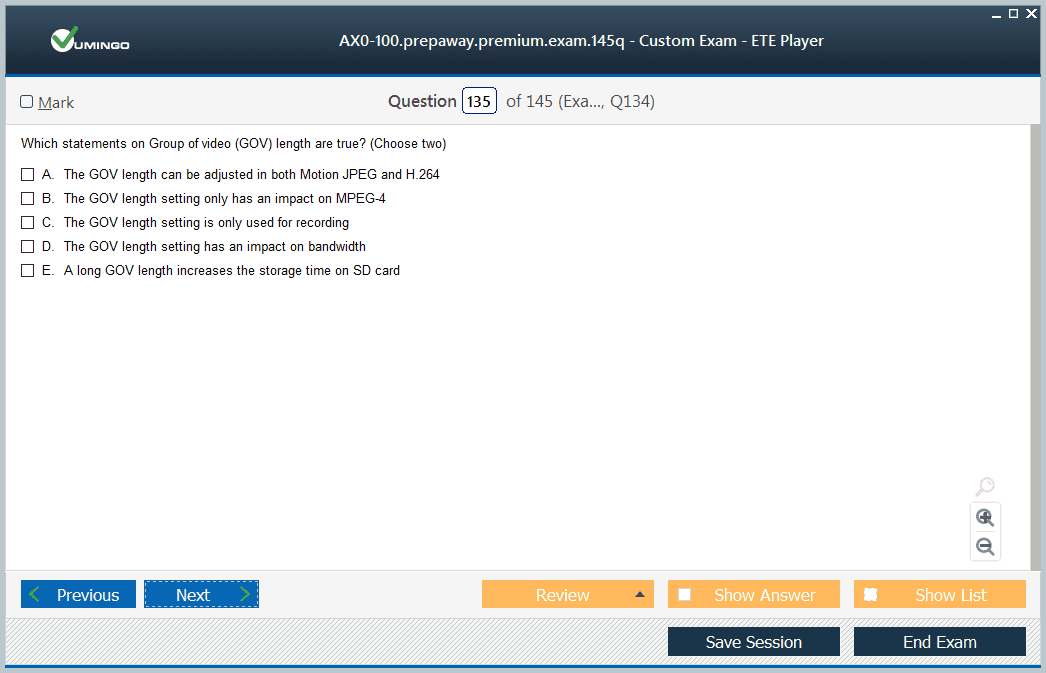
Video compression affects bandwidth, storage, image quality, and server load. Resolution, frame rate, scene motion, noise, GOP structure, and bitrate strategy all influence how much data a stream produces. An engineer who only memorizes that one codec is “better†than another misses the reason compression settings need to be tested against the actual scene and evidence requirement.
For capacity planning, estimates should be treated as models rather than guarantees. A quiet hallway and a busy street can produce different bitrates under similar nominal settings. Retention calculations should include realistic activity assumptions and overhead, then be validated with live streams. This discipline remains central to current ANVE preparation even if the terminology in an older AX0-100 resource is dated.
Video management software is where cameras become an operational system
A VMS handles live viewing, recording, search, user access, event handling, device management, and often analytics or integrations. Troubleshooting therefore needs to distinguish between the camera stream and the VMS workflow. If the camera’s direct live view is healthy but recorded video is missing, the investigation should move toward VMS configuration, storage, server health, credentials, or network paths rather than replacing the camera.
Operators also shape design requirements. A system with hundreds of cameras needs meaningful views, event prioritization, naming, maps, permissions, and search workflows so that staff can find what matters. AX0-100-era training that focuses on end-to-end system behavior is still useful; material tied to obsolete VMS versions should be treated only as historical context.
Current deployments also integrate video with analytics, audio, access control, intercom, and event-driven automation more often than early network-video programs did. That changes the troubleshooting boundary. A camera can have a healthy stream while metadata is missing, an analytic rule is not armed, or an external event never reaches the VMS. When diagnosing an integrated workflow, trace the event from source to destination and verify credentials, time synchronization, event configuration, network reachability, and the receiving application separately. The ANVE knowledge map reflects this broader system view, so candidates moving from AX0-100 material should add integration scenarios rather than studying cameras as isolated endpoints.
Security expectations have become more explicit in the current program
Network video devices can hold credentials, process sensitive imagery, communicate with servers, and expose management interfaces. Modern deployments therefore require deliberate security: unique passwords, controlled administrator access, firmware maintenance, encrypted management, certificate use where appropriate, network segmentation, service hardening, and an inventory that supports lifecycle updates. Leaving devices on broad flat networks with default settings is no longer acceptable practice.
This is one area where relying heavily on old AX0-100 preparation can create a real gap. Security guidance has matured along with the products and threat environment. The current ANVE blueprint explicitly includes networking and cybersecurity, so candidates should use present Axis hardening and lifecycle guidance rather than assuming that an older networking section represents the full security expectation.
Physical security and cyber security also meet at the device lifecycle. A camera that is mounted securely but left with unmanaged credentials is not well protected; a perfectly hardened camera that cannot be safely serviced at height is not maintainable. Current practice should document device ownership, mounting and environmental conditions, network location, software version, credential custody, and the approved procedure for replacement or reset. These details help the operations team respond to both faults and security events without improvising under pressure.
Installation quality determines whether the design survives real conditions
A camera selected correctly on paper can still fail in the field because of vibration, water ingress, bad focus, reflections, dirt, weak mounting, poor cable termination, or an obstructed view. Installation should verify mounting surface, environmental rating, cable route, weather sealing, orientation, focus, scene composition, and image performance in the lighting conditions that matter to the use case.
Maintainability deserves attention too. Devices need documented names, locations, IP addresses, credentials ownership, firmware state, and physical access plans. A camera mounted where it cannot be safely serviced may work on commissioning day but create expensive operational problems later. Current Axis certification preparation treats installation and troubleshooting as a knowledge area because field quality is inseparable from system design.
Moving from AX0-100 to ANVE means updating the blueprint, not relearning everything
The current ANVE exam formalizes eight knowledge areas and uses current Axis product and best-practice context. A professional with older AX0-100 knowledge does not need to discard networking, optics, compression, design, VMS, or installation fundamentals. The task is to refresh them against current camera capabilities, cybersecurity expectations, integration methods, analytics, tools, and exam logistics.
Use Axis’s current preparation guide, Network Video Fundamentals training, Technical Guide to Network Video, knowledge check, and practice test to identify gaps. Then spend hands-on time with current devices and management software. The transition from an old exam code to a current one is easiest when the candidate treats certification as a validation of present competence rather than an exercise in preserving a historical question set.
The most efficient transition is to compare concepts, not code names. Keep the networking, optics, image-quality, compression, system-design, installation, and troubleshooting knowledge that remains valid, then use the current ANVE guide to identify areas whose emphasis has expanded. Cybersecurity, modern analytics, current product capabilities, and integration workflows deserve particular attention. Also update the administrative facts: the live program uses the ANVE name and current Pearson VUE process, so AX0-100 should be treated as a historical identifier rather than a booking option. That keeps legacy study material useful without allowing it to define the current exam.
A practical gap analysis can be done with a small lab. Configure a current Axis device, deliberately change exposure and compression settings, observe bandwidth, place the device on a controlled network segment, integrate it with management software, create an event or analytic trigger, and then troubleshoot one broken dependency at a time. The exercise touches several current knowledge areas and quickly reveals whether an older candidate’s understanding is conceptual or merely memorized. It also provides the kind of cause-and-effect experience that multiple-choice preparation alone cannot supply.
Why customers love us?
What do our customers say?
The resources provided for the Axis Communications certification exam were exceptional. The exam dumps and video courses offered clear and concise explanations of each topic. I felt thoroughly prepared for the AX0-100 test and passed with ease.
Studying for the Axis Communications certification exam was a breeze with the comprehensive materials from this site. The detailed study guides and accurate exam dumps helped me understand every concept. I aced the AX0-100 exam on my first try!
I was impressed with the quality of the AX0-100 preparation materials for the Axis Communications certification exam. The video courses were engaging, and the study guides covered all the essential topics. These resources made a significant difference in my study routine and overall performance. I went into the exam feeling confident and well-prepared.
The AX0-100 materials for the Axis Communications certification exam were invaluable. They provided detailed, concise explanations for each topic, helping me grasp the entire syllabus. After studying with these resources, I was able to tackle the final test questions confidently and successfully.
Thanks to the comprehensive study guides and video courses, I aced the AX0-100 exam. The exam dumps were spot on and helped me understand the types of questions to expect. The certification exam was much less intimidating thanks to their excellent prep materials. So, I highly recommend their services for anyone preparing for this certification exam.
Achieving my Axis Communications certification was a seamless experience. The detailed study guide and practice questions ensured I was fully prepared for AX0-100. The customer support was responsive and helpful throughout my journey. Highly recommend their services for anyone preparing for their certification test.
I couldn't be happier with my certification results! The study materials were comprehensive and easy to understand, making my preparation for the AX0-100 stress-free. Using these resources, I was able to pass my exam on the first attempt. They are a must-have for anyone serious about advancing their career.
The practice exams were incredibly helpful in familiarizing me with the actual test format. I felt confident and well-prepared going into my AX0-100 certification exam. The support and guidance provided were top-notch. I couldn't have obtained my Axis Communications certification without these amazing tools!
The materials provided for the AX0-100 were comprehensive and very well-structured. The practice tests were particularly useful in building my confidence and understanding the exam format. After using these materials, I felt well-prepared and was able to solve all the questions on the final test with ease. Passing the certification exam was a huge relief! I feel much more competent in my role. Thank you!
The certification prep was excellent. The content was up-to-date and aligned perfectly with the exam requirements. I appreciated the clear explanations and real-world examples that made complex topics easier to grasp. I passed AX0-100 successfully. It was a game-changer for my career in IT!


