
- Home
- Avaya Certifications
- 72200X Avaya Aura Core Components Support Exam Dumps
Pass Avaya 72200X Exam in First Attempt Guaranteed!
Get 100% Latest Exam Questions, Accurate & Verified Answers to Pass the Actual Exam!
30 Days Free Updates, Instant Download!


72200X Premium File
- Premium File 62 Questions & Answers. Last Update: Oct 12, 2026
Whats Included:
- Latest Questions
- 100% Accurate Answers
- Fast Exam Updates
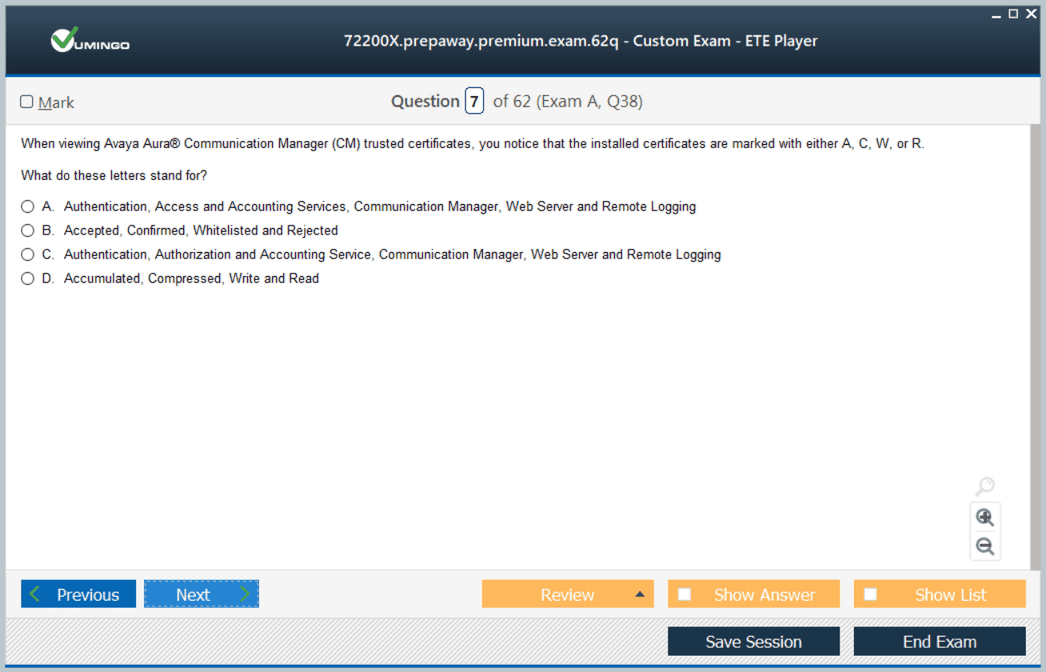
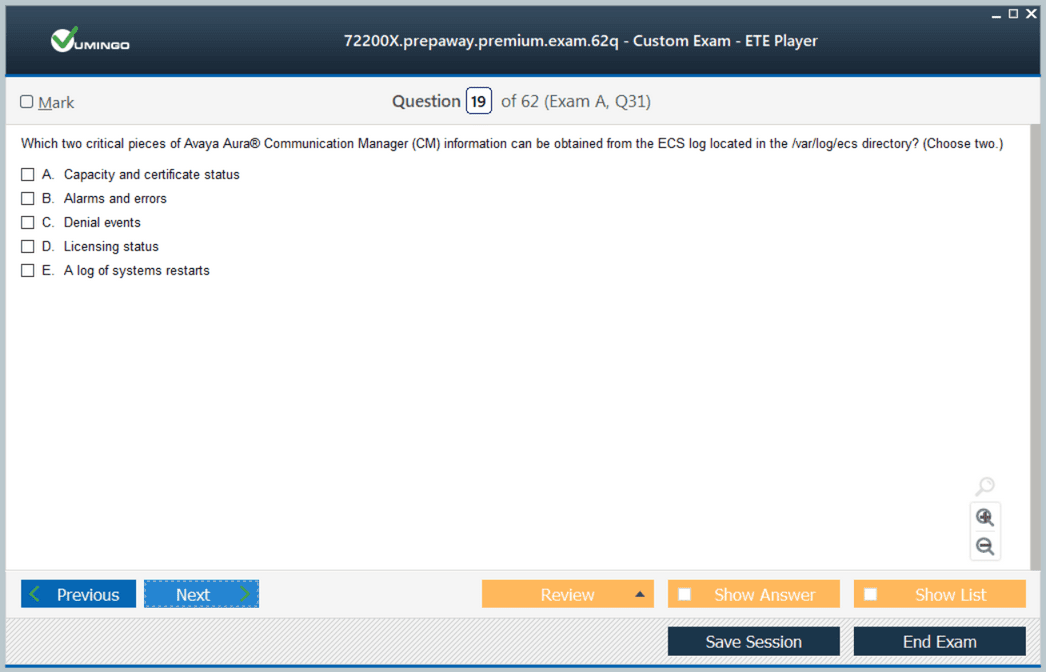
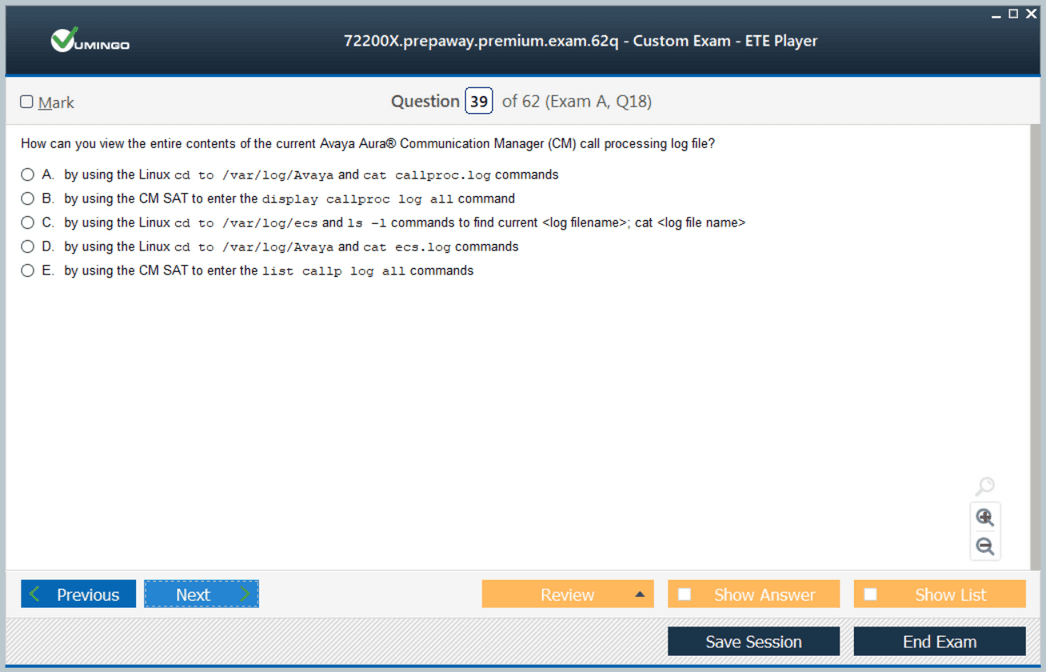
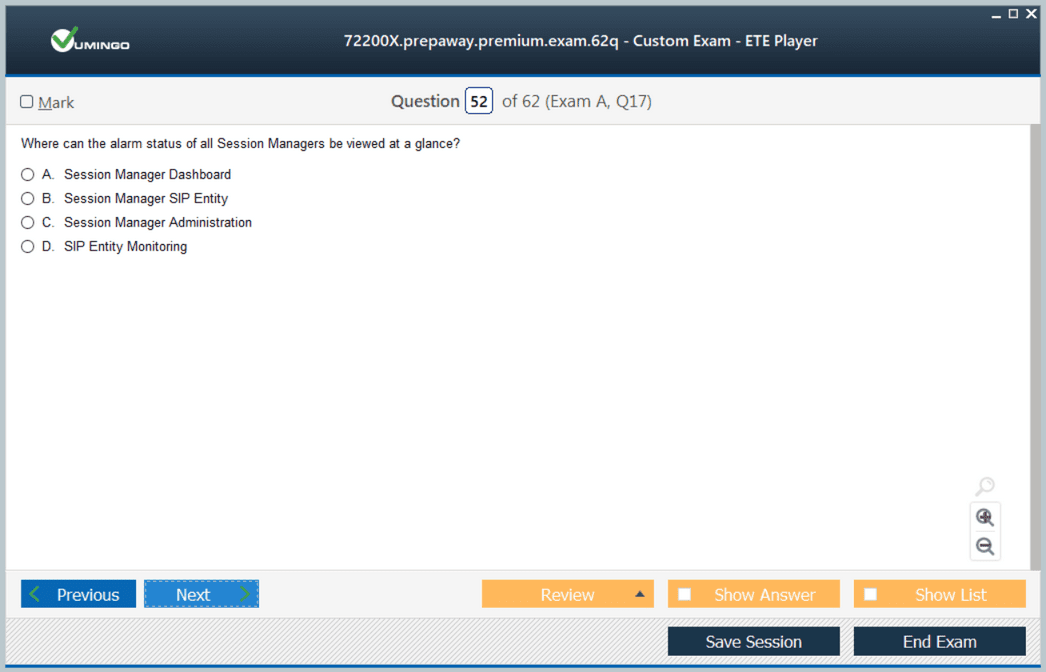
Last Week Results!
 83% students found the test questions almost same
All Avaya 72200X certification exam dumps, study guide, training courses are Prepared by industry experts. PrepAway's ETE files povide the 72200X Avaya Aura Core Components Support Exam practice test questions and answers & exam dumps, study guide and training courses help you study and pass hassle-free!
Avaya 72200X: Retired Aura Core Components Support Exam
Avaya 72200X was the earlier five-digit Avaya Aura Core Components Support Exam for the ACSS-7220 credential. Avaya replaced it with 72201X and set April 30, 2022 as the last delivery date for 72200X. It therefore represents an earlier support generation and should not be used as a current registration or product-compatibility guide.
The exam paired with the implementation side represented by 71200X, and its direct successor was 72201X. The technical themes remain useful in older Aura estates: establish a healthy baseline, isolate signaling from media, understand component dependencies, and recover service methodically. The Avaya certifications inventory provides the wider historical context.
Core support begins by defining what normal looks like
A support team needs a reference for normal server state, endpoint registration, trunk status, alarms, routing, certificate health, synchronization, and resource utilization. Without that baseline, an engineer can misinterpret a longstanding configuration condition as the cause of a new incident. The baseline should be captured during stable operation and updated after planned changes.
User reports should be translated into technical scope. “Phones are down†may mean one site cannot register, one route pattern fails, one media path has no audio, or an application cannot place calls. Asking who, where, when, and which call types are affected reduces the search area before any configuration is changed.
Support procedures should preserve evidence before restart or failover actions. Service restarts can erase transient state and make the original cause harder to find. Collecting alarms, traces, process status, timestamps, and recent change records first gives the team a chance to understand the failure instead of merely restoring service temporarily.
Baseline data should include release and patch levels because two apparently identical nodes may behave differently after uneven maintenance. Recording that information prevents support from comparing states that are not truly equivalent and helps identify when a symptom began after a partial upgrade.
Alarm review should connect platform events with customer impact
Avaya components can generate many alarms, and not every alarm has the same operational importance. Engineers should correlate severity, timestamp, affected object, and user impact rather than clearing alarms as a housekeeping exercise. A repeated minor alarm can be more useful than a single major event if it aligns with the first time users noticed degradation.
Alarm history also helps identify intermittent problems. A network interface that flaps briefly or a certificate-validation failure that occurs only during a scheduled job may not be visible when the engineer logs in later. Reviewing patterns over time provides a stronger basis for escalation and prevents the investigation from focusing only on the current snapshot.
After corrective action, the team should verify that alarms remain cleared under normal workload. A reset that removes an alarm without correcting its trigger is not a complete resolution. Closure criteria should include both restored service and evidence that the underlying condition no longer recurs.
Alarm ownership should be assigned. If every team assumes another group reviews a class of infrastructure or application alerts, important warnings can persist until users are affected. A support model should state who receives, triages, and closes each major alarm family.
Registration failures require separation of endpoint, network, and server causes
Endpoint registration crosses several layers: local configuration, DHCP or addressing, DNS, network routing, certificates or credentials, signaling services, and the target call server. Troubleshooting should move through those layers in a known order. Reconfiguring the endpoint repeatedly wastes time if the real fault is a blocked route or unavailable server.
Comparing an affected endpoint with a known-good device on the same and a different network segment can be highly informative. The comparison can isolate whether the issue follows the user, device, subnet, location, or server. This evidence-driven method is more reliable than assuming all registration failures have the same root cause.
Where remote or branch survivability exists, support should also verify whether the endpoint is registered to the expected controller. A device may appear operational but be attached to a fallback component after a WAN event. Understanding that state prevents the team from troubleshooting normal survivable behavior as though it were a platform defect.
Endpoint troubleshooting should include power, cabling, and local switch conditions where relevant. A sophisticated server investigation cannot fix a device that is not receiving network connectivity. Starting with the simplest verifiable layer saves time and prevents unnecessary changes to shared systems.
SIP signaling should be read as a transaction sequence
A failed call produces a series of requests and responses that show which component accepted, rejected, or redirected the session. Support engineers should identify the originating entity, selected route, next hop, response code, and any number or header transformations. This is more useful than searching configuration screens for something that merely looks unusual.
The signal path should be separated from the media path. A call can establish successfully and still have one-way or no audio because RTP follows different network routes and policies. Likewise, a media complaint does not automatically mean Session Manager routing is wrong. Distinguishing these planes keeps the investigation focused on the layer that actually failed.
Timestamps from SIP traces, gateway logs, and user reports should use synchronized time. Even a small clock difference makes cross-system correlation difficult. NTP is therefore part of supportability, not only an installation prerequisite, because accurate time allows engineers to reconstruct the sequence of an incident.
SIP trace review benefits from a consistent capture method. Engineers should record the call identifiers, endpoints, and time window so traces from different systems can be matched. Ad hoc packet captures without context create large files but little diagnostic value.
Dial-plan troubleshooting should follow the matching logic
Communication Manager can contain many route patterns, extensions, feature codes, coverage paths, and trunk selections. When a number fails, support should determine which rule matched and whether that rule was expected. The first visible error may occur at the far end even though the wrong route was selected earlier because of pattern precedence or digit manipulation.
Known-good comparisons help here as well. A working number with the same destination class can reveal whether the issue is specific to one prefix, one location, or one carrier path. Engineers should document changes to digit conversion and route selection carefully because a small edit can affect a large range of calls.
After a dial-plan fix, regression testing should include neighboring number ranges and important exception routes. Solving one pattern by making it more general can accidentally capture traffic that previously matched another rule. A support change is complete only when the intended call works and unaffected call classes still behave correctly.
Route-pattern changes should be peer reviewed when they affect broad ranges. A second engineer can spot overlaps or unintended precedence that the change author missed. Peer review is a simple control with high value in a system where one pattern can influence many users.
Media quality problems need measurable network evidence
Poor audio can be caused by packet loss, jitter, delay, codec mismatch, transcoding, bandwidth pressure, or asymmetric routing. Support should collect network and media evidence rather than changing voice parameters blindly. Call-quality data is strongest when it can be tied to a specific timestamp, endpoint pair, route, and network region.
One-way audio often indicates that signaling succeeded while the return media path did not. Firewalls, NAT, incorrect addresses in session descriptions, and routing asymmetry can all produce that symptom. Tracing the negotiated media addresses and confirming reachability in both directions is more productive than repeatedly restarting endpoints.
Baselines matter because acceptable measurements depend on the normal network. A WAN site may have higher latency than a campus location while still delivering usable service. Historical performance helps engineers recognize a genuine deterioration rather than treating every nonzero metric as a fault.
Quality incidents should be correlated with network events and utilization. A burst of packet loss during a WAN failover has a different remedy from persistent poor quality on one endpoint. Matching voice symptoms with infrastructure telemetry turns subjective complaints into measurable conditions.
Backups and recovery procedures should be tested before an outage
Support teams need to know which configuration, database, certificate, and application data must be protected for each component. A backup schedule is useful only if the files are complete, accessible, and compatible with a documented restore process. Older Aura environments may also contain hardware or software constraints that make replacement during an emergency more complex than the original design assumed.
Recovery planning should establish dependencies and order. Restoring one management component before the systems it controls are ready can create synchronization or registration problems. The runbook should identify which services must be available first, how restored data is validated, and what user-facing tests prove that the environment is healthy again.
Periodic recovery exercises can be limited in scope while still providing evidence. Restoring configuration to a lab or validating backup integrity against a non-production target is better than discovering during an outage that credentials, encryption keys, or media are missing. Support maturity is measured partly by how confidently the team can recover, not just how quickly it can diagnose.
Recovery documentation should list prerequisites such as licenses, credentials, encryption keys, and installation media. Restoring data is not enough if the replacement environment cannot start or authenticate. Keeping those dependencies with the recovery plan makes the process executable under pressure.
72200X is a predecessor reference, not a modern support syllabus
Avaya retired 72200X in 2022 when 72201X became the updated support exam. The later 72201X proctored exam was itself retired in 2025 as Avaya moved testing online. This layered history is why candidates should separate technical concepts from credential administration when working with old training material.
The durable concepts remain strong: establish baselines, interpret alarms, isolate registration, read SIP transactions, follow dial-plan logic, measure media, and prepare recovery. Those methods help with legacy Aura environments even when exact commands or component versions have changed. Current documentation should supply release-specific procedures.
For teams inheriting an older estate, 72200X-era material can also help decode project documents and support notes written by previous engineers. The best use is to translate that historical vocabulary into a current topology and runbook, preserving useful operational knowledge while discarding obsolete exam and version assumptions.
Legacy support documents should be annotated when commands or interfaces no longer match the installed release. Preserving useful reasoning while marking obsolete procedures prevents technicians from applying an old fix mechanically to a newer system.
Avaya 72200X practice test questions and answers, training course, study guide are uploaded in ETE Files format by real users. Study and Pass 72200X Avaya Aura Core Components Support Exam certification exam dumps & practice test questions and answers are to help students.
Why customers love us?
What do our customers say?
The resources provided for the Avaya certification exam were exceptional. The exam dumps and video courses offered clear and concise explanations of each topic. I felt thoroughly prepared for the 72200X test and passed with ease.
Studying for the Avaya certification exam was a breeze with the comprehensive materials from this site. The detailed study guides and accurate exam dumps helped me understand every concept. I aced the 72200X exam on my first try!
I was impressed with the quality of the 72200X preparation materials for the Avaya certification exam. The video courses were engaging, and the study guides covered all the essential topics. These resources made a significant difference in my study routine and overall performance. I went into the exam feeling confident and well-prepared.
The 72200X materials for the Avaya certification exam were invaluable. They provided detailed, concise explanations for each topic, helping me grasp the entire syllabus. After studying with these resources, I was able to tackle the final test questions confidently and successfully.
Thanks to the comprehensive study guides and video courses, I aced the 72200X exam. The exam dumps were spot on and helped me understand the types of questions to expect. The certification exam was much less intimidating thanks to their excellent prep materials. So, I highly recommend their services for anyone preparing for this certification exam.
Achieving my Avaya certification was a seamless experience. The detailed study guide and practice questions ensured I was fully prepared for 72200X. The customer support was responsive and helpful throughout my journey. Highly recommend their services for anyone preparing for their certification test.
I couldn't be happier with my certification results! The study materials were comprehensive and easy to understand, making my preparation for the 72200X stress-free. Using these resources, I was able to pass my exam on the first attempt. They are a must-have for anyone serious about advancing their career.
The practice exams were incredibly helpful in familiarizing me with the actual test format. I felt confident and well-prepared going into my 72200X certification exam. The support and guidance provided were top-notch. I couldn't have obtained my Avaya certification without these amazing tools!
The materials provided for the 72200X were comprehensive and very well-structured. The practice tests were particularly useful in building my confidence and understanding the exam format. After using these materials, I felt well-prepared and was able to solve all the questions on the final test with ease. Passing the certification exam was a huge relief! I feel much more competent in my role. Thank you!
The certification prep was excellent. The content was up-to-date and aligned perfectly with the exam requirements. I appreciated the clear explanations and real-world examples that made complex topics easier to grasp. I passed 72200X successfully. It was a game-changer for my career in IT!


