
- Home
- VMware Certifications
- 5V0-62.19 VMware Workspace ONE Design and Advanced Integration Specialist Dumps
Pass VMware 5V0-62.19 Exam in First Attempt Guaranteed!
Get 100% Latest Exam Questions, Accurate & Verified Answers to Pass the Actual Exam!
30 Days Free Updates, Instant Download!


5V0-62.19 Premium File
- Premium File 63 Questions & Answers. Last Update: Oct 19, 2026
Whats Included:
- Latest Questions
- 100% Accurate Answers
- Fast Exam Updates
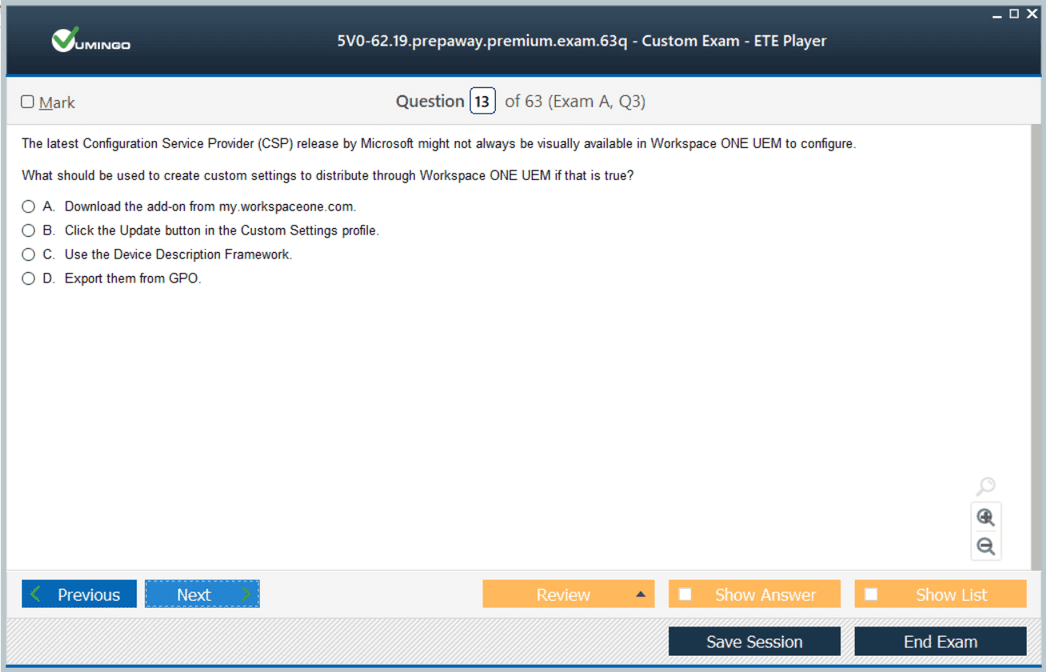
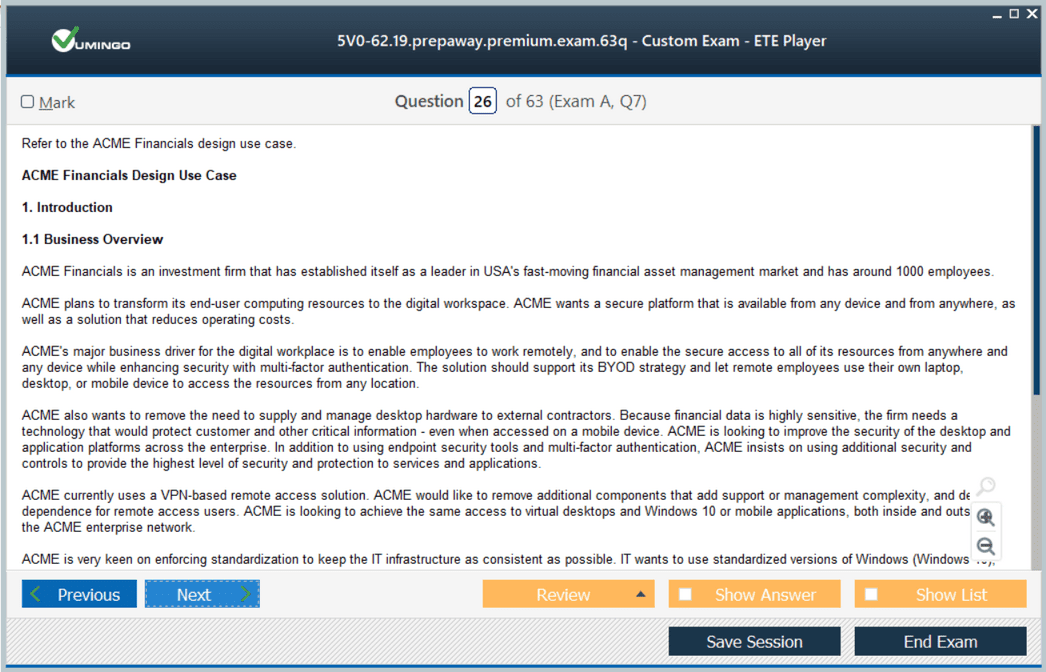
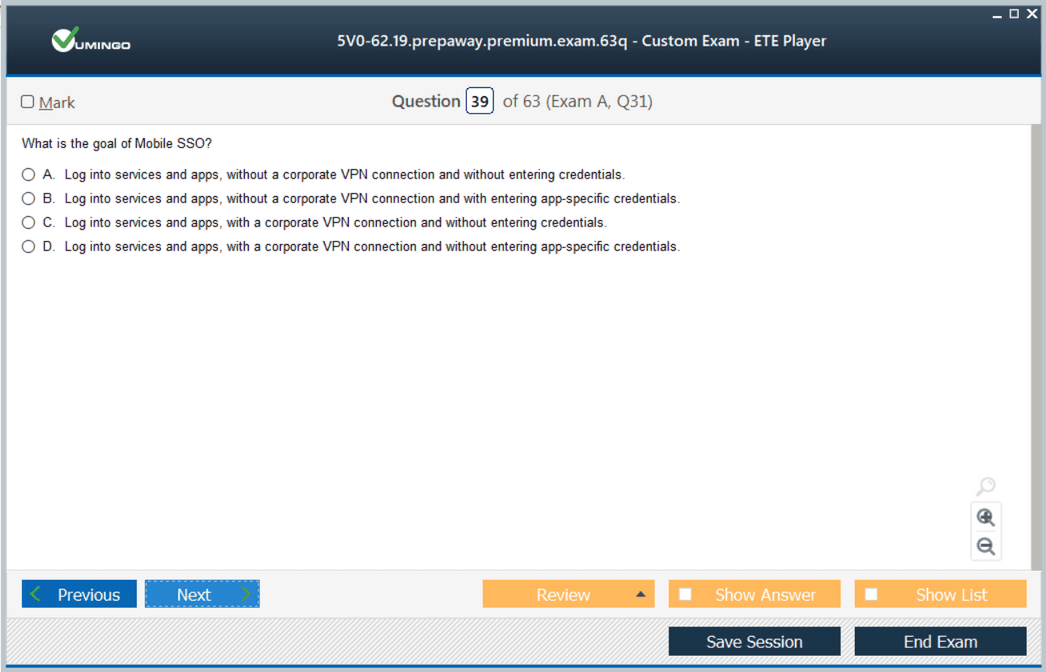
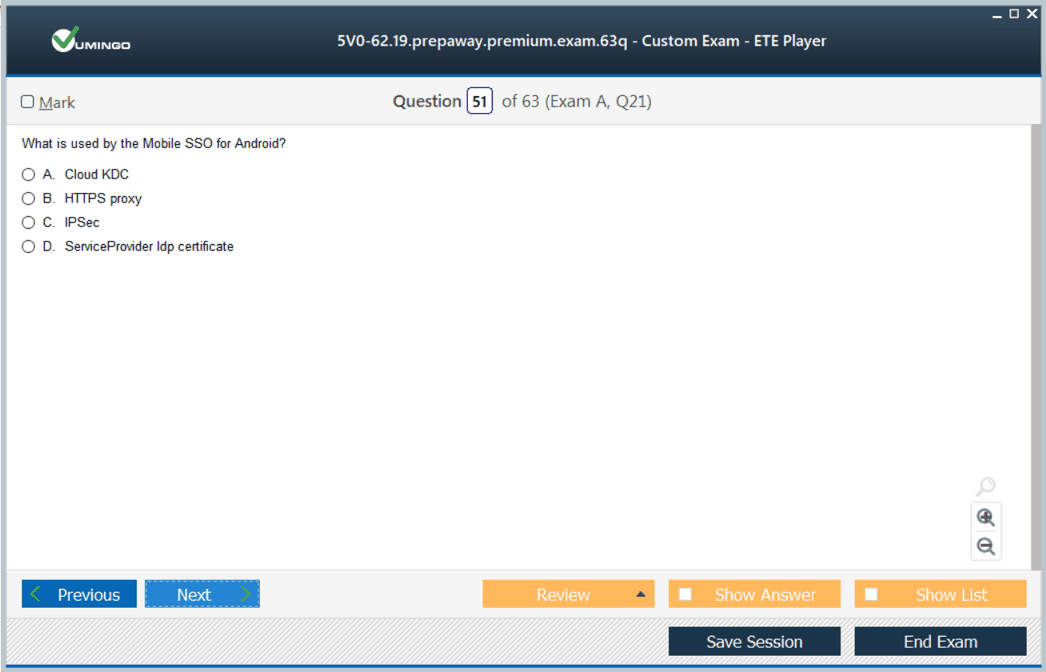
Last Week Results!
 83% students found the test questions almost same
All VMware 5V0-62.19 certification exam dumps, study guide, training courses are Prepared by industry experts. PrepAway's ETE files povide the 5V0-62.19 VMware Workspace ONE Design and Advanced Integration Specialist practice test questions and answers & exam dumps, study guide and training courses help you study and pass hassle-free!
5V0-62.19 Workspace ONE Design and Advanced Integration: A Retired Blueprint for Enterprise Mobility Architecture
5V0-62.19 was the Workspace ONE Design and Advanced Integration Specialist exam. Broadcom lists it as retired on June 30, 2022. It belongs to an earlier VMware-era Workspace ONE portfolio, but the design problems it emphasized remain relevant wherever organizations manage mobile and desktop endpoints through identity, policy, applications, certificates, gateways, and enterprise services.
This was not merely a console-administration blueprint. Design work asks what the environment must accomplish, which risks and constraints matter, where components should be placed, how users and devices establish trust, how applications and data are reached, and how the service survives failures. Those questions age more slowly than specific screens or product branding.
For historical progression, compare the retired 5V0-61.19 UEM Specialist with the later 5V0-61.22 Advanced Integration, 5V0-62.22 UEM Troubleshooting, and 2V0-62.23 Workspace ONE Professional. Present-day product and certification context should be verified through Omnissa certifications.
A design should begin with personas, use cases, data sensitivity, and operating constraints
Identify who will use the service: corporate employees, contractors, frontline workers, shared-device users, executives, developers, or other populations. For each persona, document device ownership, supported platforms, applications, data classes, connectivity patterns, privacy expectations, and support model.
Turn business statements into measurable requirements. “Secure mobile access” should become specific controls such as managed applications, encrypted local data, certificate-based network access, conditional access, remote enterprise-data removal, and a recovery target for the services that provide those controls.
Constraints belong in the same document. Existing identity providers, certificate authorities, network segmentation, cloud restrictions, data residency, mergers, legacy applications, and support staffing can all shape the architecture more strongly than a preferred product feature.
Nonfunctional requirements deserve equal attention. Define expected enrollment volume, peak authentication demand, geographic latency, maintenance windows, audit retention, administrative separation, and support hours. These factors drive scale and placement decisions even when they do not appear in an end-user feature list. A technically functional design can still fail the business if it cannot absorb onboarding peaks or if every maintenance event requires a global outage.
Logical architecture should separate identity, management, access, and application responsibilities
Draw the environment as services before drawing servers. A user authenticates, a device enrolls, configuration is delivered, trust is evaluated, an application requests access, and data is returned. Label which logical component is responsible for each step and what information it needs from another service.
This prevents architecture from becoming a collection of appliance icons. If an integration changes later, the logical responsibility remains clear even when the implementation moves to a new component or cloud service.
Identity is especially central because the same user may access managed and unmanaged devices, browser sessions, native applications, SaaS, and internal services. Identity as a security perimeter provides a useful way to reason about that shared control plane.
Physical placement must reflect trust boundaries, network paths, and ownership
Components that accept internet traffic belong in a different trust context from internal directory or certificate services. Design firewall policy and routes so edge components can reach only the internal services they require. Avoid broad “any-to-any” access simply because several integrations are being deployed at once.
DNS, load balancing, proxy behavior, NAT, and certificate names should be part of the architecture documentation. They are common causes of deployment and failover problems but are often missing from high-level diagrams.
If some services are cloud-hosted and others remain on-premises, record the dependency on outbound connectivity, private links, proxies, and identity synchronization. A hybrid design needs explicit behavior for loss of either side.
Administrative access should have its own design. Decide which teams can change endpoint policy, identity configuration, gateways, certificates, and infrastructure; require strong authentication; and record privileged actions. Separation of duties is especially useful during incidents because it reduces the temptation to solve a problem by granting broad access that later becomes permanent.
Enrollment and device-management models should match ownership and privacy requirements
Choose the management model by asking what the organization must control. Corporate-owned devices may justify full management, while personally owned devices may need a narrower application or work-profile boundary. Shared and purpose-built devices require different identity and session assumptions again.
The design should define platform support, minimum OS versions, enrollment prerequisites, naming, organizational placement, smart-group logic, and what occurs when a device falls outside policy. Device lifecycle includes replacement, ownership transfer, loss, retirement, and employee departure, not just first enrollment.
A unified endpoint strategy still has to respect platform-specific controls. Managing Windows and mobile endpoints as one estate still requires platform-specific controls because common governance does not remove operating-system differences.
Identity and conditional access should combine user assurance with device assurance
Authentication strength should reflect application risk and context. Certificates, device compliance, network location, multifactor authentication, and account risk can be combined, but the policy should remain understandable enough to troubleshoot and govern.
Define the source of each trust signal. If an application requires a compliant managed device, the identity system needs a reliable way to consume that management state. Stale or delayed signals can create both false blocks and unsafe access.
The relationship described in conditional access and trusted device signals should be explicit in the design: identity policy is only as reliable as the endpoint evidence it receives.
Certificates are architecture components because many endpoint services depend on them
Certificate-based Wi-Fi, VPN, email, and authentication introduce issuing authorities, templates, enrollment services, trust stores, renewal periods, revocation, and disaster-recovery requirements. A design should identify the certificate path for each service rather than treating PKI as a background utility.
Lifecycle is as important as issuance. Plan what happens when a device is lost, a user changes role, a certificate expires, an intermediate authority changes, or the PKI team rotates keys. Large endpoint estates amplify certificate mistakes quickly.
PKI trust chains and failure modes connect application symptoms to the certificate dependencies that can actually cause them.
Application, tunnel, email, and content design should preserve data boundaries
Applications may reach SaaS directly, use secure tunnels to private services, or rely on gateways for email and content. For each path, document authentication, network route, inspection, data-at-rest behavior, copy/paste or sharing restrictions, and what happens when enterprise access is withdrawn.
Least privilege matters at the network layer. Per-app access should reach only required destinations rather than exposing a broad internal subnet. If a security service is inserted, define failure behavior and capacity so the control does not become an unexplained outage point.
A zero-trust approach is useful when it remains concrete. Zero-trust architecture across identity, data, applications, and networks should translate into specific verification and segmentation decisions, not simply a label on the diagram.
Data-loss controls should be tested at the boundaries users actually encounter: opening corporate attachments in personal applications, copying data between managed and unmanaged contexts, saving files to consumer storage, printing, screenshots where the platform allows control, and sharing through sanctioned collaboration tools. The architecture should state which flows are blocked, which are logged, and which are permitted because business productivity requires them. A policy that cannot be explained in these concrete terms is difficult to support.
Availability design has to include directories, PKI, gateways, DNS, and upstream networks
Redundant UEM nodes or gateways do not provide an available service if every transaction depends on one directory connector, certificate service, load balancer, DNS zone, or internet circuit. Create a dependency matrix and decide which components share a failure domain.
Define recovery targets for user outcomes such as enrollment, authentication, application access, and administrative control. The service may remain partially available even when one function is degraded, and the recovery plan should prioritize the capabilities the business needs first.
Backups support recovery but do not prove continuity. The distinction in backup, recovery, and continuity is important for any architecture that spans several products and operational teams.
Capacity during failure should be modeled explicitly. A two-node service may survive one node technically while the remaining node cannot handle peak enrollment or authentication load. Likewise, a secondary site may be reachable but lack the same certificate, directory, or application connectivity. Availability targets need both functional recovery and enough performance to support the required user population.
Operational readiness also requires monitoring each dependency from the perspective of the service that uses it. A certificate authority can be “up” while enrollment requests fail, and DNS can answer generic probes while the endpoint service name resolves incorrectly from one network segment. Synthetic enrollment, authentication, and application-access tests can expose these partial failures earlier than infrastructure-only health checks.
A legacy design blueprint is most valuable when used to practice architecture tradeoffs
Take a realistic organization with several personas, two major operating systems, a private application, SaaS, certificate-based Wi-Fi, and remote users. Build logical and physical diagrams, trust boundaries, identity flows, endpoint policy, application paths, and recovery assumptions. Then explain every major choice in terms of a requirement or constraint.
Challenge the design with changes: a new acquisition, stricter privacy requirements, loss of an on-premises data center, a move to cloud identity, or a new device ownership model. A sound architecture should adapt through explicit assumptions rather than collapse because every integration was tightly coupled.
That exercise is the strongest legacy of 5V0-62.19. Product ownership and certification paths have changed, but design quality still depends on requirements, trust, service dependencies, failure behavior, and an operating model that can explain what happens from the user's device all the way to the application.
Document rejected options as well as the selected architecture. Recording why a team avoided a full-tunnel design, chose cloud over on-premises components, accepted a single regional dependency, or separated two device populations makes later change easier to evaluate. When requirements shift, architects can revisit the original tradeoff instead of reverse-engineering intent from configuration years later.
VMware 5V0-62.19 practice test questions and answers, training course, study guide are uploaded in ETE Files format by real users. Study and Pass 5V0-62.19 VMware Workspace ONE Design and Advanced Integration Specialist certification exam dumps & practice test questions and answers are to help students.
- 2V0-17.25 - VMware Cloud Foundation 9.0 Administrator
- 2V0-13.25 - VMware Cloud Foundation 9.0 Architect
- 3V0-25.25 - Advanced VMware Cloud Foundation 9.0 Networking
- 2V0-16.25 - VMware vSphere Foundation 9.0 Administrator
- 3V0-21.25 - Advanced VMware Cloud Foundation 9.0 Automation
- 3V0-24.25 - VMware Certified Advanced Professional - VMware Cloud Foundation VKS
- 2V0-15.25 - VMware Cloud Foundation 9.0 Support
- 2V0-21.23 - VMware vSphere 8.x Professional
- 3V0-11.26 - VMware Certified Advanced Professional - VMware Cloud Foundation 9 Administrator
- 3V0-22.25 - Advanced VMware Cloud Foundation 9.0 Operations
- 2V0-41.24 - VMware NSX 4.X Professional V2
- 2V0-72.22 - Professional Develop VMware Spring
- 2V0-51.23 - VMware Horizon 8.x Professional
- 2V0-11.25 - VMware Cloud Foundation 5.2 Administrator
- 1V0-21.20 - Associate VMware Data Center Virtualization
Why customers love us?
What do our customers say?
The resources provided for the VMware certification exam were exceptional. The exam dumps and video courses offered clear and concise explanations of each topic. I felt thoroughly prepared for the 5V0-62.19 test and passed with ease.
Studying for the VMware certification exam was a breeze with the comprehensive materials from this site. The detailed study guides and accurate exam dumps helped me understand every concept. I aced the 5V0-62.19 exam on my first try!
I was impressed with the quality of the 5V0-62.19 preparation materials for the VMware certification exam. The video courses were engaging, and the study guides covered all the essential topics. These resources made a significant difference in my study routine and overall performance. I went into the exam feeling confident and well-prepared.
The 5V0-62.19 materials for the VMware certification exam were invaluable. They provided detailed, concise explanations for each topic, helping me grasp the entire syllabus. After studying with these resources, I was able to tackle the final test questions confidently and successfully.
Thanks to the comprehensive study guides and video courses, I aced the 5V0-62.19 exam. The exam dumps were spot on and helped me understand the types of questions to expect. The certification exam was much less intimidating thanks to their excellent prep materials. So, I highly recommend their services for anyone preparing for this certification exam.
Achieving my VMware certification was a seamless experience. The detailed study guide and practice questions ensured I was fully prepared for 5V0-62.19. The customer support was responsive and helpful throughout my journey. Highly recommend their services for anyone preparing for their certification test.
I couldn't be happier with my certification results! The study materials were comprehensive and easy to understand, making my preparation for the 5V0-62.19 stress-free. Using these resources, I was able to pass my exam on the first attempt. They are a must-have for anyone serious about advancing their career.
The practice exams were incredibly helpful in familiarizing me with the actual test format. I felt confident and well-prepared going into my 5V0-62.19 certification exam. The support and guidance provided were top-notch. I couldn't have obtained my VMware certification without these amazing tools!
The materials provided for the 5V0-62.19 were comprehensive and very well-structured. The practice tests were particularly useful in building my confidence and understanding the exam format. After using these materials, I felt well-prepared and was able to solve all the questions on the final test with ease. Passing the certification exam was a huge relief! I feel much more competent in my role. Thank you!
The certification prep was excellent. The content was up-to-date and aligned perfectly with the exam requirements. I appreciated the clear explanations and real-world examples that made complex topics easier to grasp. I passed 5V0-62.19 successfully. It was a game-changer for my career in IT!


