
- Home
- CIW Certifications
- 1D0-61A CIW Internet Business Associate Dumps
Pass CIW 1D0-61A Exam in First Attempt Guaranteed!
Get 100% Latest Exam Questions, Accurate & Verified Answers to Pass the Actual Exam!
30 Days Free Updates, Instant Download!


1D0-61A Premium File
- Premium File 57 Questions & Answers. Last Update: Oct 01, 2026
Whats Included:
- Latest Questions
- 100% Accurate Answers
- Fast Exam Updates
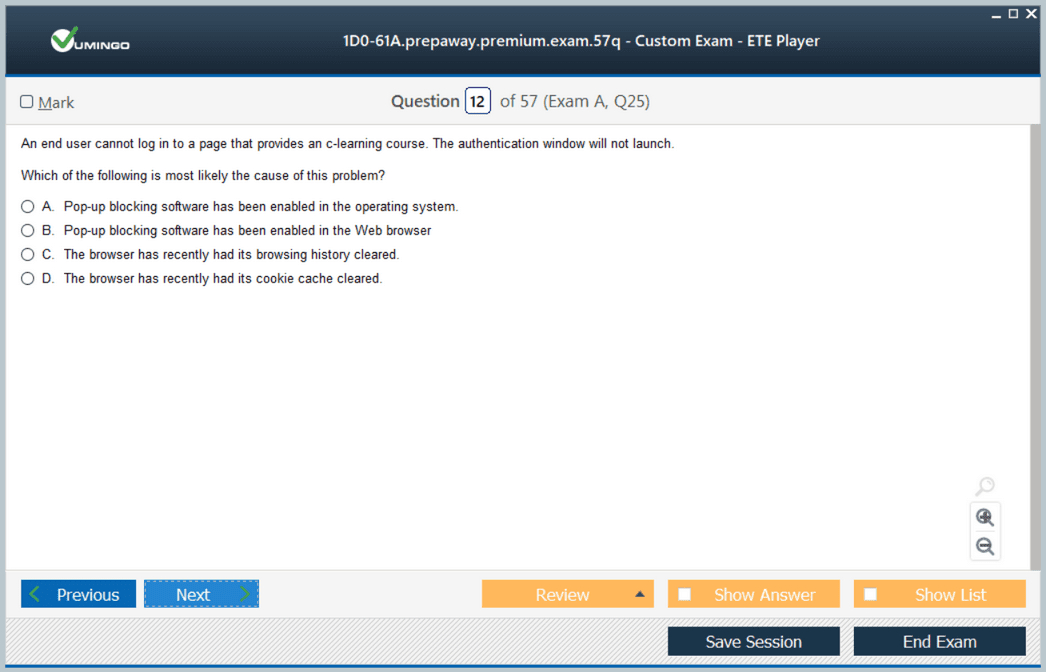
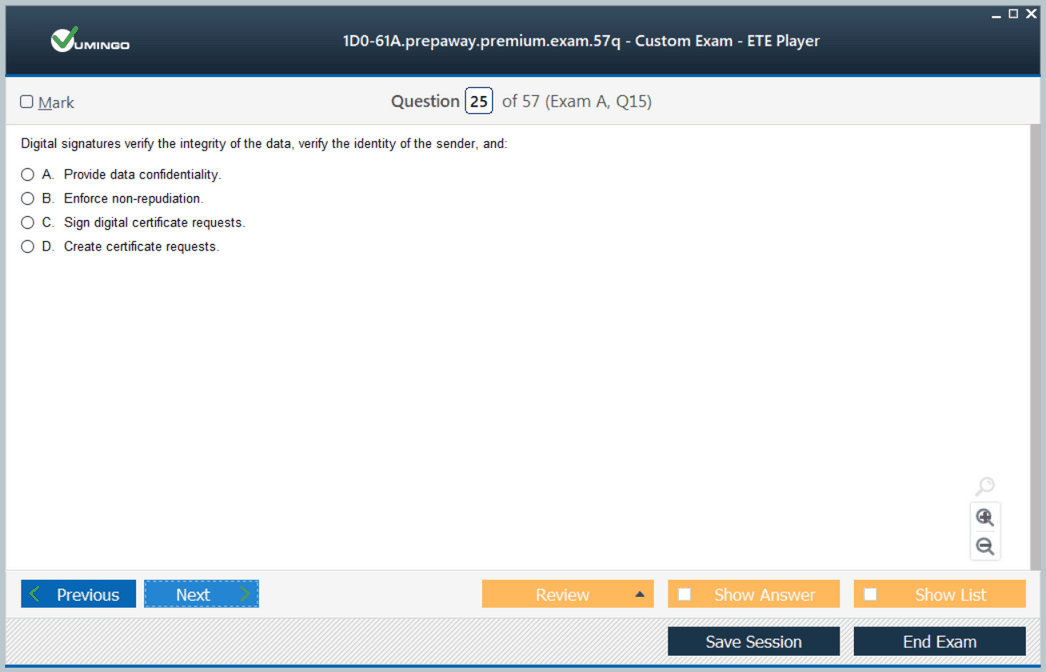
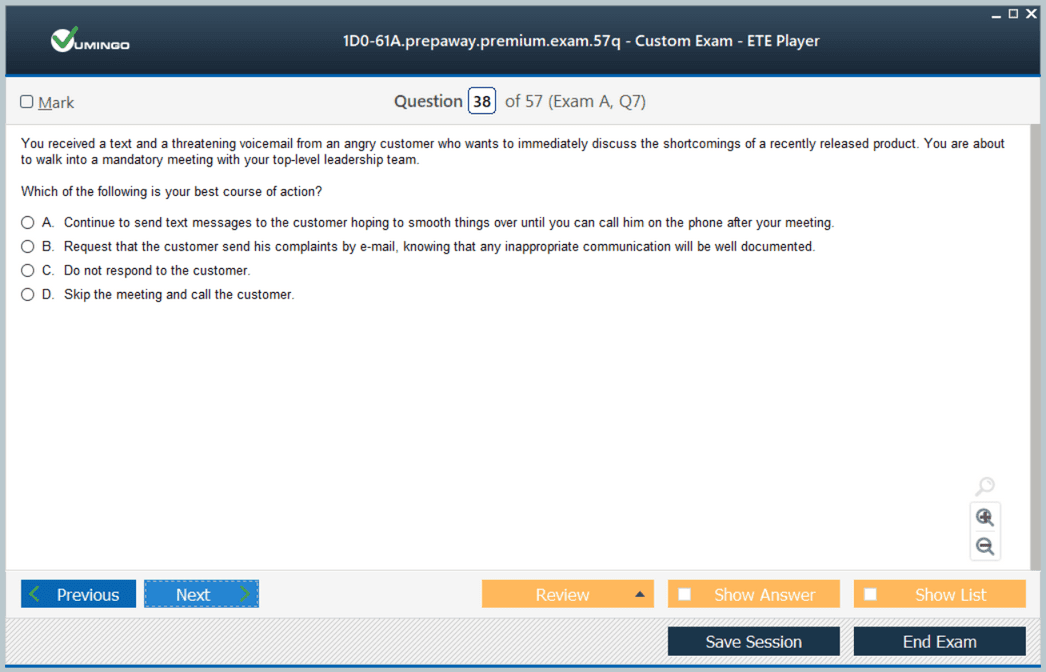
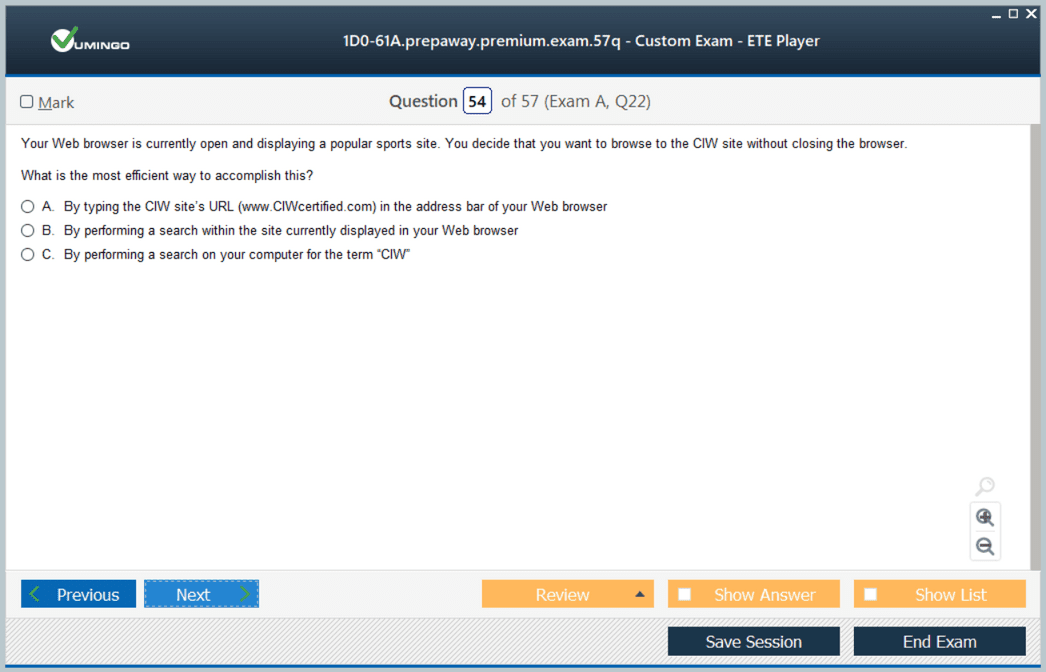
Last Week Results!
 83% students found the test questions almost same
All CIW 1D0-61A certification exam dumps, study guide, training courses are Prepared by industry experts. PrepAway's ETE files povide the 1D0-61A CIW Internet Business Associate practice test questions and answers & exam dumps, study guide and training courses help you study and pass hassle-free!
1D0-61A: CIW Internet Business Associate
CIW 1D0-61A is a current Internet Business Associate exam in the Web Foundations series. Certification Partners lists 30 questions, a 30-minute time limit, a 66.66 percent passing score, and three-year validity. The curriculum covers IT careers, Internet communication, connection methods and protocols, browsers, multimedia, databases and search engines, business email, privacy, Internet tools, software and licensing concepts, and project/program management.
The exam is intentionally broad. It is aimed at people who use Internet technologies in business and need enough technical understanding to communicate effectively, protect information, choose tools, and recognize how online services work. It is not a network-engineering or web-development specialist test, but it creates the vocabulary needed to work with those specialists.
Within CIW certifications, Internet Business Associate is one of the three foundation areas behind 1D0-610 Web Foundations Associate. It complements 1D0-61B Site Development Associate and 1D0-61C Network Technology Associate by supplying the business, communication, privacy, and service-selection context in which web and network technologies are actually used.
IT roles and business goals provide context for Internet technology
Candidates should recognize common responsibilities across support, development, networking, security, data, project management, and business roles. The important skill is knowing which type of specialist owns a problem and what information that person needs. A business analyst and network administrator may discuss the same service from different perspectives, but both need a shared vocabulary around availability, users, data, and risk.
Career awareness also helps explain why broad technical literacy matters. Marketing professionals work with analytics and websites, finance teams rely on online systems and data security, and project managers coordinate technical dependencies. Internet Business Associate is useful precisely because Internet technology crosses job boundaries. Practice describing a technical problem in language that a nontechnical stakeholder can act on without losing essential accuracy.
Internet protocols and addressing make online communication predictable
The Internet depends on layered protocols that separate addressing, transport, and application services. IP moves packets across networks, TCP provides reliable connections for many applications, and protocols such as HTTP, HTTPS, SMTP, and DNS support recognizable services. Candidates should understand the role of each layer rather than assuming the browser communicates directly with a website by name alone.
DNS translates names into addresses, while URLs identify resources and schemes. Connection problems can therefore occur at several stages: local network access, name resolution, routing, transport, TLS, or application response. A business user who understands those stages can report useful symptoms and avoid blaming the wrong system. Simple command-line tools and browser developer information can make the abstract process visible.
Browsers are business clients with privacy and security implications
Browsers manage history, cache, cookies, downloads, extensions, certificates, and local storage while rendering web content. These features improve usability but can also expose privacy or security risk. Candidates should understand how private-browsing modes differ from true anonymity, why untrusted extensions are dangerous, and why certificate warnings should not be ignored simply to reach a page.
Business environments may enforce browser policies to control updates, extensions, password storage, downloads, proxy settings, and access to sites. Users should know the difference between a browser problem and a service problem. Clearing cache can fix some stale-content issues, but it is not a universal troubleshooting step and can remove useful session data. Evidence-based troubleshooting is more effective than repeating rituals.
Search engines and databases organize information for different purposes
Search engines index and rank documents so users can retrieve relevant information, while databases store structured records for applications and reporting. Effective searching uses precise terms, operators, source evaluation, and comparison across references. A result’s ranking is not proof of accuracy, so business users should consider authority, date, evidence, and potential bias before relying on online information.
Database literacy includes tables, records, fields, keys, queries, and the difference between structured storage and free-form documents. A search engine may use databases internally, but its user-facing purpose is information retrieval. Understanding that distinction helps candidates reason about why a customer record belongs in a controlled business database rather than an arbitrary spreadsheet or public web page.
Email and collaboration tools require both communication skill and technical judgment
Business email combines protocols, clients, identity, attachments, etiquette, retention, and security. Users should understand recipient fields, threading, attachment size, cloud links, signatures, and the risk of sending sensitive information to the wrong address. Phishing often exploits normal email behavior, so careful review of sender identity, links, requests, and context is part of professional communication.
Collaboration platforms add messaging, shared documents, meetings, calendars, and presence. Their convenience creates governance questions about guest access, retention, ownership, and where authoritative files are stored. Choose the tool according to the work: an urgent chat, a formal approval, a reusable document, and a regulated record may require different channels even when one platform can technically support all of them.
Privacy, reputation, and software rights matter in everyday Internet use
Online activity creates data through accounts, cookies, analytics, social media, search, device identifiers, and transactions. Users should know how privacy settings, permissions, and sharing choices affect exposure. Deleting a local browser history does not remove data already stored by an online service. Protecting reputation also means thinking about permanence and audience before publishing information publicly.
Software licensing and intellectual property shape how business tools and content can be used. Open-source and proprietary models can both be appropriate, but they carry different licenses and obligations. Copying images, code, or documents from the Internet does not make them free to reuse. Business professionals should know when to seek permission, use licensed assets, or involve legal/procurement teams.
Cloud and Internet tools should be evaluated as services, not just features
Cloud applications can reduce local infrastructure and accelerate collaboration, but organizations still need to consider identity, data location, availability, integration, export, security, and vendor dependency. A browser-based service may feel simple to the user while relying on complex external systems. Service-level expectations should be matched to business criticality.
When evaluating an online tool, identify the problem it solves, who will use it, what data enters it, how users authenticate, how information is recovered, and how the organization exits the service if needed. Feature checklists alone can hide operational risk. A smaller tool with clear ownership and export capability may be a better business fit than a richer service that creates uncontrolled data silos.
Project management turns Internet-business ideas into controlled delivery
Projects need scope, stakeholders, tasks, dependencies, risks, schedule, communication, and acceptance. Program management coordinates related efforts toward broader business outcomes. Internet projects often cross departments because websites, marketing, identity, networking, security, legal review, and customer support may all be involved. Clear responsibilities reduce handoff failures.
For exam preparation, apply project concepts to a small website or cloud-service rollout. Define objectives, deliverables, constraints, risks, owners, and success measures. Then identify how the Internet technologies in the syllabus support that project. This approach ties technical vocabulary to business execution and reflects the purpose of the Internet Business Associate credential more accurately than memorizing isolated definitions.
Multimedia on the web introduces practical questions about file formats, streaming, compression, accessibility, and bandwidth. A business user should understand why a high-resolution asset may load slowly, why captions matter for video, and why a third-party embed can introduce tracking or availability dependencies. The goal is not to become a media engineer but to make informed choices about how information is delivered.
Personal information management connects email, contacts, calendars, tasks, and synchronization. These tools become operational systems when teams depend on shared calendars, delegated mailboxes, or contact directories. Permissions should be reviewed carefully because a shared resource can reveal sensitive schedules or messages. Sync failures can also create duplicate or stale information across devices, so users need to know which copy is authoritative.
Internet research requires more than entering keywords. Narrow the question, use quotation marks or site filters when useful, inspect publication dates, follow primary sources, and distinguish sponsored content from independent evidence. For business decisions, preserve the source and context of important claims. A search result snippet can omit qualifications that appear on the underlying page.
Basic software-development awareness helps business professionals communicate with technical teams. Source code, compiled or interpreted execution, version control, testing, open-source licenses, APIs, and issue tracking are common concepts even outside developer roles. Understanding them helps a project manager or analyst recognize why a “small change” may still require testing, deployment, and dependency review.
For preparation, create a practical Internet-business notebook rather than a glossary. Record a DNS lookup, browser certificate details, an advanced search example, privacy settings, an email header, a cloud collaboration permission, and a short project plan. Explain what each artifact means in business terms. This produces evidence-based understanding and makes the broad syllabus easier to remember.
Online commerce and service interactions also require users to recognize trust signals without relying on superficial indicators. HTTPS protects transport to the named site, but it does not prove that the business itself is trustworthy. Check domain spelling, organizational context, privacy notices, and transaction expectations. Unexpected urgency or requests to bypass normal processes are warning signs even when a page has a valid certificate.
Business continuity applies to personal productivity tools as well. Important contacts, calendars, documents, and account-recovery information should not exist only on one unmanaged device. Organizations need backup or synchronization policies and a method for recovering access when a device is lost. Users should know which information is centrally managed and which data they are personally responsible for protecting.
Account recovery deserves deliberate setup because a forgotten password can become a security incident if recovery relies on outdated phone numbers or weak challenge questions. Keep recovery methods current, protect backup codes, and avoid sharing them across accounts. In business environments, know when self-service recovery is appropriate and when identity verification should involve a managed support process.
CIW 1D0-61A practice test questions and answers, training course, study guide are uploaded in ETE Files format by real users. Study and Pass 1D0-61A CIW Internet Business Associate certification exam dumps & practice test questions and answers are to help students.
Why customers love us?
What do our customers say?
The resources provided for the CIW certification exam were exceptional. The exam dumps and video courses offered clear and concise explanations of each topic. I felt thoroughly prepared for the 1D0-61A test and passed with ease.
Studying for the CIW certification exam was a breeze with the comprehensive materials from this site. The detailed study guides and accurate exam dumps helped me understand every concept. I aced the 1D0-61A exam on my first try!
I was impressed with the quality of the 1D0-61A preparation materials for the CIW certification exam. The video courses were engaging, and the study guides covered all the essential topics. These resources made a significant difference in my study routine and overall performance. I went into the exam feeling confident and well-prepared.
The 1D0-61A materials for the CIW certification exam were invaluable. They provided detailed, concise explanations for each topic, helping me grasp the entire syllabus. After studying with these resources, I was able to tackle the final test questions confidently and successfully.
Thanks to the comprehensive study guides and video courses, I aced the 1D0-61A exam. The exam dumps were spot on and helped me understand the types of questions to expect. The certification exam was much less intimidating thanks to their excellent prep materials. So, I highly recommend their services for anyone preparing for this certification exam.
Achieving my CIW certification was a seamless experience. The detailed study guide and practice questions ensured I was fully prepared for 1D0-61A. The customer support was responsive and helpful throughout my journey. Highly recommend their services for anyone preparing for their certification test.
I couldn't be happier with my certification results! The study materials were comprehensive and easy to understand, making my preparation for the 1D0-61A stress-free. Using these resources, I was able to pass my exam on the first attempt. They are a must-have for anyone serious about advancing their career.
The practice exams were incredibly helpful in familiarizing me with the actual test format. I felt confident and well-prepared going into my 1D0-61A certification exam. The support and guidance provided were top-notch. I couldn't have obtained my CIW certification without these amazing tools!
The materials provided for the 1D0-61A were comprehensive and very well-structured. The practice tests were particularly useful in building my confidence and understanding the exam format. After using these materials, I felt well-prepared and was able to solve all the questions on the final test with ease. Passing the certification exam was a huge relief! I feel much more competent in my role. Thank you!
The certification prep was excellent. The content was up-to-date and aligned perfectly with the exam requirements. I appreciated the clear explanations and real-world examples that made complex topics easier to grasp. I passed 1D0-61A successfully. It was a game-changer for my career in IT!