
Pass Cisco CCIE Enterprise Certification Exam in First Attempt Guaranteed!
Get 100% Latest Exam Questions, Accurate & Verified Answers to Pass the Actual Exam!
30 Days Free Updates, Instant Download!


350-401 Premium Bundle
- Premium File 743 Questions & Answers. Last update: Oct 08, 2026
- Training Course 196 Video Lectures
- Study Guide 636 Pages
350-401 Premium Bundle
- Premium File 743 Questions & Answers
Last update: Oct 08, 2026 - Training Course 196 Video Lectures
- Study Guide 636 Pages
Purchase Individually

Premium File
Training Course

Study Guide
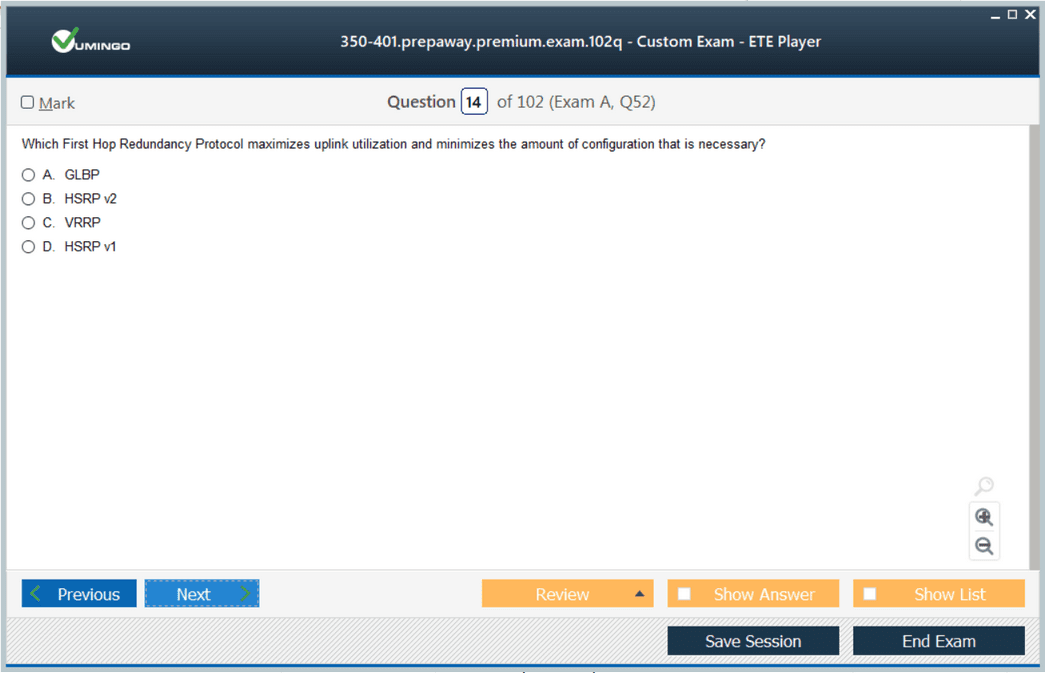
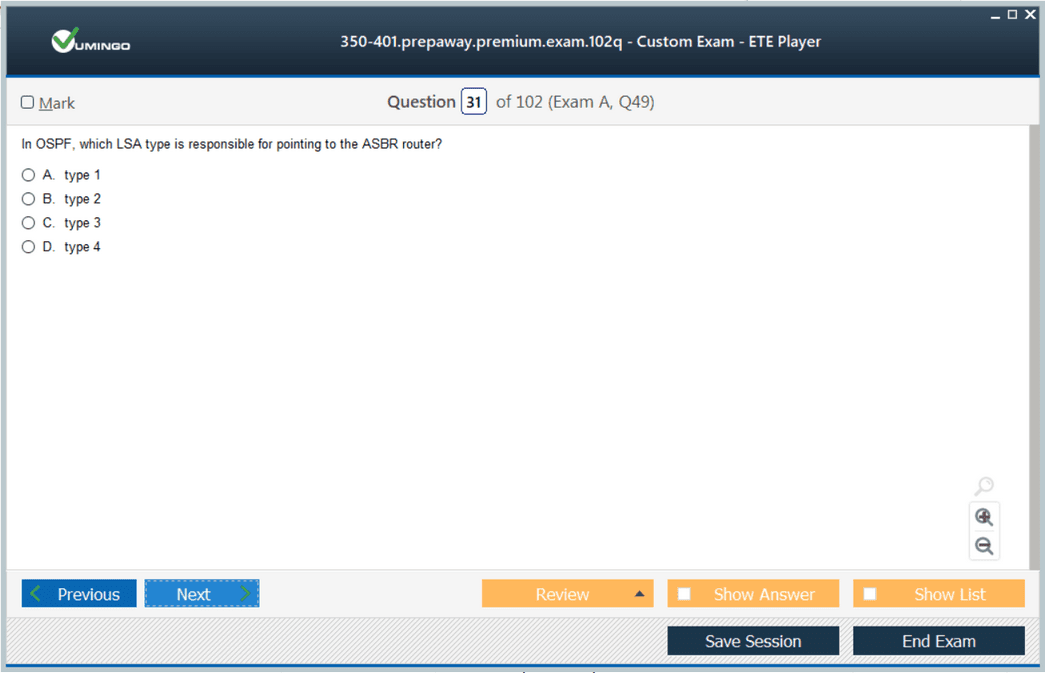
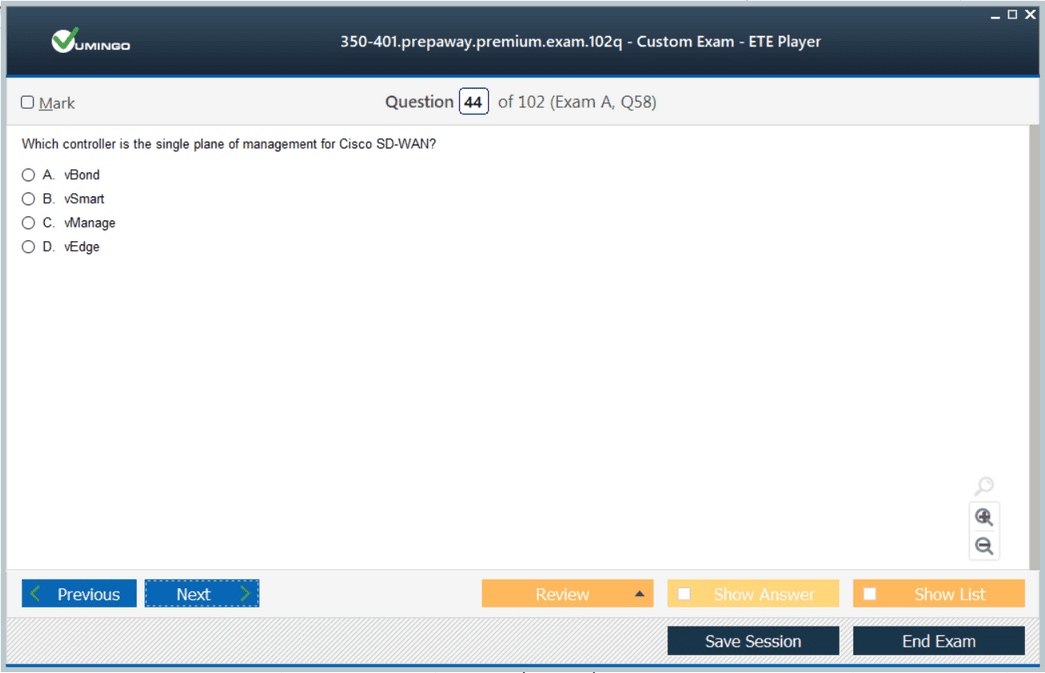
350-401 Exam - Implementing Cisco Enterprise Network Core Technologies (ENCOR)
| Download Free 350-401 Exam Questions |
|---|
Cisco CCIE Enterprise Certification Practice Test Questions and Answers, Cisco CCIE Enterprise Certification Exam Dumps
All Cisco CCIE Enterprise certification exam dumps, study guide, training courses are prepared by industry experts. Cisco CCIE Enterprise certification practice test questions and answers, exam dumps, study guide and training courses help candidates to study and pass hassle-free!
CCIE Enterprise Infrastructure: ENCOR, the Lab, and Expert-Level Network Engineering
The PrepAway page labeled CCIE Enterprise maps to Cisco’s current CCIE Enterprise Infrastructure certification. This is an expert-level path for engineers who can design, deploy, operate, and optimize complex enterprise networks rather than simply recognize protocol behavior. The current structure uses the 350-401 ENCOR core exam followed by the hands-on CCIE Enterprise Infrastructure lab. Passing ENCOR also earns the Enterprise Core Specialist credential, but the CCIE itself is awarded only after the lab requirement is completed.
Cisco describes the current expert path as covering dual-stack enterprise architecture, virtualization, infrastructure, network assurance, security, automation, software-defined networking, and programmability. The broader Cisco certifications path places CCIE Enterprise Infrastructure above the professional-level enterprise track, but there is no formal prerequisite certification. In practice, candidates normally need years of real network design and troubleshooting experience because the lab measures integrated judgment under time pressure.
ENCOR Is the Qualifying Core, Not the Finish Line
350-401 ENCOR v1.2 is a 120-minute core exam that validates broad enterprise networking knowledge. It covers architecture, virtualization, infrastructure, network assurance, security, and automation. Cisco moved wireless objectives out of ENCOR v1.2 into the dedicated Wireless certification family, so candidates using older v1.1 notes should not carry the former wireless scope forward; the PrepAway CCIE Wireless destination explains that transition. The ENCOR scope overlaps with CCNP Enterprise because the same core exam also serves that professional certification. The difference is what comes next: CCNP adds a concentration exam, while CCIE Enterprise Infrastructure adds an eight-hour expert lab.
That distinction should shape preparation. ENCOR study needs enough breadth to explain the technologies and make correct design or troubleshooting decisions. CCIE lab preparation must go further into implementation speed, validation, failure isolation, and recovery. A candidate who memorizes ENCOR facts but cannot build or repair a multi-domain network is not yet preparing at CCIE depth.
The Expert Skill Is End-to-End Enterprise Reasoning
Enterprise networks are systems, not collections of independent features. A routing change can alter application paths, security inspection, wireless reachability, telemetry, and failover. A software-defined policy can simplify operations while also introducing controller dependencies. An automation workflow can reduce drift but create a large blast radius if its assumptions are wrong. CCIE-level work means seeing those interactions before making the change.
One useful bridge from core knowledge into expert design is the PrepAway discussion of enterprise network design. At CCIE level, extend that discipline by asking what each design choice does during normal operation, partial failure, maintenance, scaling, and recovery. The best design is rarely the one with the most features; it is the one whose behavior remains predictable under the stated constraints.
Routing and Switching Still Matter, but the Scope Is Wider
Advanced routing remains fundamental. Practice OSPF, BGP, route redistribution, policy, filtering, path selection, summarization, multicast, first-hop redundancy, and failure convergence in topologies large enough to expose interactions. On the campus side, be comfortable with VLAN design, trunking, EtherChannel, spanning-tree behavior, Layer 3 boundaries, and redundancy. The expert difference is being able to diagnose why a design behaves incorrectly when several technologies interact.
For candidates who need more routing depth before the lab, 300-410 ENARSI is a relevant enterprise concentration exam even though it is not required for CCIE. The supporting discussion of advanced enterprise routing is useful when building a deliberate troubleshooting practice rather than relying on command recall.
Software-Defined Infrastructure Changes How You Troubleshoot
Modern enterprise expertise includes SD-Access, SD-WAN, controller-based policy, segmentation, assurance, and overlay concepts. These technologies add abstraction, but they do not remove the need to understand the underlay. When an overlay fails, you still need to determine whether the cause is transport, reachability, identity, policy, control-plane state, edge configuration, or a controller workflow.
Build a troubleshooting habit that moves between layers deliberately. Verify physical and IP reachability, then control-plane state, then overlay or policy state, then application behavior. Avoid jumping directly to the controller GUI because a symptom appears there. Expert operators understand what the controller is orchestrating underneath and can prove where the failure actually begins.
Network Assurance Is About Evidence, Not Dashboards
Telemetry, logs, SNMP, streaming data, packet capture, synthetic testing, and platform health all provide evidence. The expert skill is correlating them. A high-latency alert may be caused by congestion, path change, queueing, wireless conditions, application behavior, or a failing dependency. One metric rarely proves the cause.
Create baselines for healthy operation so that you know what changed. During labs, document the expected state before you create a fault. Then determine which signal detects the issue first, which signal confirms the failure domain, and which evidence proves recovery. That process is more valuable than memorizing isolated show commands because it scales to unfamiliar scenarios.
Automation and Programmability Must Be Safe
Python, APIs, structured data, model-driven interfaces, templates, and controller APIs are part of modern enterprise operations. The point is not to become a full-time application developer. The point is to remove repetitive work, validate state consistently, and reduce configuration drift while preserving change safety.
The PrepAway material on network automation is useful context for building that mindset. For CCIE preparation, practice reading JSON or XML, interpreting API responses, understanding authentication and HTTP methods, and validating what an automation task changed. Add guardrails such as input validation, limited scope, idempotent behavior, logging, and rollback planning.
Security Is Embedded in Enterprise Architecture
CCIE Enterprise Infrastructure is not a security certification, but enterprise design cannot ignore segmentation, secure access, device hardening, control-plane protection, encrypted transport, identity, and policy enforcement. Security decisions also affect availability and troubleshooting. A control that silently drops routing or management traffic may look like a network failure unless the engineer understands where policy is enforced.
Practice drawing trust boundaries and identifying the policy owner at each one. Know which problems belong to infrastructure, which belong to identity or security policy, and how to prove the difference from logs and state. This prevents broad emergency changes that restore one flow while weakening the environment elsewhere.
The Lab Rewards Verification and Change Discipline
The eight-hour lab is a practical exam, so preparation should be organized around complete workflows. Read the requirement carefully, implement the smallest correct change, verify the intended effect, and confirm that unrelated behavior still works. Build checkpoints so that a later problem does not force you to question everything completed earlier.
Use timed labs that include deliberate faults. Break a route policy, create an MTU mismatch, misapply a segmentation rule, introduce asymmetric routing, damage a controller policy, or cause an automation task to produce the wrong state. Recovery practice teaches you how to stay systematic when the clock is running.
The PrepAway comparison of ENCOR and CCIE depth is helpful when deciding whether your study is still professional-level or has reached expert-level integration. CCIE readiness is not measured by how many configuration examples you have completed; it is measured by whether you can explain, implement, verify, and troubleshoot the network as a whole.
Where CCIE Enterprise Fits in a Long-Term Path
Candidates often arrive from CCNP Enterprise, but Cisco does not require that certification first. Others come from architecture, service provider, wireless, security, or automation backgrounds and use ENCOR to standardize their enterprise core knowledge. Engineers whose work is more design-centric may also compare the CCDE path, which emphasizes architecture decisions and requirements analysis rather than a configuration-focused expert lab.
For final preparation, narrate the life of a packet and a change. Explain how traffic enters the network, how routing and policy choose the path, where identity or security influences the decision, how the path is observed, what fails over when a component is lost, and how automation would make the change repeatable. If you can reason through those questions without relying on one product screen, you are developing the integrated expertise the certification is intended to test.
One area that deserves deliberate depth is failure convergence across domains. A campus gateway may fail over correctly while an overlay policy, routing adjacency, or upstream service still takes longer to recover. Practice measuring the sequence rather than declaring the design “redundant.†Which protocol detects the failure first? Which control plane recalculates? Which forwarding entries change? Does stateful security preserve the session? Does the application reconnect automatically? These questions turn high availability from a diagram feature into an observable behavior.
Another important skill is change scoping. Expert engineers rarely receive a perfectly isolated task. A request to add a new segment can touch IP addressing, routing, policy, DHCP, DNS, telemetry, firewall rules, automation templates, and documentation. Before implementation, list the systems that will consume or advertise the new state. After implementation, verify both the intended new path and representative existing paths. This discipline prevents a technically correct local change from creating a hidden network-wide regression.
Capacity and performance also belong in expert preparation. Learn to distinguish control-plane saturation, interface congestion, microbursts, queuing, wireless contention, application latency, and path inefficiency. Collect the right counters before making a change. If utilization is high, determine whether the problem is sustained load, transient bursts, an unexpected path, or a policy that shifted traffic. Scaling a link without understanding the cause may temporarily hide an architectural issue.
Documentation should become part of the lab method. Maintain a compact topology map, addressing plan, routing-policy notes, automation assumptions, and a list of validated checkpoints. Under pressure, these notes reduce repeated discovery and make it easier to identify what changed. In production networks the same habit improves handoffs and incident response; in the exam it helps protect working sections from unnecessary reconfiguration.
Finally, practice explaining alternatives. For a design or remediation, state why you did not choose the most obvious second option. Perhaps it increases operational complexity, creates a larger failure domain, violates a security boundary, adds unnecessary tunneling, or makes rollback harder. Expert certification is ultimately a test of judgment. The strongest preparation therefore trains you to defend a decision with technical consequences, not merely reproduce a familiar configuration.
CCIE Enterprise certification practice test questions and answers, training course, study guide are uploaded in ETE files format by real users. Study and pass Cisco CCIE Enterprise certification exam dumps & practice test questions and answers are the best available resource to help students pass at the first attempt.