SAT Practice Test


SAT Test Premium Bundle
- Premium File 930 Questions & Answers. Last update: Sep 27, 2026
- Training Course 18 Video Lectures
- Study Guide 899 Pages
SAT Test Premium Bundle
- Premium File 930 Questions & Answers
Last update: Sep 27, 2026 - Training Course 18 Video Lectures
- Study Guide 899 Pages
Purchase Individually

Premium File
Training Course
Study Guide
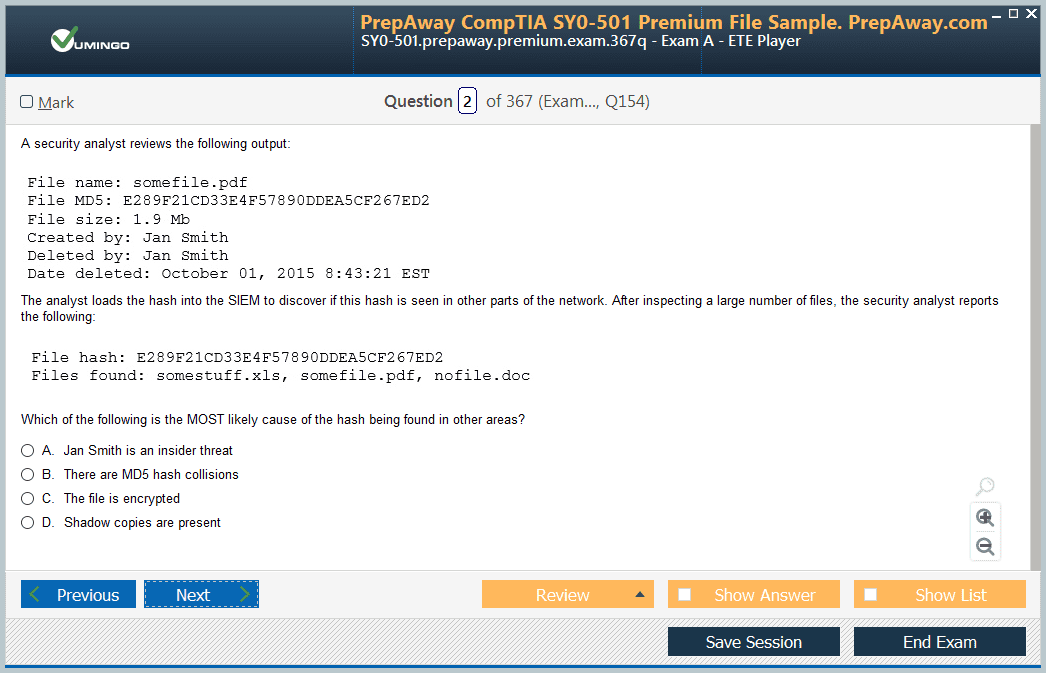
Test Prep SAT Course Practice Test Questions and Answers, Test Prep SAT Course Exam Dumps
All Test Prep SAT certification exam dumps, study guide, training courses are prepared by industry experts. Test Prep SAT certification practice test questions and answers, exam dumps, study guide and training courses help candidates to study and pass hassle-free!
SAT certification practice test questions and answers, training course, study guide are uploaded in ETE files format by real users. Study and pass Test Prep SAT certification exam dumps & practice test questions and answers are the best available resource to help students pass at the first attempt.
SAT Test Exam - Scholastic Assessment Test: Reading, Writing and Language, Mathematics
| Download Free SAT Test Exam Questions |
|---|
Test Prep SAT Certification Practice Test Questions and Answers, Test Prep SAT Certification Exam Dumps
All Test Prep SAT certification exam dumps, study guide, training courses are prepared by industry experts. Test Prep SAT certification practice test questions and answers, exam dumps, study guide and training courses help candidates to study and pass hassle-free!
SAT Practice: Building a Focused Digital-Test Strategy
The SAT is a fully digital assessment delivered through College Board's Bluebook application. The current test contains two sections—Reading and Writing, and Math—and provides 2 hours and 14 minutes of testing time. Reading and Writing has 54 questions in 64 minutes, while Math has 44 questions in 70 minutes. Each section is divided into two modules, with the second module adapting in difficulty based on performance in the first.
Effective SAT preparation should mirror this current structure. Older resources can still contain useful algebra, grammar, and reading practice, but they may teach obsolete pacing assumptions or question formats. Build the study plan around digital module timing, short-passage Reading and Writing items, calculator-enabled Math, and official Bluebook practice.
Learn the Adaptive Module Logic Without Trying to Game It
The first module in each section includes a mix of difficulty levels. Performance there influences the route to the second module. Students sometimes respond by overthinking the adaptation, trying to judge whether they received a “hard” module or changing pace based on how difficult the questions feel. That usually wastes attention.
Treat every module as a set of opportunities to earn credit. Read carefully, make a decision, flag uncertain items, and return if time allows. Do not intentionally slow down to prove something about the module or panic because several questions feel difficult. Adaptive testing rewards accurate performance, not speculation about the algorithm.
Reading and Writing Requires Fast, Precise Context Switching
Digital SAT Reading and Writing uses short passages or text snippets with one question attached to each. The work spans information and ideas, craft and structure, expression of ideas, and standard English conventions. Students may move from a scientific passage to a literary excerpt to a grammar item in just a few minutes.
That makes precision more important than a single long-passage strategy. Identify the task before reading every answer choice. For inference questions, demand evidence. For vocabulary in context, substitute the meaning back into the sentence. For transitions, identify the logical relationship first. The discussion of SAT Reading and Writing can help reinforce the current format and the kinds of decisions students must make quickly.
Math Is Calculator-Friendly but Still Reasoning-Heavy
The Math section allows calculator use throughout, and Bluebook includes an embedded Desmos calculator. The tested content includes algebra, advanced math, problem solving and data analysis, and geometry and trigonometry. Calculator access is valuable for graphing, checking solutions, and managing arithmetic, but it does not replace equation setup or interpretation.
Practice deciding when the calculator saves time and when algebra is faster. A detailed look at SAT mathematics can help organize the content. During review, classify mistakes as concept, setup, calculation, or interpretation errors. That classification tells you whether to study the topic, change the method, or slow down when reading.
Use Desmos as a Tool, Not a Substitute for Understanding
Desmos can solve systems graphically, locate intersections, inspect functions, test transformations, and verify many numerical relationships. Students should practice these features before test day so the tool feels routine. At the same time, typing every problem into the calculator can be slower than recognizing a simple factorization, proportion, or linear relationship.
Build a mixed toolkit. Know how to solve algebraically, estimate, and use graphing technology. Then choose the fastest reliable method for the particular question. If a Desmos approach gives an answer, still check whether the question asks for an x-value, y-value, coefficient, sum, or another quantity. Calculator accuracy cannot compensate for answering the wrong question.
Practice with Bluebook Under Real Timing
College Board provides official full-length digital practice tests in Bluebook, plus a Student Question Bank and targeted practice resources. Use one full-length test early enough that its results can shape the study plan. Save another official test for later so you can measure transfer after targeted work.
A realistic simulation includes the device, the module timers, the break, and the same calculator approach you plan to use on test day. Afterward, review every uncertain item, not just the wrong ones. Correct guesses can hide weak reasoning that will fail on a slightly different question. The goal of review is to understand the decision process well enough to reproduce it on new material.
Build a Math Study Plan from Skill Clusters
Do not treat every Math miss as an isolated topic. Group related problems: linear equations and systems, nonlinear expressions, ratios and percentages, data interpretation, geometry, or trigonometry. Work several variations of one skill until the setup becomes recognizable, then mix it back into a broader set.
A structured SAT Math study strategy can help turn a long list of topics into a sequence. Keep an error log that records what went wrong and the corrected method. If the same mistake appears three times, create a rule for yourself that changes future behavior.
Reading and Writing Improvement Comes from Explaining the Evidence
When a Reading and Writing answer is wrong, do not stop after reading the explanation. State what evidence makes the correct answer work and what exact flaw makes the strongest distractor fail. Common distractors are too broad, too narrow, unsupported, logically reversed, grammatically incomplete, or inconsistent with the passage's purpose.
For grammar, learn the underlying convention and then apply it in new contexts. For rhetorical questions, identify the writer's goal before comparing choices. For data-linked questions, make sure the chosen statement accurately describes the table or graph. This habit builds transfer because it focuses on the reasoning pattern rather than the wording of one item.
Accommodations and Testing Tools Should Be Practiced in Advance
Students with approved accommodations should learn how those supports operate in the digital environment before test day. Bluebook practice can help students test assistive technology, extended-time settings, and interface features. A broader discussion of SAT and ACT accommodations may be useful, but the current College Board approval and test-day instructions should govern the actual setup.
Even students without accommodations should rehearse the practical details: device charging, Bluebook installation, permitted calculator choice, and the test-center process. Reducing administrative uncertainty protects mental energy for the test itself. Do not leave software familiarity or device preparation until the night before.
Use Earlier PSAT Results as Evidence, Not Destiny
Students who have taken the PSAT/NMSQT already have useful diagnostic information because the SAT Suite measures related skills in a similar digital environment. Use the score report to identify persistent weaknesses in Reading and Writing or Math. Do not assume a PSAT result fixes the ceiling for the later SAT.
Skill growth, additional coursework, and targeted practice can change performance substantially. Compare old weaknesses with current practice to see what remains relevant. If an area has improved, move study time elsewhere. If the same domain continues to generate errors, strengthen the underlying concept before spending more time on full-length testing.
Adaptive preparation is strongest when module results are reviewed separately. A low first-module accuracy rate suggests that foundational execution needs work, because avoidable mistakes early in a section can limit the opportunity to demonstrate higher performance later. Strong first-module accuracy followed by a steep decline in the second module points more toward difficulty management, endurance, or gaps in advanced content. Tracking those patterns over several Bluebook sessions is more informative than looking only at the final total score.
For Reading and Writing, create a compact evidence routine. Identify the task first—vocabulary in context, rhetorical purpose, transition, grammar, synthesis, or inference—then use only the part of the text needed to answer it. For Math, use a parallel routine: define the unknown, translate the relationships, choose algebra, arithmetic, or Desmos deliberately, and check whether the result fits the question. Repeating a stable decision process reduces the amount of mental energy spent inventing a new approach for every item.
The final week should protect familiarity rather than chase dramatic score gains. Use one realistic timed session early enough to review it thoroughly, then focus on a small number of recurring errors. Verify the device, Bluebook setup, approved identification, calculator plan, and testing logistics before the last night. Candidates who need approved accommodations should practice with the same timing and tools they expect to use. Removing administrative uncertainty leaves more attention available for the reading and mathematical decisions that actually determine performance.
Finish with a Deliberate Test-Day Plan. In the final week, reduce novelty. Use familiar methods, review a compact error list, and complete only enough timed work to keep pacing comfortable. A final official module can confirm readiness, but repeated full tests immediately before the exam can create fatigue without adding much learning.
Keep a small set of recurring error categories rather than dozens of labels. Common categories might include evidence selection, sentence boundaries, algebra setup, function interpretation, geometry, data reading, and time-pressure mistakes. Review those categories every few sessions and retire one only after performance improves on unfamiliar questions. A compact error system makes trends visible and keeps the study plan responsive.
On test day, protect the basics: read the exact task, answer every question, use flags strategically, and keep moving when one item becomes expensive. There is no penalty for guessing, so an unanswered question has no advantage. Strong SAT performance comes from durable reading, writing, and mathematical skills combined with practiced digital pacing, not from trying to predict the adaptive path or memorize a collection of tricks.
SAT certification practice test questions and answers, training course, study guide are uploaded in ETE files format by real users. Study and pass Test Prep SAT certification exam dumps & practice test questions and answers are the best available resource to help students pass at the first attempt.